ADM, Bunge, Nutrien on China food security
China’s decades-long push to insulate itself from food shocks has become an economic and geopolitical lever that is now reverberating through global energy, grain and fertilizer markets.
Beijing’s strategy is simple in concept and powerful in practice: stockpile, diversify suppliers, control trade flows and use its buying power to shape prices. That has turned food insecurity from a domestic vulnerability into a source of external influence, especially as wars, weather and policy shifts keep commodity markets tight and politically sensitive.
The stakes are obvious for investors. When a country that imports vast quantities of soybeans, corn inputs, fertilizer feedstocks and energy-linked farm commodities decides to shift sourcing or build reserves, it can move margins across the agricultural complex. It also creates a second-order trade: the firms that move, crush, store, fertilize and ship food and farm inputs often benefit more consistently than the farmers themselves.
That dynamic is visible in market pricing. U.S. crude oil has climbed back to about $84.71 a barrel in the latest forecast, up from $81.96 on Aug. 3, while the 10-year Treasury yield sits near 4.72%, reflecting a backdrop of persistent inflation pressure and higher financing costs. In agriculture, Archer-Daniels-Midland shares have recovered to $80.46, above their 200-day moving average of $69.60, while Bunge has retreated to $111.60 from a June high above $131 and Nutrien has stabilized near $67.28 after a sharp pullback. The market is still sorting out who has pricing power and who merely has exposure.
ADM stands out as the cleaner toll-road bet. Its oilseeds and Ag Services operations are directly tied to global trade flows, and the stock has held well above the 200-day moving average despite recent volatility. Bunge remains the more cyclical trade: it can benefit when China’s import demand tightens margins and freight, but its recent decline shows how quickly investors fade commodity-linked earnings when the cycle cools. Nutrien is the leverage play on the fertilizer side, where global supply discipline and food-security buying can eventually support potash and nitrogen pricing.
The broader investment thesis is that China’s food-security doctrine is not a one-off policy headline. It is a structural force redirecting capital into the infrastructure of scarcity: grain origination, storage, shipping, crush capacity, fertilizers and agricultural logistics. The market often prices those businesses as simple commodity proxies, but the better framing is that they are strategic chokepoints in a world where food, fuel and geopolitics are increasingly entangled.
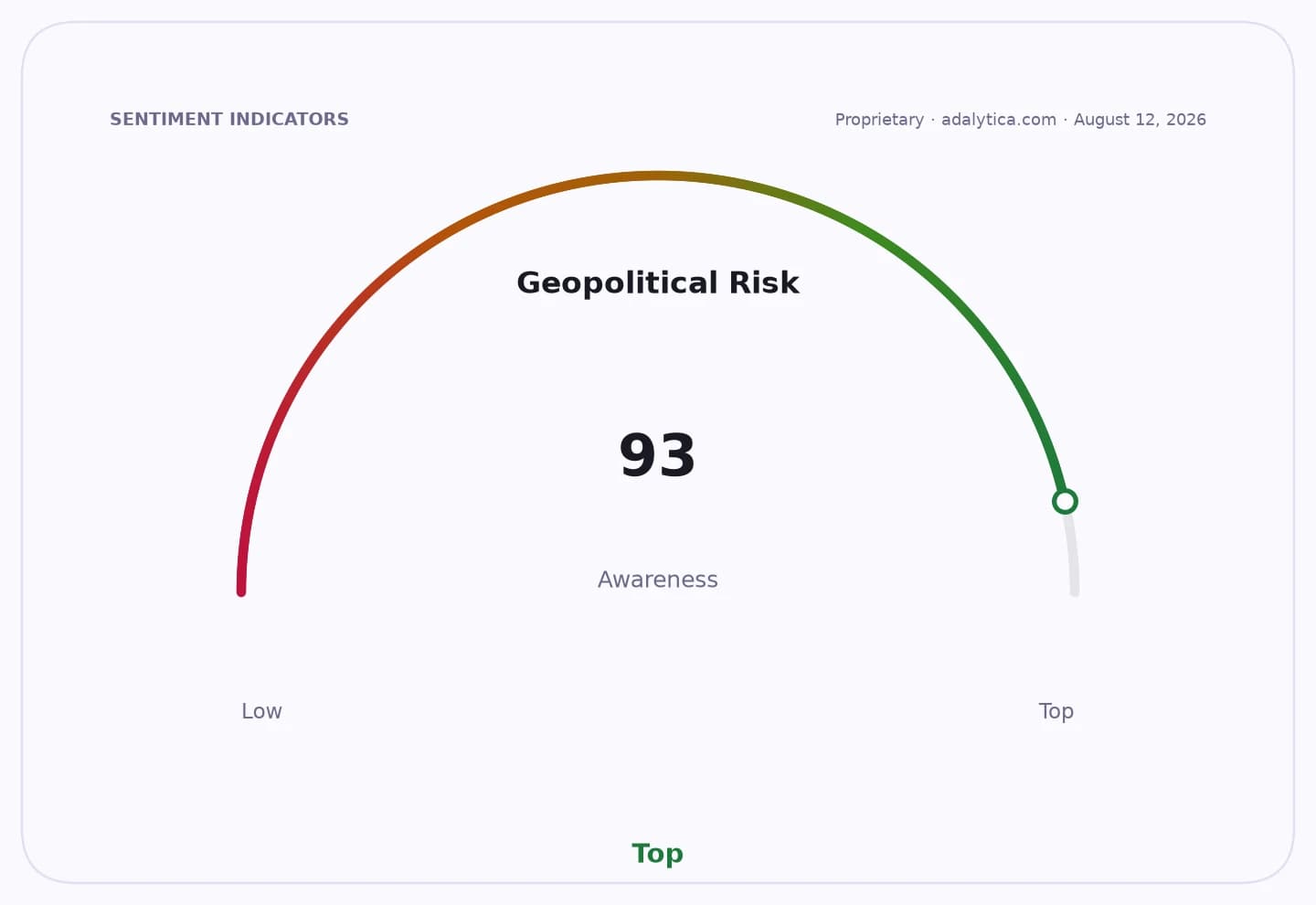
With geopolitical risk still elevated and the Adalytica Global Stability Sentiment sitting at an extreme greed reading of 100, the setup argues for staying positioned in the picks-and-shovels names that profit from dislocation rather than trying to time the next crop or shipping shock. I believe the best opportunity is to own the infrastructure behind China’s food-security obsession before the next supply squeeze makes that leverage obvious.
| Entity | Gains | Losses |
|---|---|---|
| ADM | ▲Trade-flow volatility | ▼Pure commodity exposure |
| Bunge | ▲Global origination spreads | ▼Margin compression |
| Nutrien | ▲Fertilizer demand | ▼Oversupplied nutrient markets |
| China | ▲Supply security leverage | ▼Dependence on imports |