AfD Bid for Saxony-Anhalt Government Role
Germany’s far-right Alternative for Germany is on the cusp of its first shot at governing a state, and that matters far beyond Saxony-Anhalt because it would mark a break with postwar political convention in Europe’s biggest economy.
If the AfD can translate a strong result into a governing role, investors should treat it as more than a regional upset. It would deepen fears that Germany’s political center is fragmenting just as the country is trying to restore growth, rebuild industry and fund a costly defense and infrastructure agenda. Markets dislike institutional uncertainty, and Germany’s ability to deliver stable policy has been one of the eurozone’s anchor assumptions for decades.
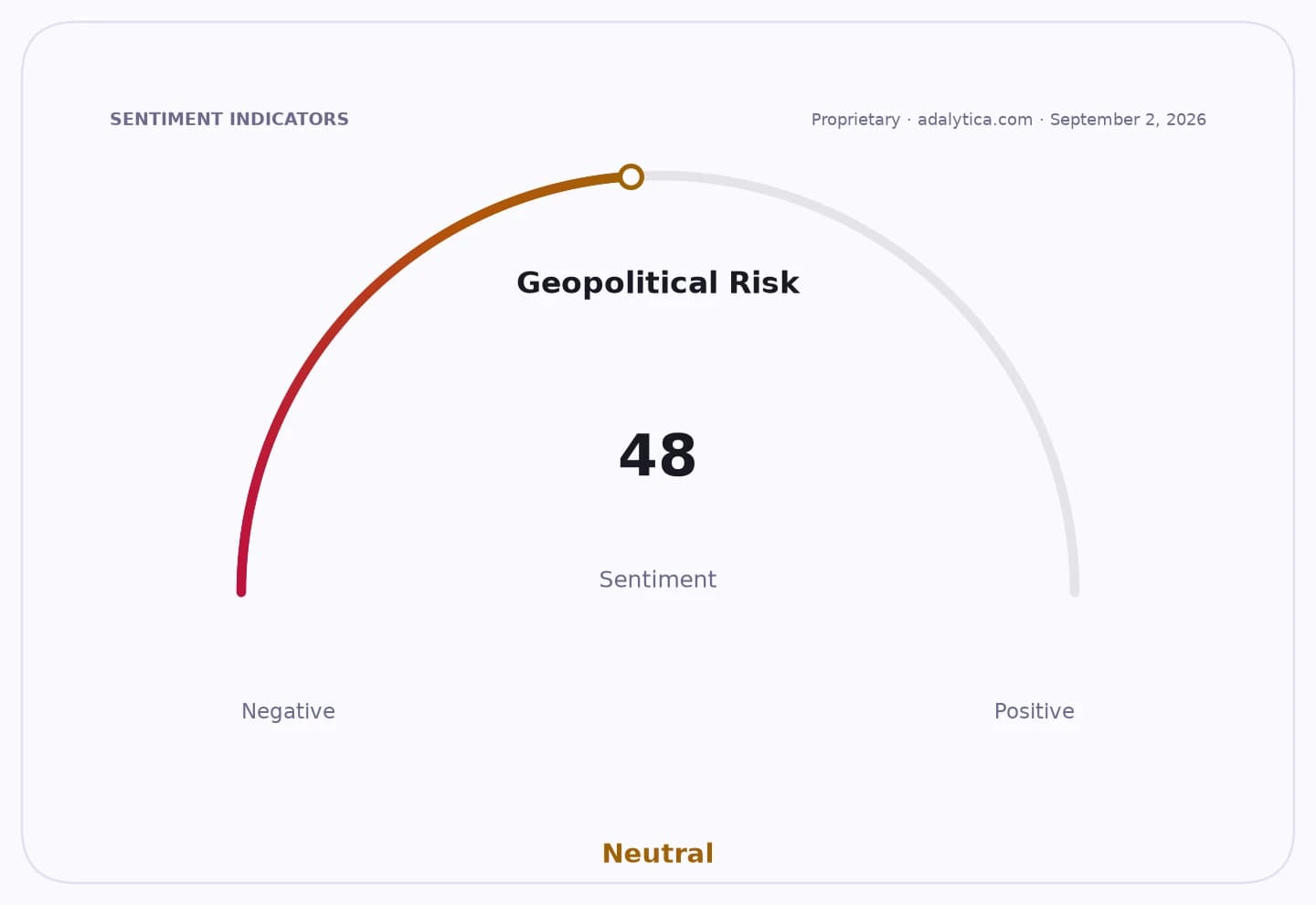
The immediate market read-through is modest but real. The euro has been resilient around $1.16, but political stress in Germany can weigh on sentiment toward the common currency, especially when global stability gauges are already fragile. Adalytica’s Global Stability Sentiment has slipped sharply to 48, with awareness marked at “Extreme Fear,” suggesting investors are already primed for geopolitical and political shocks. That is the kind of backdrop in which election headlines can matter more than usual.
For investors, the bigger issue is not a one-day FX move but the policy mix that follows. A stronger AfD presence raises the odds of more contentious coalition arithmetic, slower decision-making and louder resistance to climate, migration and fiscal policy. That can delay spending, complicate industrial planning and keep a lid on the kind of long-term certainty companies need to commit capital in Europe’s manufacturing heartland.
Germany’s U.S.-listed ETF, EWG, has already shown how quickly sentiment can swing. The fund closed at $43.44 on Sept. 1, up from a recent trough near $37.45, but the technical picture remains fragile, with the price sitting below its recent highs and the 50-day moving average still above the latest close. That suggests investors are not pricing a clean political resolution — just a market that is waiting for the next catalyst.
The real narrative here is not simply a protest vote. It is whether Germany’s political model can still produce stable government while voters drift toward the extremes. If Saxony-Anhalt becomes the first place where the AfD can help form a government, the message to markets will be that Germany’s domestic politics are entering a new, less predictable regime.
For investors, that means staying selective. The beneficiaries of prolonged German political strain are likely to be defensive assets, non-euro havens and companies with global revenue exposure rather than pure Germany cyclicals. The losers are policymakers, domestic rate-sensitives and any thesis that assumes Europe’s largest economy will remain a smooth engine of consensus-driven reform.
| Entity | Gains | Losses |
|---|---|---|
| AfD | ▲Political legitimacy | ▼Mainstream parties |
| Eurozone stability trades | ▲Volatility tailwind | ▼Policy certainty |
| EWG holders hedged to FX | ▲Better entry on weakness | ▼Unhedged Germany bulls |
| Germany’s coalition system | ▲Higher turnout | ▼Governing clarity |