AI Investment and Fed Rate Cuts

Artificial intelligence is moving from a productivity story to a monetary-policy variable, and that could matter for how fast the Federal Reserve cuts rates.
The central issue is whether AI-driven investment will first lift inflation through heavier capital spending and then, over time, suppress it by boosting productivity. That is the framework now surfacing in Washington, where Federal Reserve Governor Christopher Waller has argued that rapid AI investment does not necessarily add to inflation and may even create disinflationary pressure as efficiency gains spread through the economy.
For investors, the debate matters because it touches the Fed’s reaction function at a time when policy is already becoming more politically charged. If AI adoption ultimately raises potential output, the economy could absorb lower rates without overheating. If the spending wave comes first, however, it could keep services and goods prices sticky and delay easing. In other words, AI may complicate the timing of cuts before it helps justify them.
The policy significance goes beyond one official’s view. The G20’s recent statement in Asheville said central banks should carefully distinguish between expanded productive capacity and shifts in demand as AI and other structural changes reshape economies. That language captures the core dilemma for rate-setters: whether a surge in technology investment should be treated as demand stimulus or as a supply-side improvement that lowers the neutral rate over time.
Markets are already positioning around that question. Small-cap stocks, which tend to be more sensitive to borrowing costs, have been volatile even after a strong run, with the Russell 2000 ETF IWM closing at 285.58 on Sept. 21, below its 50-day moving average of 294.24 and 200-day average of 273.73. The financial sector ETF XLF ended at 55.90, also below its 50-day average of 56.99, suggesting investors are not yet pricing a clean, broad easing cycle. By contrast, the Nasdaq-100 ETF QQQ finished at 741.47, above both its 50-day and 200-day averages, underscoring how AI-heavy megacap technology remains the market’s preferred way to express growth even as rates stay restrictive.
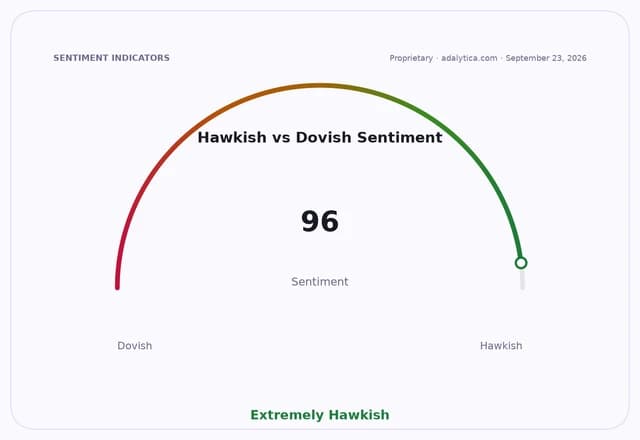
Adalytica’s Hawkish vs Dovish Fed Policy Sentiment gauge is now at 96, or “Extreme Greed,” reflecting how aggressively traders are leaning into a dovish path. Yet its Federal Reserve Forward Guidance Sentiment sits at 33, a neutral reading, showing the market still lacks a firm policy anchor. Treasury-bond sentiment has also surged, with the TLT gauge at 91, suggesting investors are positioning for lower yields even as the policy outlook remains unsettled.
The economic backdrop leaves room for both sides of the argument. The Fed funds rate is around 3.63%, while unemployment is near 4.1% and CPI is running at 334.131 in the latest series reading, reinforcing the idea that policymakers do not face a clean recession case for deep cuts. That makes AI important not as a near-term excuse to ease, but as a possible reason the economy’s speed limit may be rising.
The bullish case for rate cuts is that AI investment eventually lifts productivity enough to slow unit labor costs and restrain inflation, allowing the Fed to reduce borrowing costs without reigniting price pressure. The bearish case is that the current buildout — from chips to data centers to power infrastructure — keeps capital demand and financing costs elevated, especially if the benefits take years to materialize.
That tension also has a political edge. Waller’s dovish tone, and the market’s willingness to hear it as supportive of cuts, adds to speculation that the Fed’s policy debate could be influenced by White House pressure for easier money. That does not change the data dependence of the central bank, but it raises the stakes if AI becomes part of the argument for why rates can come down sooner.
| Entity | Gains | Losses |
|---|---|---|
| AI-heavy tech stocks | ▲Higher valuations from lower-rate case | ▼Multiple compression if cuts are delayed |
| Small-cap equities | ▲Cheaper financing if easing arrives | ▼Credit costs stay elevated |
| Treasury bonds | ▲Rally on dovish Fed expectations | ▼Selloff if inflation stays sticky |
| Fed hawks | ▲Less pressure to rush cuts | ▼Risk being seen as behind the curve |