AI is increasingly being used not just to boost output but to justify fewer jobs, and that shift is now showing up in both corporate actions and market pricing around Microsoft and the wider technology sector.
AI Cuts Jobs as Microsoft Faces Margin Trade-Off
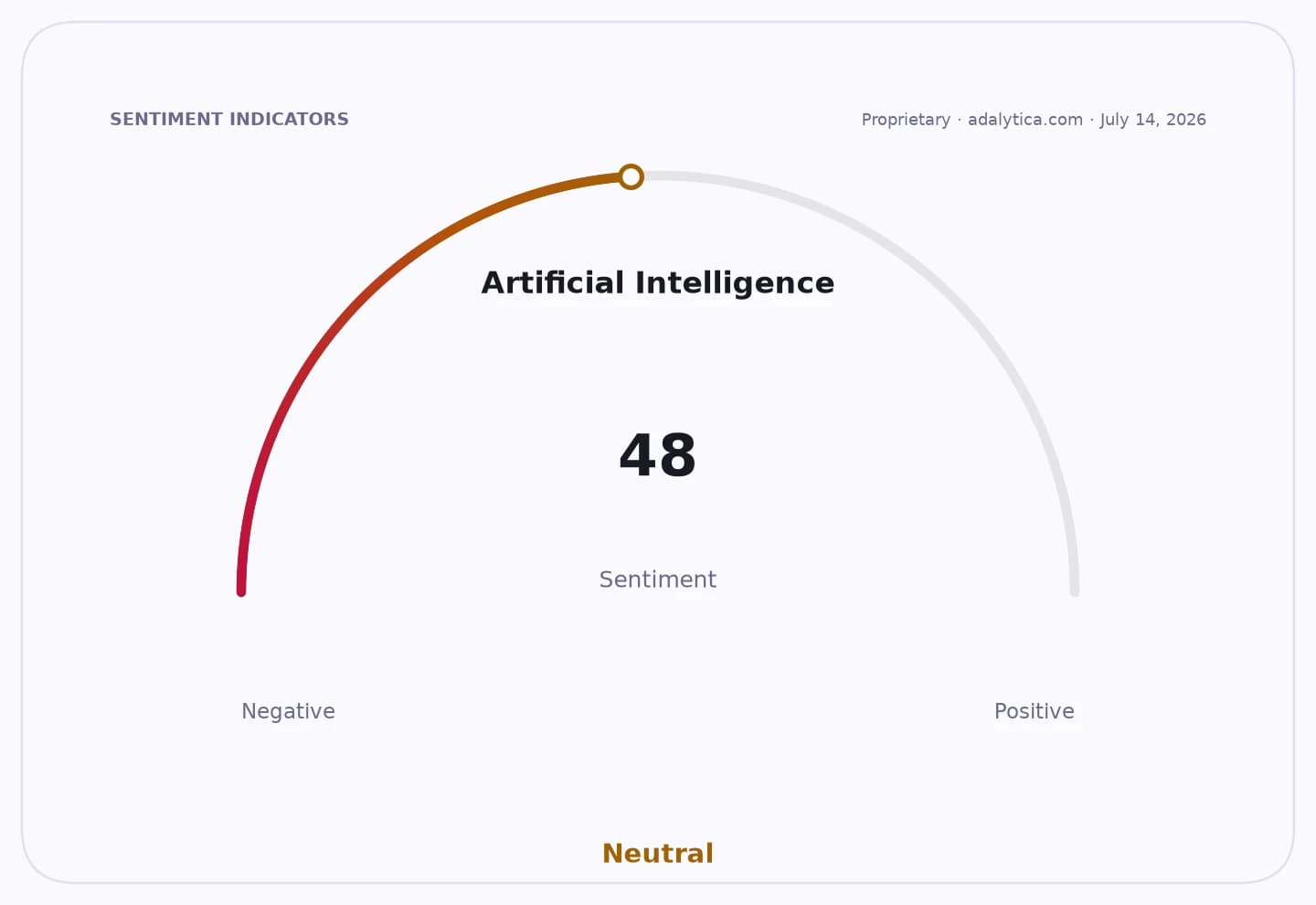
The most economically significant development is the emerging link between AI investment and labor reduction. The supplied context points to Microsoft cutting 4,800 positions while expanding its AI buildout, part of a broader pattern in which large employers are using automation to squeeze costs and rework operating models. That matters because labor is still the largest expense line in many service-heavy businesses, so even modest productivity gains from AI can translate into meaningful margin expansion, but also into more persistent pressure on white-collar employment.
Sentiment IndicatorsⓘProprietary · adalytica.com · July 14, 2026
This is a snapshot — live sentiment, awareness and momentum for 130+ markets update continuously in the dashboard.Open AlphaPulse
That tension is exactly what gives the story macro significance. If AI is now displacing more roles than it creates, the near-term effect is not just a corporate efficiency gain; it is a redistribution of income from labor to capital. For companies, that can improve operating leverage and free cash flow. For the economy, it can restrain wage growth and weaken household demand if layoffs broaden beyond early adopters. The warning from 200 economists asking governments and companies to act reflects a rising concern that the adjustment may be faster than labor markets and policy frameworks can absorb.
Microsoft sits at the center of that trade-off. The company has been one of the biggest corporate beneficiaries of AI enthusiasm because investors see its cloud and software franchises as the clearest way to monetize the technology. But the stock action shows how quickly that narrative can turn when markets start to price in the costs of transformation as well as the benefits. Microsoft’s shares are down sharply from their earlier highs and remain below the 200-day moving average, while recent technical readings have improved but not yet repaired the longer-term damage. That suggests investors are still debating whether AI will become a durable earnings accelerator or a capital-intensive transition that pressures returns before it pays off.
The market backdrop reinforces that caution. The broader S&P 500 has held up better than Microsoft, underscoring that this is not a general equity selloff but a more specific reassessment of AI-related winners. Nvidia remains a key bellwether for AI infrastructure demand, but the more consequential question for investors is whether software and platform leaders can convert that infrastructure spending into durable profit growth without increasingly relying on workforce cuts to do it. Microsoft’s own filings already acknowledge AI-related reputational, competitive and liability risks, indicating management sees the technology as both a growth engine and a governance challenge.
For investors, the immediate issue is not whether AI adoption will continue — it will — but whether the next phase of adoption will be judged by revenue growth or by headcount efficiency. A bull case is that AI gives Microsoft and peers a lasting margin tailwind and strengthens pricing power. A bear case is that the same gains invite regulatory scrutiny, labor backlash and slower consumer spending if job losses widen. The balance between those outcomes will determine whether AI is treated as a productivity revolution or as a destabilizing cost-cutting wave.
The next catalysts are likely to be further restructuring announcements, management commentary on AI-driven efficiency gains, and any policy response from regulators or labor ministries. Until then, the market is likely to keep rewarding AI leaders on execution while punishing any sign that the technology’s benefits are arriving through layoffs faster than through new growth.
| Entity | Gains | Losses |
|---|---|---|
| Microsoft and AI adopters | ▲Higher margins | ▼Workforce and labor relations |
| Investors in AI infrastructure | ▲Efficiency upside | ▼Near-term valuation risk |
| White-collar workers | ▲Long-term new roles | ▼Job displacement |
| Regulators and labor advocates | ▲More urgency | ▼Slower policy response |