AI labor risk and $4.8 trillion market

Artificial intelligence automation could reshape a large slice of the global labor market even as the industry powering it races toward a nearly $4.8 trillion valuation, sharpening the economic stakes for workers, employers and investors alike.
The UN’s warning that AI could affect about 40% of jobs underscores that the technology is no longer just a productivity story for balance sheets and stock multiples; it is becoming a labor-market shock with broad macro implications. If adoption continues at the pace implied by the build-out in chips, cloud infrastructure and software, the gains from higher output and lower costs may be offset in the near term by pressure on entry-level hiring, wage growth and workforce turnover.
That tension is visible in the market. Nvidia has climbed back above $227 after a volatile summer, trading above both its 50-day and 200-day moving averages, while Microsoft has rebounded to about $505 and Alphabet to roughly $341. Those moves reflect investors’ continuing conviction that AI spending will keep flowing through the ecosystem, even as company filings show the risks are rising. Microsoft has warned that customers may slow or shift AI workloads and that its own AI systems could create legal and reputational liabilities, while Nvidia has flagged regulatory restrictions and the difficulty of meeting surging infrastructure demand.
For investors, the labor-market angle matters because it broadens the AI thesis beyond capex and revenue growth. A market nearing $4.8 trillion can support the winners in semiconductors, cloud and enterprise software, but it also raises questions about political backlash, regulation and demand durability if AI is seen as suppressing job creation faster than it generates new roles. The risk is not just social; it is economic. Slower hiring among younger workers and lower-tier roles could weaken consumption at the margin, while companies may face higher compliance costs and heavier scrutiny over how automation is deployed.
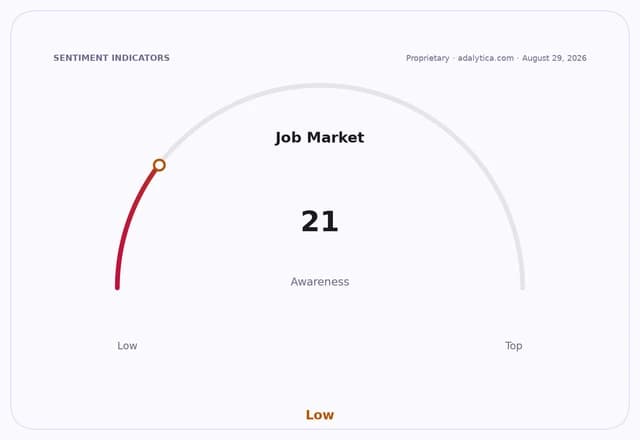
The data backdrop suggests the labor market remains steady for now. U.S. unemployment is hovering around 4.1%, with nonfarm payrolls still near record highs, and Adalytica’s job-market snapshot has eased into neutral territory even as fear around AI disruption remains elevated. That combination points to an economy that has not yet absorbed a full AI employment shock, but one in which the debate is moving from theory to operating reality.
The bull case is that AI becomes a general-purpose technology that lifts productivity, spurs new categories of work and sustains spending on chips and cloud services. The bear case is that the transition proves uneven, concentrating gains among capital owners and highly skilled workers while hollowing out the entry rung of the labor market. For investors, the next catalyst will be whether companies can show AI-driven revenue growth without triggering a broader political or labor-market pushback that forces them to slow deployment.
| Entity | Gains | Losses |
|---|---|---|
| Nvidia, Microsoft, Alphabet | ▲Higher AI spending | ▼Regulation and labor backlash |
| Employers using AI | ▲Lower costs, faster output | ▼Higher compliance risk |
| Entry-level workers | ▲Limited near-term gains | ▼Hiring displacement |
| Policymakers and unions | ▲More leverage to shape rules | ▼Less control if adoption accelerates |