Black professionals and the companies that employ them are entering a job market that is no longer being driven by broad hiring growth, but by a widening split between AI-enabled sectors that are still expanding and legacy industries that are cutting aggressively. That matters because the next hiring cycle will reward people and firms that can move fastest into higher-productivity work, while punishing those exposed to automation, restructuring and slower consumer demand.
AI-Driven Labor Split Reshapes Hiring
The economic significance is straightforward: labor demand is becoming more selective just as corporate America is leaning harder on automation to protect margins. That creates a tough environment for workers who have historically faced tighter access to networks, promotions and high-growth roles, but it also opens a clear path for candidates who can pair business judgment with AI literacy, data skills and industry-specific expertise. The market underestimates how quickly that shift changes bargaining power.
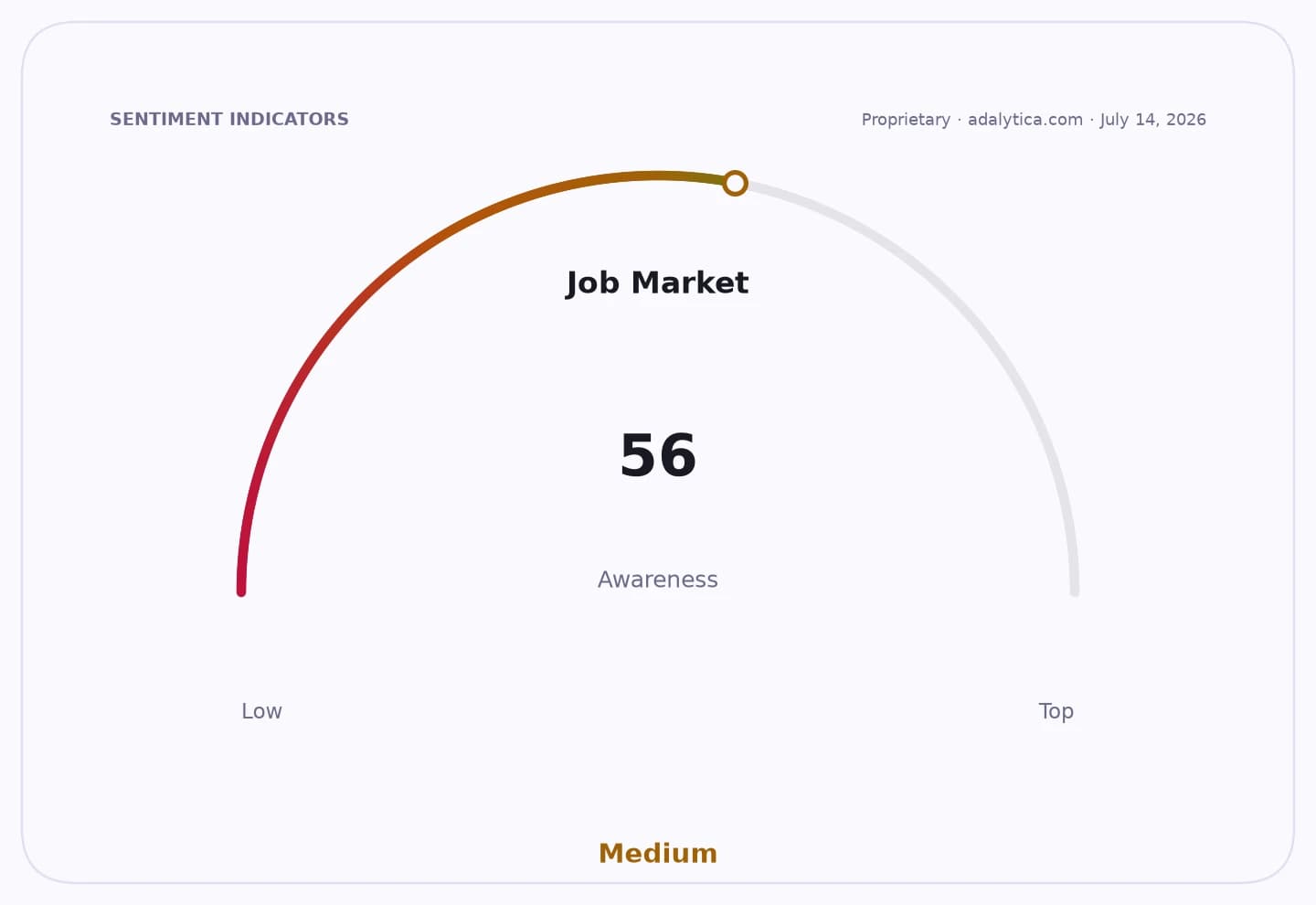
Sentiment IndicatorsⓘProprietary · adalytica.com · July 14, 2026
This is a snapshot — live sentiment, awareness and momentum for 130+ markets update continuously in the dashboard.Open AlphaPulse
The latest sentiment reads as cautious rather than panicked. Adalytica’s job-market gauge sits at 41, neutral, but that masks sharp swings underneath the surface, with a 41% drop over seven days and a 52% slide over 30 days. The payroll gauge is also neutral at 57, while consumer-confidence recession sentiment remains fragile at 41. In plain English, employers are still hiring, but they are doing it more selectively, and workers are operating in a more uneven market than the headline numbers suggest.
That is where the investable story begins. The strongest opportunities are likely to sit in the “picks-and-shovels” of labor-market disruption: workforce training, recruiting technology, AI software, cloud infrastructure and professional services that help companies automate without breaking their operations. For Black professionals, the implication is just as important. The best defense against a tightening labor market is not waiting for traditional openings to return; it is moving into roles where AI adoption creates new demand, not just displacement. The best-positioned candidates will be those who can translate technology into revenue, compliance, operations or customer retention.
Job Market — 30-day sentimentadalytica.com
Explore this data interactively — full history, time series and cross-market comparisons.Open AlphaPulse
The split is already visible. Finance and technology employers continue to hire in places like Limassol, even as steel, banking and FMCG companies cut jobs elsewhere. That is the kind of divergence that usually marks an inflection point rather than a normal slowdown. When automation and restructuring start to reshape headcount across industries at the same time, the winners are not the old employers with the biggest payrolls. They are the firms building the tools, workflows and talent pipelines that make leaner operations possible.
For investors, that means the thesis is bigger than one labor report. It is a secular shift in how labor markets function, and it will likely favor companies that help workers reskill and help employers do more with fewer people. I believe the market is still pricing this as a cyclical jobs story when it is increasingly a structural one. That creates asymmetric upside in AI infrastructure, online education, staffing platforms with technical specialization, and software vendors tied to enterprise productivity.
The actionable takeaway is simple: if you are positioning for the next phase of the labor market, focus on the enablers of adaptation, not the companies most exposed to headcount compression. And if you are a Black professional navigating this cycle, prioritize AI fluency, portable skills and industries where demand is being created by transformation, not destroyed by it. That is where both career resilience and investment returns are likely to compound.
| Entity | Gains | Losses |
|---|---|---|
| AI software and cloud providers | ▲Enterprise adoption tailwind | ▼Legacy labor-intensive firms |
| Workforce training platforms | ▲Reskilling demand | ▼Workers without AI skills |
| Finance and tech employers | ▲Talent access in growth sectors | ▼Steel, FMCG and automating banks |
| Black professionals with AI fluency | ▲Better mobility and pay leverage | ▼Candidates tied to stagnant roles |