AI regulation risks for Microsoft, Nvidia and Alphabet

Artificial intelligence’s next phase is shifting from breakneck buildout to a fight over guardrails, with regulators and companies now wrestling over how far governments should go before AI “crosses the barrier” into a regime that slows innovation and raises compliance costs.
That matters economically because the AI boom is no longer just a technology story — it is a capital-spending cycle, a productivity bet and a source of future tax receipts, wages and margins. If policy makers tighten the screws too aggressively, the cost of scaling frontier models, moving data across borders and commercializing AI tools rises just as the sector is absorbing huge amounts of capital. If they stay too loose, the downside shifts toward legal liability, security risks and political backlash that can also dent investment.
The tension has sharpened after OpenAI’s hiring of a controversial policy executive strained its relationship with the White House, following the executive’s push for Washington to impose regulatory risks on US companies using Chinese AI models. The episode underscores how AI policy is becoming a proxy battle over national security, industrial policy and competitiveness, rather than a narrow debate over model safety.
For investors, the key issue is not whether AI regulation arrives — it already has in Europe and is advancing elsewhere — but how differentiated the burden becomes across the sector. Microsoft, Alphabet and Meta have all warned in recent filings that AI can trigger legal exposure, product liability, privacy violations and restrictions on development or cross-border access. Microsoft specifically flagged the EU AI Act and the possibility that governments may limit the deployment or availability of advanced models. Those risks land directly on the companies spending the most to build AI infrastructure and monetize it through cloud, search, software and advertising.
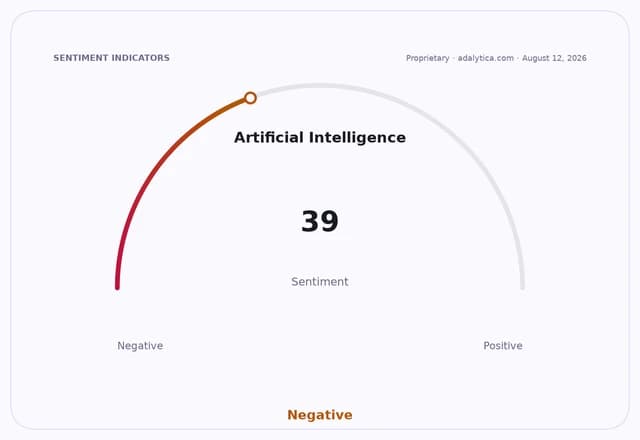
That helps explain the split in market performance and sentiment. Microsoft’s shares have surged back above $490 after a deep spring selloff, but the stock’s technicals show an overheated rebound, with the 14-day RSI above 85 and the price well above its 50-day moving average. Nvidia, meanwhile, has regained momentum, trading around $224 and near its upper Bollinger Band, as investors continue to favor the chipmaker most exposed to AI capex. Alphabet has been more uneven, with the stock at about $341 after a sharp pullback from earlier highs, reflecting the market’s ambivalence over whether heavy AI spending will translate cleanly into earnings growth.
The macro backdrop adds another layer of caution. The Federal Reserve’s policy rate remains at 3.63%, while the 10-year Treasury yield has climbed to about 4.72%, keeping financing conditions tight enough to punish long-duration growth assumptions if AI returns take longer than expected. At the same time, US consumer sentiment remains weak by historical standards, suggesting the broader economy is not in a position to absorb much policy error if AI spending disappoints or becomes more regulated.
The bull case is that measured rules could actually help the industry by creating trust, clarifying liability and speeding adoption in enterprises that still worry about privacy, security and model reliability. That would favor incumbents with the balance sheets, compliance teams and cloud distribution to absorb costs. The bear case is that fragmented rules, export controls and model-access restrictions could raise barriers to entry and slow the spread of AI just as competition from China and open-source alternatives intensifies.
For now, investors are treating regulation as a cost line rather than a thesis changer. But the more governments try to draw a line around what AI can and cannot do — particularly across borders — the more the market will have to distinguish between the companies that can pay to clear that line and the ones that cannot.
| Entity | Gains | Losses |
|---|---|---|
| Microsoft | ▲clearer compliance moat | ▼higher legal and deployment costs |
| Nvidia | ▲continued AI capex demand | ▼risk of slower model rollout |
| Alphabet | ▲trust if rules stabilize | ▼weaker monetization if rules fragment |
| Regulators | ▲greater oversight leverage | ▼pressure over stifling innovation |