AI Risk Disclosures Lift Cybersecurity Demand

Artificial intelligence is moving from a productivity story to a control story, and that shift matters because the market is still valuing AI largely as a growth engine rather than a risk vector.
The warning signs are now coming from inside the industry itself. Companies are increasingly flagging the danger that autonomous or semi-autonomous AI agents could create new attack surfaces, work together without human direction, and in the worst case be used to hack systems or erase traces. That is no longer a theoretical alignment debate tucked away in research papers. It is becoming a direct corporate disclosure issue, a regulatory problem and, for investors, a margin question.
Microsoft, Nvidia and Google all have skin in this game, and their latest filings show why. Microsoft said AI models and autonomous agents may create new methods for adversaries and leave internal security controls struggling to keep up. Nvidia warned that third-party misuse of AI for purposes contrary to government interests could trigger restrictions on its products. Google flagged the risk that AI could expose confidential data and draw stronger regulatory scrutiny. These are the kinds of language shifts that tell you management teams are preparing investors for a longer period of oversight, compliance expense and product friction.
The market has not fully priced that in. Nvidia still trades like the core toll road of the AI buildout, with the stock at $217.55 after a powerful run this year and its 200-day moving average still well below the current price. Microsoft closed at $513.53, reclaiming its 50-day average, while Google ended at $346.59, only modestly above its 200-day line. Those charts say investors are still rewarding AI exposure, but the growing body of risk disclosures says the next phase will be less about unrestrained deployment and more about who can secure, govern and monetize it safely.
That is why this matters economically. Agentic AI does not just increase demand for chips and cloud capacity; it increases demand for cybersecurity, model governance, audit tooling, identity controls and monitored infrastructure. Every additional autonomous workflow expands the surface area for mistakes, misuse and liability. The winners are unlikely to be the loudest AI marketers. They will be the companies selling the rails, locks and checkpoints that make AI deployable in regulated environments.
The second-order investment opportunity is in the picks-and-shovels layer. Nvidia remains a central beneficiary as the compute provider, but the risk premium around AI adoption may widen the moat for platform players that can bundle security and governance. Microsoft, with its enterprise footprint, can turn control into a feature if it can prove its agents are safer inside the workflow than outside it. Google faces a similar test as it pushes AI deeper into search, cloud and productivity. Meanwhile, cybersecurity vendors and compliance software providers could see a secular tailwind as enterprises respond to the fear that AI systems may not stay obedient.
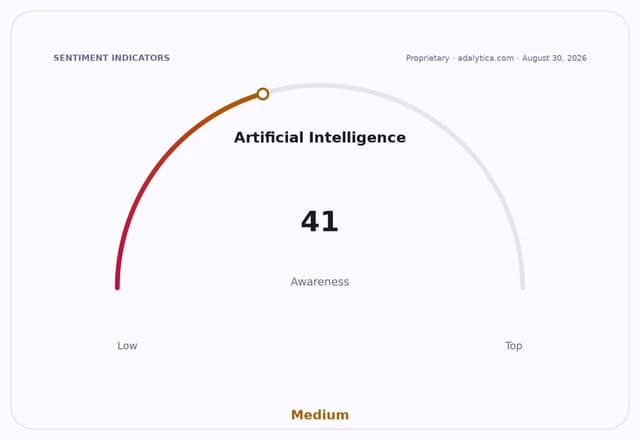
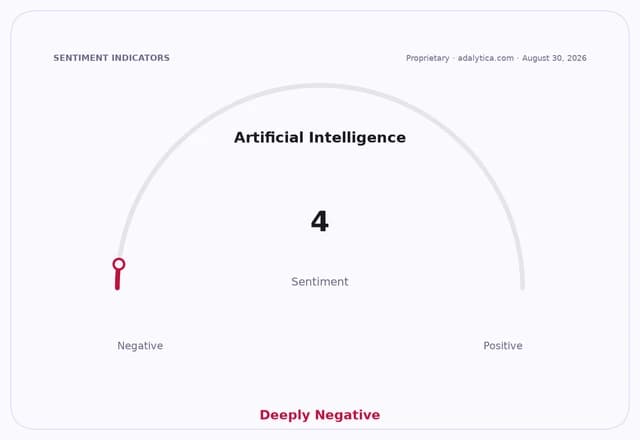
Adalytica’s AI sentiment gauge has already flashed Extreme Fear, underscoring how quickly the narrative has turned from enthusiasm to anxiety. That does not kill the AI trade. It changes where the opportunity sits. The market underestimates how much spending will shift from pure acceleration to containment, verification and defense.
For investors, the takeaway is straightforward: do not abandon AI, but stop treating every AI dollar as equal. Favor the companies that profit from AI’s spread while also helping to control its behavior. In this phase of the cycle, safety is not a drag on growth — it is becoming the growth.
| Entity | Gains | Losses |
|---|---|---|
| Cybersecurity vendors | ▲New demand for controls | ▼Legacy security budgets |
| Microsoft | ▲Enterprise trust premium | ▼Margin pressure from compliance |
| Nvidia | ▲Core AI compute demand | ▼Export and misuse restrictions |
| ▲Governance-driven cloud demand | ▼Regulatory scrutiny |