AI Shifts From Chatbots to Workflow Tools
Claude’s growing feature set underscores a bigger shift in artificial intelligence: the market is moving from novelty chatbots toward software that can manage workflows, cut costs and generate revenue across enterprise systems.
That matters because the next leg of AI investment is less about who has the biggest model and more about which platform can do useful work at a price customers will pay for. The news context points to a broader industry pivot toward efficiency and deployment, with OpenAI also emphasizing complex workflow management as companies tighten spending and demand measurable returns.
For investors, that changes the valuation debate across the AI stack. Companies that can convert AI from a demo into a productivity tool stand to win enterprise contracts, while pure model hype may not be enough to justify premium multiples if monetization lags. The competitive pressure also spills into chip demand, cloud infrastructure and software bundling, where winners can capture recurring spend and losers risk being commoditized.
The market backdrop shows how quickly sentiment can swing around AI leaders. Nvidia has rebounded to $210.96 from $177.85 in late January, though its recent technicals are mixed, with the stock hovering around its 50-day moving average and the MACD still negative. Microsoft closed at $385.10, far below its recent peaks after a steep drawdown earlier this year, while Google parent Alphabet ended at $357.18, also below its 50-day average.
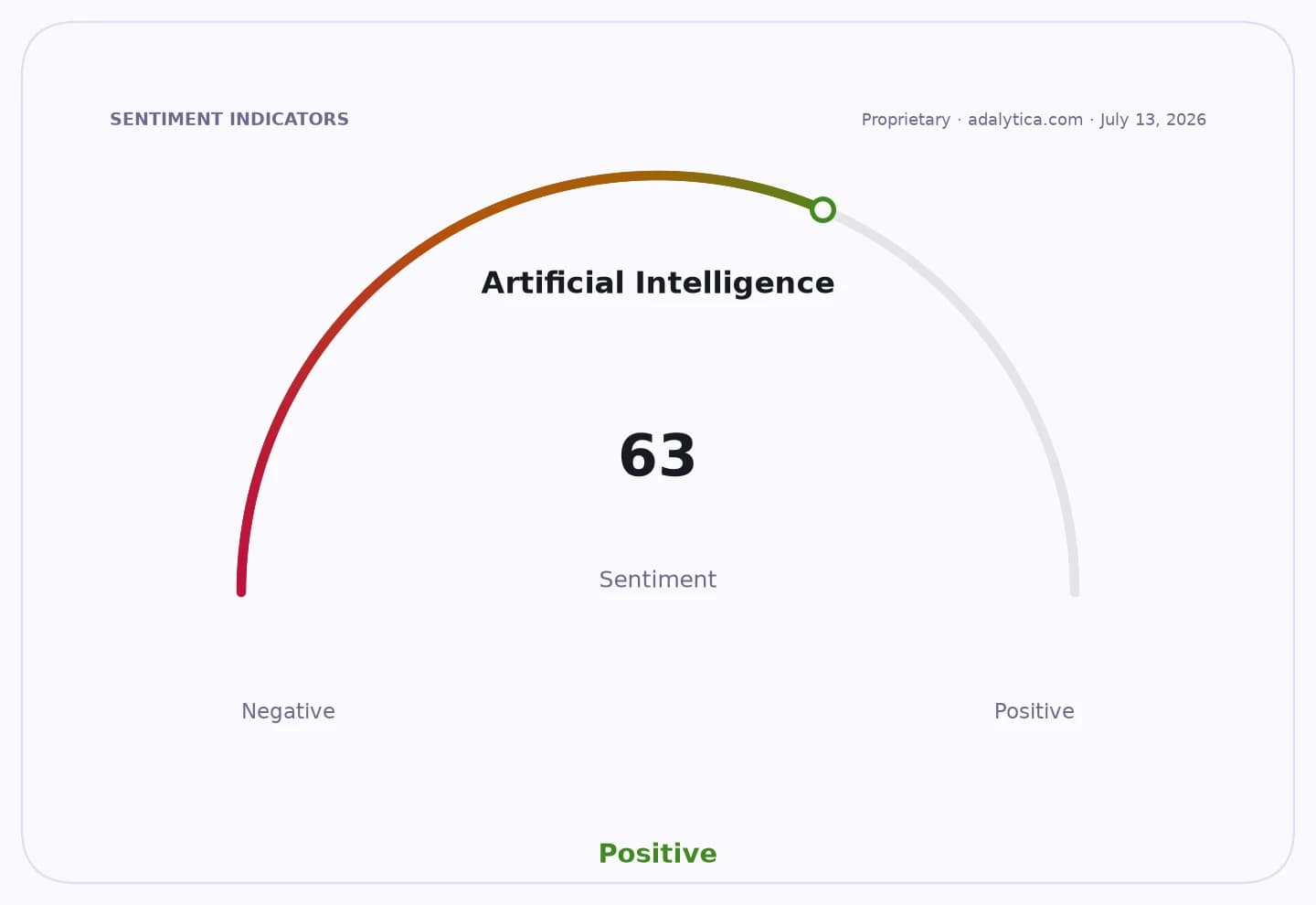
Adalytica’s AI sentiment snapshot has turned more constructive, with the index at 63 and 1-day and 7-day gains, while Nvidia’s earnings sentiment remains in “fear” territory at 22 even as awareness stays elevated. That split suggests traders are still skeptical on near-term earnings translation even as attention around AI platforms remains intense.
The narrative now is clear: AI is no longer being sold only as a chatbot, but as infrastructure for work. The companies that prove they can automate tasks, improve margins and embed into daily operations are likely to drive the next earnings cycle, while investors will keep watching for signs that enterprise adoption is broadening beyond the headline names.
| Entity | Gains | Losses |
|---|---|---|
| AI platform providers | ▲Higher enterprise adoption | ▼Chatbot-only commoditization |
| Nvidia | ▲Continued AI hardware demand | ▼Multiple compression if spending slows |
| Microsoft and Alphabet | ▲Cross-sell into workflows | ▼Spending scrutiny and execution risk |
| Enterprise buyers | ▲Lower labor and software costs | ▼Upfront integration and switching costs |