Alibaba is waking up because investors are finally treating it less like a battered China stock and more like an AI platform with real upside.
Alibaba Gains AI Re-Rating Attention

That matters because the market is rewarding companies that can turn artificial intelligence into durable revenue, not just headlines. Alibaba sits at the intersection of cloud computing, enterprise software, commerce and AI infrastructure, which gives it more ways to compound over time than a simple retail story ever could. When a stock like this starts to move, it is usually because the market is beginning to believe the business mix is changing.
Sentiment IndicatorsⓘProprietary · adalytica.com · July 14, 2026
This is a snapshot — live sentiment, awareness and momentum for 130+ markets update continuously in the dashboard.Open AlphaPulse
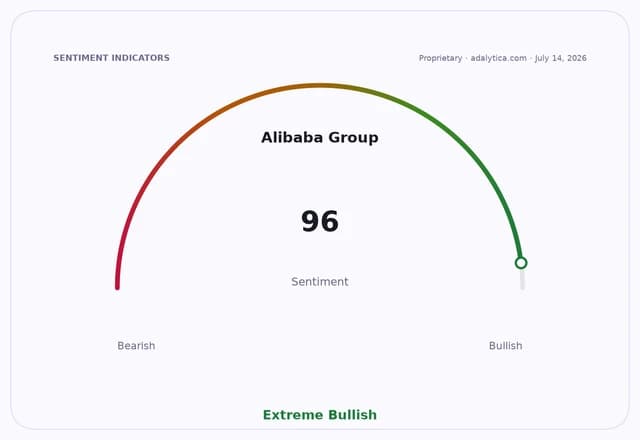
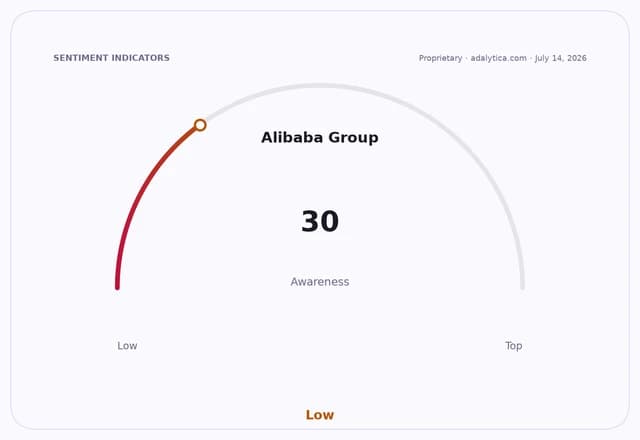
The latest price action says that shift is underway. Alibaba’s U.S.-listed shares have climbed to about $112 from $111.14 on July 9, while the Hong Kong listing sits near HK$111.40, and the move has come with stronger momentum readings than the market had seen a few months ago. On Adalytica’s proprietary Alibaba earnings sentiment gauge, sentiment has surged to 96, or “Extreme Greed,” while awareness remains stuck in “Fear,” a combination that often appears when investors are enthusiastic but the broader market has not fully caught on yet.
For long-term investors, that gap is the interesting part. Alibaba is still trading well below its 200-day moving average in both markets, which tells you this is not yet a full-blown secular breakout. But the stock has also rebounded from a deep selloff, and the 50-day moving average is now acting as a reference point again. In plain English: the market has stopped assuming permanent decay and is re-testing the idea that Alibaba can grow into its AI ambitions.
That is where the economic story gets more compelling. AI is not just an add-on for Alibaba; it can strengthen the parts of the business that matter most to compounding, especially cloud services and enterprise spending. If customers build more workloads on Alibaba Cloud and use its AI tools more deeply, that can improve stickiness, raise switching costs and support higher-margin revenue streams over time. For investors thinking in years, that is far more important than whether the stock is up or down over a few sessions.
The broader backdrop helps, too. China growth sentiment, as tracked by Adalytica, is at extreme fear, which means the market remains cautious on the economy even as selective AI leaders attract capital. That creates a split-screen setup: macro pessimism can keep valuations restrained, but strong business execution can still re-rate individual winners. In other words, Alibaba does not need China to become euphoric for the stock to work — it needs its own AI story to keep gaining credibility.
There are still risks, of course. China policy uncertainty, slower consumer spending, competition in cloud and AI, and the possibility that sentiment gets ahead of actual earnings all deserve respect. The recent move has also been fast enough to leave the stock vulnerable to pullbacks. But for investors with a 3- to 10-year horizon, that is exactly why Alibaba is worth watching rather than chasing.
If the company keeps proving that AI can drive cloud demand, support commerce efficiency and improve cash generation, this rally could be the beginning of a much larger rerating. Alibaba does not need to become the next Nvidia to reward patient shareholders — it just needs to become a stronger, more durable AI compounder than the market expected.
For now, that makes Alibaba a high-interest name for the watchlist, and possibly a buy on weakness for investors who can tolerate volatility and think long term.
| Entity | Gains | Losses |
|---|---|---|
| Alibaba bulls | ▲AI rerating potential | ▼Missed upside if they wait too long |
| Alibaba bears | ▲Short-covering risk | ▼Thesis if AI monetization improves |
| China skeptics | ▲None | ▼Left behind if Alibaba decouples |
| Cloud competitors | ▲More pressure | ▼Share if Alibaba Cloud gains traction |