Alibaba raises equity for AI expansion
Alibaba Group is tapping investors for 1.6 trillion yen, or more than $10 billion, in fresh equity to fund an intensified push into artificial intelligence, a move that underscores how expensive the global AI race has become and how willing China’s largest internet companies are to dilute shareholders to stay in it.
The financing matters because it comes against a sharp deterioration in earnings: Alibaba’s profit has fallen 76% as heavy spending on AI and related infrastructure weighs on the bottom line. That makes the capital raise less a discretionary growth measure than a balance-sheet decision, giving the company a larger war chest for compute, cloud, model development and product rollout at a time when the market is rewarding scale, not restraint, in AI.
For investors, the deal is a test of whether Alibaba can convert spending into strategic advantage before returns are visible. Bulls will argue that raising equity now gives the company flexibility to defend its cloud franchise and expand AI services without overleveraging. Bears will see another sign that the company’s path back to durable earnings will be slower and more capital intensive than hoped, especially if AI investments continue to suppress near-term margins.
The market backdrop suggests investors are not treating this as a routine fund-raising. Alibaba’s shares have been volatile, with recent trading showing a sharp drop to around $119 after earlier peaks above $175, while technical indicators such as the 50-day moving average and RSI readings have swung between overbought and oversold territory. That kind of price action reflects a market that still believes in the AI story but is increasingly focused on execution risk, capital intensity and the timing of monetization.
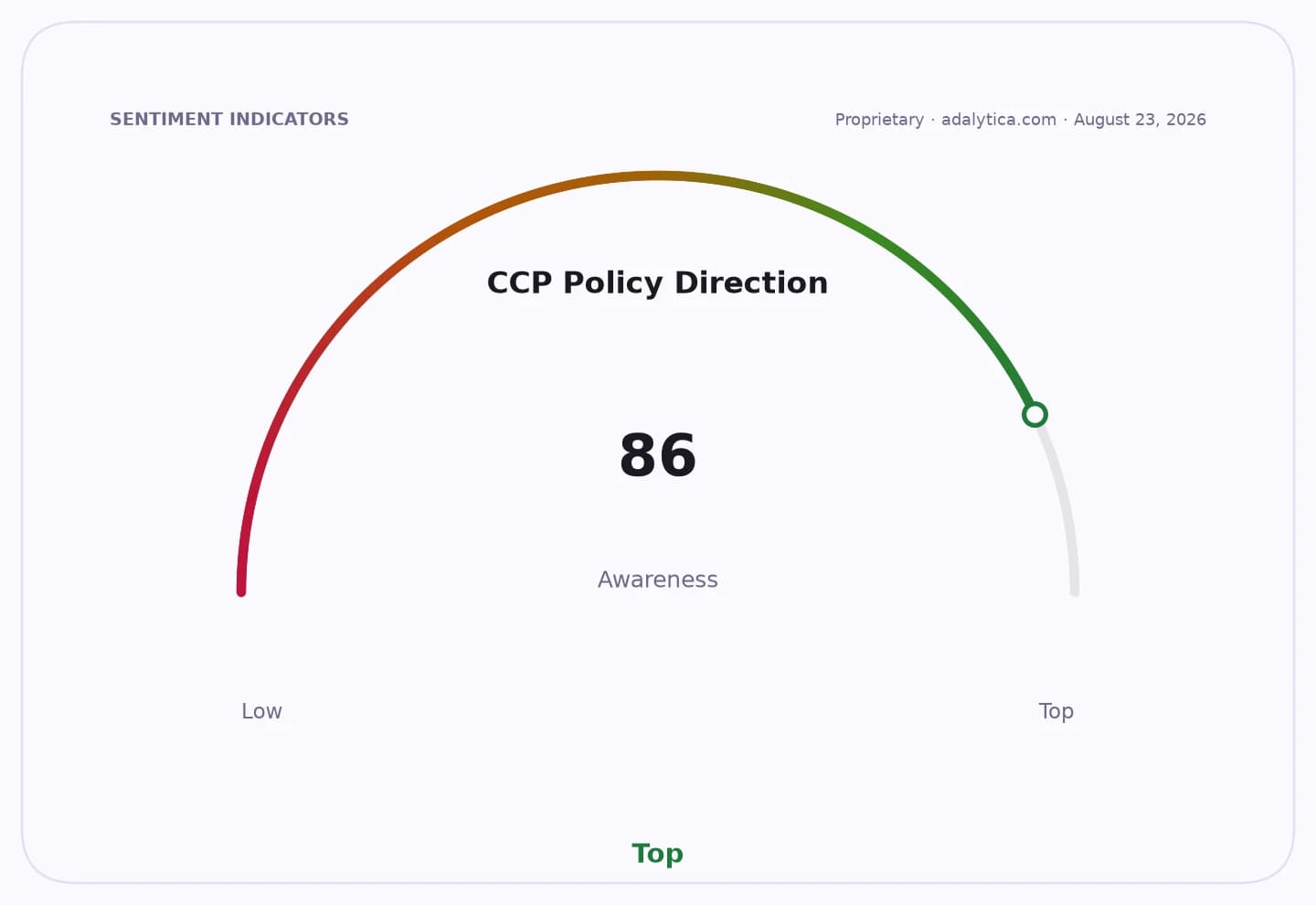
The broader narrative is that Alibaba is choosing to fight the AI battle on offense. Chinese technology groups face a similar trade-off: spend aggressively now on chips, cloud capacity and AI applications, or risk losing strategic relevance to faster-moving rivals. Alibaba’s move also speaks to the policy environment in China, where Beijing has been encouraging domestic tech capability even as companies are pressured to deliver shareholder value. Adalytica’s China CCP Policy Direction Sentiment gauge has recently moved higher, pointing to a friendlier policy tone, which may help explain why markets are more willing to tolerate aggressive capital deployment in strategic sectors.
The key question for the next few quarters is whether the new capital translates into revenue growth in cloud and AI services fast enough to offset dilution and margin pressure. If it does, Alibaba could strengthen its position as one of the few Chinese internet companies able to fund a full-stack AI strategy. If it does not, the share sale will be remembered as the point where the market accepted that the AI race was no longer being won on cash generation alone, but on who could absorb the most capital.
| Entity | Gains | Losses |
|---|---|---|
| Alibaba | ▲More AI capital | ▼Share dilution |
| AI suppliers | ▲Higher demand | ▼Pricing pressure |
| Long-term AI bulls | ▲Funding visibility | ▼Near-term earnings |
| Short-term shareholders | ▲Strategic optionality | ▼Lower per-share value |