Alibaba Holds Near $114 as AI Cloud Growth Continues

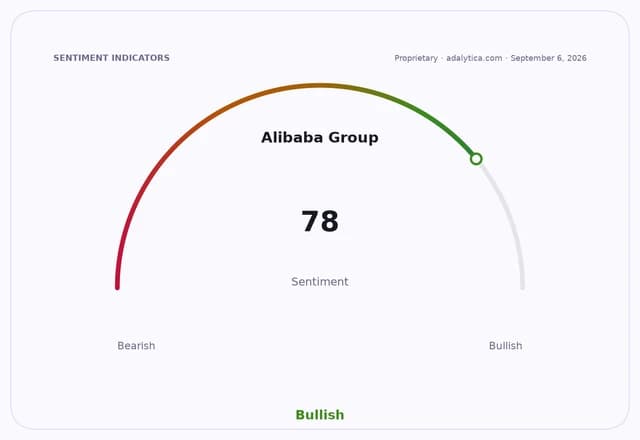
Alibaba shares are trapped just above a critical support zone, and the market is now deciding whether a steep valuation discount is a buying opportunity or a warning that the bear case still owns the tape.
At $113.94, Alibaba Group Holding Ltd. is trading below its 20-day, 50-day and 12-day moving averages, with price compressed near the lower end of its Bollinger Band range. That leaves $114 as the immediate battleground and roughly $107.50 as the next major technical floor. For investors, the significance is not the chart pattern alone: it is the mismatch between a weakened share price and a business that is still expanding in one of its most important growth engines.

The stock’s recent drift lower has pushed sentiment into a classic tension point. RSI readings around 40 suggest momentum is soft but not yet washed out, while the MACD has flattened, implying the prior downswing is losing force. That combination often invites a short-covering bounce, but only if buyers can defend the support band and force a reclaim of the 20-day moving average near $118. The market is effectively telling investors that near-term direction depends less on fundamentals than on whether $114 can hold long enough to matter.
What makes the setup more important economically is that Alibaba’s equity is being priced as if the company were in persistent deterioration, even though the underlying business is still producing growth. The most recent quarterly update showed revenue rising 9% year over year to $39.64 billion, while AI Cloud and Compute Services grew 45%, its fastest pace in 22 quarters. That matters because cloud and AI infrastructure are where investors are still willing to pay for future growth, even in a slower Chinese consumer and regulatory backdrop. The company’s AI-related product revenue is running at an annualized rate of about $7.3 billion, and management has said it could exceed half of external cloud revenue within a year.
That growth has come at a cost. GAAP net income fell sharply, weighed down by a European regulatory fine and elevated capital spending tied to AI infrastructure. But operating cash flow remained positive at $3.38 billion, up 11% from a year earlier, which is the more relevant number for long-term investors trying to separate accounting noise from business stress. The bull case is straightforward: Alibaba is reinvesting through a cyclical earnings trough, and the market is underestimating how quickly AI cloud expansion can translate into a rerating.
The bear case is equally clear. Alibaba still carries the burden of China regulatory risk, U.S.-China tension and the lingering perception that capital allocation may not generate an immediate earnings payoff. That is why the stock continues to trade at a discount to global cloud peers. But that discount is now becoming uncomfortable relative to the pace of revenue growth and the company’s cash generation. Analysts remain broadly constructive, with consensus targets implying meaningful upside from current levels, though that optimism has not yet been confirmed by price action.
Positioning data suggests investors are not outright abandoning the name. Long exposure remains elevated in derivatives, and buying has appeared on the tape without producing a decisive breakout. That points to a market waiting for a catalyst rather than one preparing for a collapse. The risk is that if $113 fails, the next move could be mechanical, not fundamental, as stop-loss levels give way and the stock is pulled toward the lower Bollinger Band.
For investors, the question over the next few weeks is whether Alibaba can turn valuation into a catalyst. If support holds and the stock reclaims its short-term averages, the market may begin to price the AI cloud story more aggressively. If it cannot, the discount may simply reflect a business that is improving, but not fast enough to overcome macro and geopolitical skepticism.
| Entity | Gains | Losses |
|---|---|---|
| Alibaba bulls | ▲Value re-rating, AI upside | ▼Near-term drawdown if support breaks |
| Alibaba bears | ▲Lower entry levels, technical downside | ▼Forced cover if $114 holds |
| Long-only investors | ▲Exposure to cheap growth | ▼Further earnings volatility |
| Short sellers | ▲Validation of technical weakness | ▼Squeeze risk on a rebound |