Amazon Australia rollout follows 15% international sales growth
Amazon is rolling out a major new product launch in Australia, underscoring how the company is leaning on international expansion to keep revenue growth broadening beyond the U.S. and AWS.
The move matters because Amazon’s overseas businesses are still a smaller part of its total profit pool than North America and cloud, but they remain one of the clearest levers for adding customers, order frequency and logistics density. Amazon said in its latest quarterly filing that international sales rose 15% in the second quarter, while it also flagged foreign-exchange swings, tariffs and supply volatility as ongoing risks to expansion.
For investors, the Australia launch is less about one market in isolation than about execution. A stronger local product push can deepen Prime engagement, increase checkout volume and improve fulfillment economics in a market where Amazon has been steadily building scale. That is especially relevant after Amazon’s shares have been volatile, even as they trade far above their 50-day and 200-day moving averages and remain close to overbought territory on RSI readings, suggesting the market is rewarding growth catalysts but sensitive to any sign of execution slippage.
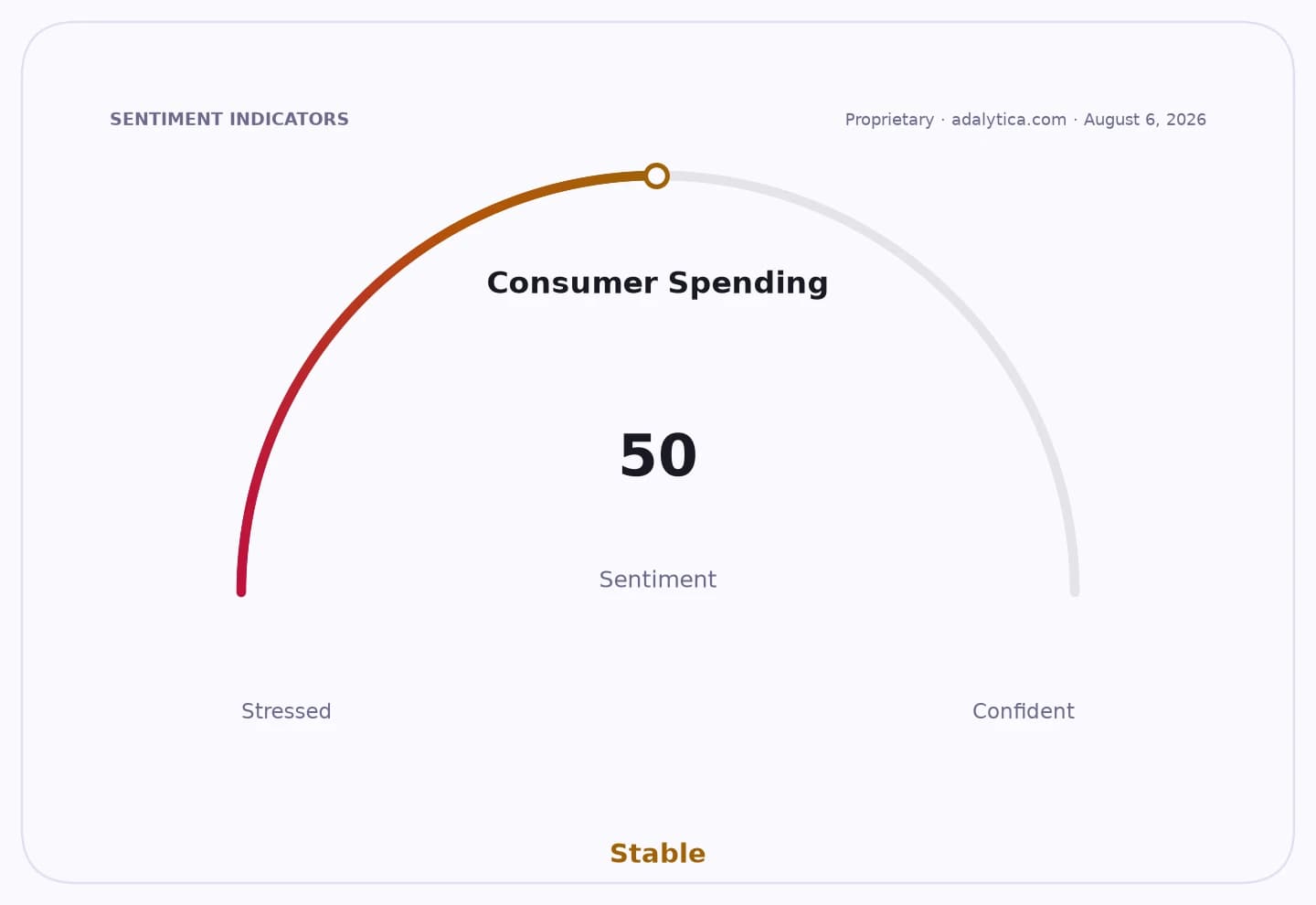
The launch also lands alongside a broader consumer backdrop that is mixed rather than uniformly strong. Adalytica’s Consumer Spending Sentiment gauge sits at neutral, while its Retail Goods Spending Sentiment remains in fear territory, a sign that discretionary demand is still uneven even as broader market risk appetite is elevated.
Amazon has been pushing internationally while also investing heavily in AWS, which grew 37% in the second quarter and remains the company’s biggest earnings engine. That combination leaves Australia as a useful test of whether Amazon can keep expanding commerce abroad without sacrificing margins in a period of higher costs, currency swings and tariff uncertainty.
The next catalyst is whether the Australia rollout translates into measurable sales momentum and higher order density over the coming quarters, especially as investors look for proof that Amazon’s international expansion can keep pace with its cloud growth.
| Entity | Gains | Losses |
|---|---|---|
| Amazon | ▲New customers and sales growth | ▼Higher launch and logistics costs |
| Australian consumers | ▲Broader product access | ▼Potential competitive pressure on local retailers |
| Local retailers | ▲— | ▼More price and assortment competition |
| Amazon shareholders | ▲Longer-term growth optionality | ▼Near-term margin execution risk |