Amazon Slides 10% From August Peak

Amazon shares have slid 10% from this month’s peak even as the company’s core businesses keep growing, underscoring how quickly investors are re-rating the stock when momentum cools and consumer spending looks less secure.
The latest pullback leaves Amazon at $256.42, down from an Aug. 3 high of $284.02, after a run that pushed the stock well above its 50-day moving average. The retreat is happening despite a still-solid longer-term trend: Amazon remains above its 200-day moving average of $238.59, which suggests the broader uptrend is intact even as short-term selling pressure has returned.
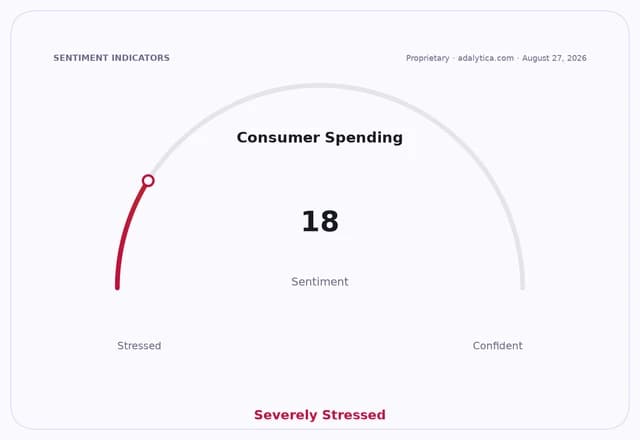
What matters economically is the market’s growing concern that the consumer backdrop is weakening just as Amazon’s valuation had begun to reflect better execution and stronger cloud demand. Adalytica’s consumer spending sentiment gauge sits at 18, in “fear” territory, while retail-goods spending sentiment, though improved sharply to 71, remains volatile. That combination points to a fragile demand environment for discretionary e-commerce, particularly if households keep trading down or delaying purchases.
The stock’s technical picture also reflects a reset in near-term momentum. Amazon’s 14-day relative strength index has fallen to 29.9, a level that typically indicates oversold conditions, while MACD remains below its signal line. In plain terms, sellers have the upper hand for now, even though the shares are no longer stretched as they were when RSI briefly reached 77.9 earlier this month.
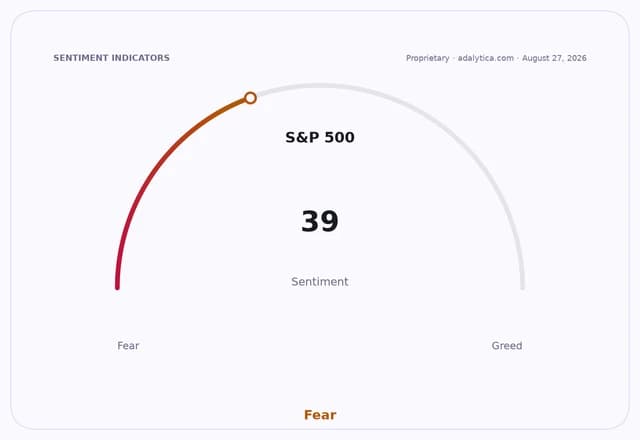
The decline also fits a broader market pattern. Adalytica’s S&P 500 trade signals are neutral, suggesting the move is less about a one-day index shock and more about investors rotating away from stocks that had run hard. That matters for Amazon because the shares had rallied sharply after a summer surge, leaving room for profit-taking once earnings enthusiasm faded and macro worries about China and broader global demand resurfaced.
Fundamentally, the bull case is still anchored by Amazon Web Services, which the company said grew 37% in the second quarter, and by scale advantages in logistics and advertising. But the bear case is that the market is no longer willing to pay up for those strengths without clearer evidence that consumer demand can hold up and margins can expand through the second half. For a stock as widely owned as Amazon, even a modest change in sentiment can trigger repeated air pockets as managers trim exposure into strength.
For investors, the key question is whether this is just a consolidation after a sharp run or the start of a more persistent de-rating. If AWS growth and retail resilience remain intact, the pullback could prove to be a reset in an otherwise constructive trend. If spending sentiment keeps weakening and the stock loses its 50-day moving average, the market may be signaling that Amazon’s next leg higher will require more than just good execution.
| Entity | Gains | Losses |
|---|---|---|
| Short-term sellers | ▲Lower entry points | ▼Risk of oversold bounce |
| Long-term Amazon bulls | ▲Better valuation setup | ▼Near-term momentum |
| Consumers | ▲Potential pricing power | ▼Weaker discretionary demand |
| Competitors | ▲Room to gain share | ▼Less pressure from Amazon expansion |