Apple and Google are likely to strengthen their AI partnership as Apple looks for a sturdier counterweight to OpenAI, and that matters because the fight over who controls consumer AI could soon determine the next distribution layer in tech.
Apple-Google AI Tie-Up Could Reprice Alphabet
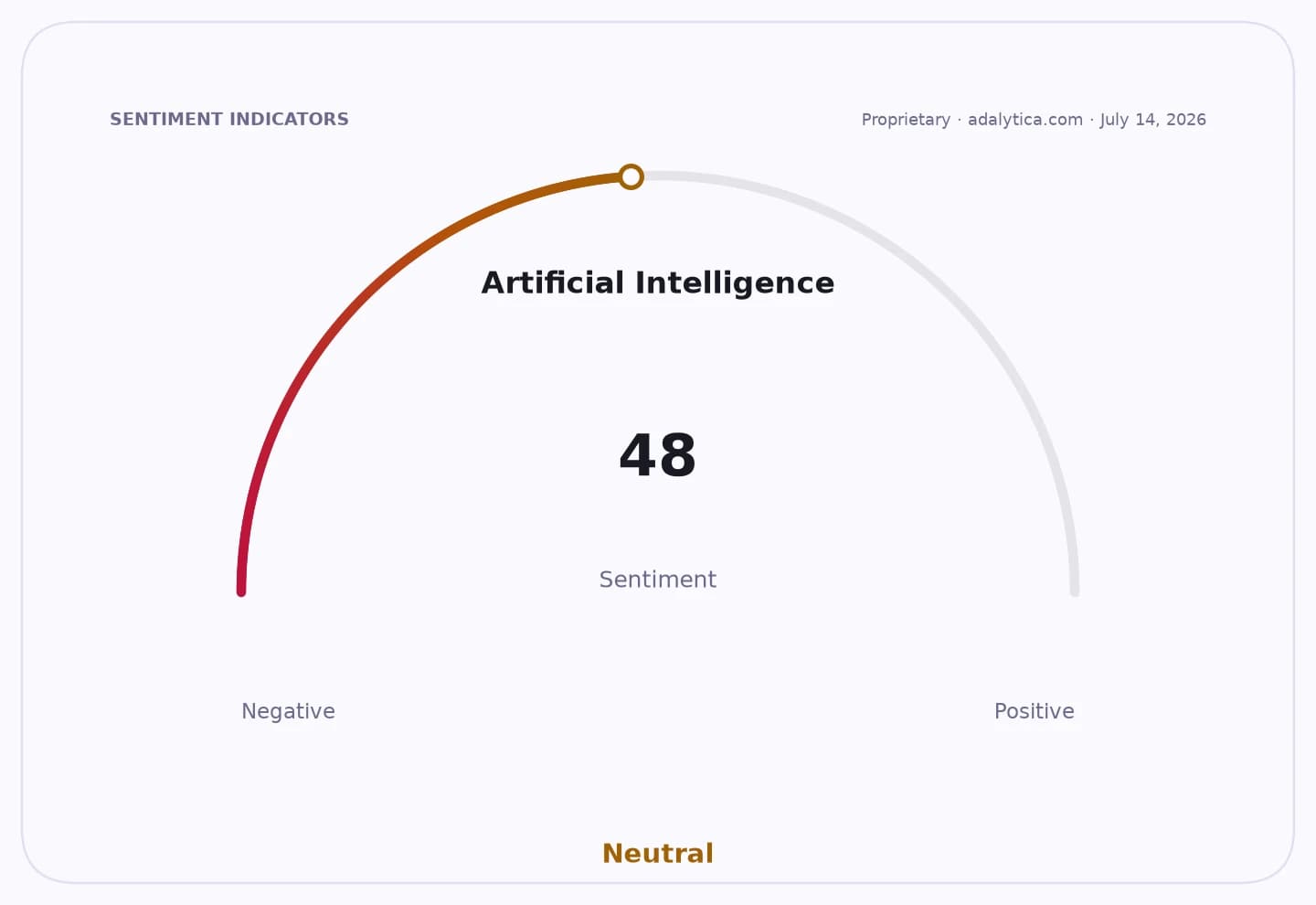
The market has spent months treating AI as a model race. The real money is in access: the default assistant, the browser, the phone, the search box and the payments rail behind them. If Apple leans harder on Google, it would be a tacit admission that the fastest route to AI monetization is not building everything in-house, but stitching the best model provider into the world’s most valuable device ecosystem.
Sentiment IndicatorsⓘProprietary · adalytica.com · July 14, 2026
This is a snapshot — live sentiment, awareness and momentum for 130+ markets update continuously in the dashboard.Open AlphaPulse
That is why the OpenAI lawsuit backdrop is so important. It raises the odds that Apple broadens its partnerships rather than betting on a single outside champion. Google, for its part, gains leverage because it already owns search, Android and a deep AI stack. For Apple, a closer tie offers immediate product credibility without sacrificing the premium hardware franchise. For investors, that combination is powerful: the winners are the companies that sit at the junction of intent, distribution and compute.
The latest price action suggests the market is beginning to price in that shift. Apple is trading around 317, well above its 50-day moving average near 299, with momentum indicators still positive, while Google has given back some of its earlier AI premium and sits near 353, below its 50-day average around 373. That split leaves room for a rerating if investors conclude Alphabet’s AI infrastructure and search dominance become more central to Apple’s roadmap. Microsoft, meanwhile, remains a critical competitor in the broader AI stack, but its role here is more as a pressure point than a direct beneficiary.
Artificial Intelligence vs AAPLadalytica.com
Explore this data interactively — full history, time series and cross-market comparisons.Open AlphaPulse
The strategic narrative is bigger than a single lawsuit. Apple is under pressure to make AI feel native on the iPhone, not bolted on. Google wants to defend its core traffic engine as AI changes how users search, shop and act. A tighter Apple-Google alignment would be a defensive and offensive move at once: defensive against OpenAI’s rising consumer brand, and offensive against the idea that one startup should own the conversational layer on top of mobile computing.
The stock market still underestimates how durable this arrangement could become. Apple does not need to become an AI model company to win; it needs to control the interface where AI gets used. Google does not need to win every assistant battle; it needs to remain embedded in the pipes that route queries and recommendations. That is a classic toll-road setup, and toll roads tend to compound for much longer than the market expects.
The investors who should pay attention are those looking for asymmetric exposure to AI distribution, not just AI training. Alphabet looks like the cleaner way to play a deeper Apple tie-up, while Apple gets a practical boost to its AI roadmap without disrupting its ecosystem economics. If this partnership intensifies, the next leg of AI value creation may come less from flashy demos and more from who quietly owns the default on the most valuable screen in the world.
| Entity | Gains | Losses |
|---|---|---|
| Apple | ▲Stronger AI product credibility | ▼More dependence on outside models |
| Google/Alphabet | ▲Distribution leverage | ▼Pressure on standalone search moat |
| OpenAI | ▲More attention | ▼Less control over consumer access |
| Microsoft | ▲Ecosystem pressure | ▼Fewer default-placement wins |