Apprentice Statute Could Reshape Staffing Demand
The Senate is preparing to vote on a project that would create an “Apprentice Statute,” a move that could open thousands of vacancies in the job market and force employers to rethink how they hire, train and retain workers.
The significance is less about the legal label than the labor-market mechanics. By formalizing an apprenticeship framework, the proposal could channel young and entry-level workers into structured jobs, but it may also leave firms scrambling to fill gaps where apprentices are currently doing lower-cost or transitional work. That makes the measure important for unemployment, payroll growth and the cost of labor just as the U.S. job market is showing signs of steady but unspectacular expansion.
Nonfarm payrolls have continued to rise, with employment projected at 159,170,900 in July from 158,984,000 in June, while the unemployment rate is expected to edge down to 4.18% from 4.2%. That points to a labor market that remains resilient, but not loose enough to absorb a large policy-driven reshuffling of workers without friction. Job openings, meanwhile, have moderated from their pandemic-era peaks, with openings at 7,594 in May and a forecast of 7,656.9 in June, well below the 2021-22 surge but still elevated by historical standards.
For employers, the risk is not just headline vacancies but the transition cost. Apprenticeship schemes can improve productivity over time, broaden the hiring funnel and create a pipeline for skilled labor. But they also tend to require more supervision, training investment and compliance, which can reduce near-term operating flexibility. That matters for staffing firms such as ManpowerGroup, Korn Ferry and Kelly Services, whose businesses depend on matching employers to available workers and on the pace of hiring across sectors.
The market reaction has already shown that investors are sensitive to labor-policy shifts and the broader employment backdrop. ManpowerGroup’s shares have climbed sharply to 40.62 from 26.32 in April, while Kelly Services has risen to 75.39 from 60.05 in April, reflecting a more constructive view on labor demand and staffing volumes. By contrast, Twi’s shares have struggled, trading at 7.35 and below both the 50-day and 200-day moving averages, a sign that investors remain skeptical of its near-term earnings power. The moves suggest the market is already trying to price in whether a structural hiring change will support staffing volumes or pressure margins.
Technical indicators underscore that divergence. ManpowerGroup’s stock is trading well above its 50-day and 200-day moving averages, with RSI readings near 75, indicating strong momentum but also a potentially stretched move. Kelly Services is also above both moving averages, though with a less extreme RSI, while Twi remains below key trend measures. In investor terms, that points to selective enthusiasm for labor-cycle beneficiaries rather than a broad-based re-rating of the staffing sector.
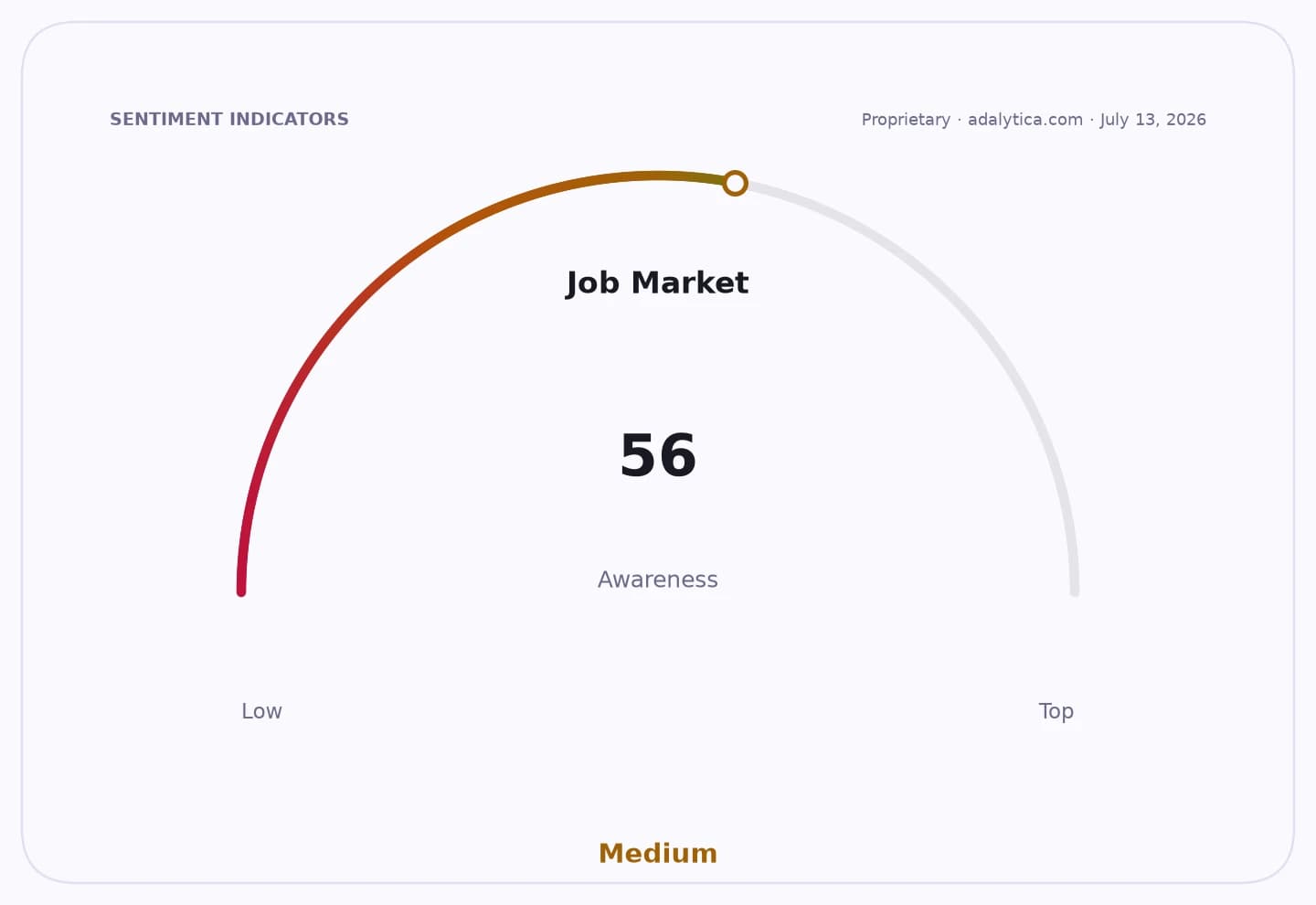
Adalytica’s Job Market Sentiment gauge sits at 41, neutral, after a sharp 30-day decline, suggesting investors and market participants are still uncertain about the direction of employment conditions. That uncertainty matters because apprenticeship legislation can be pro-employment over the long run but disruptive in the short run, particularly if it reallocates labor across sectors faster than firms can adapt.
The bull case is that the statute expands access to work, lowers youth unemployment and creates a more disciplined talent pipeline at a time when many employers complain about skill shortages. The bear case is that it increases administrative burdens, shifts costs onto firms and creates a temporary mismatch between openings and available candidates. Either way, the vote would be more than a labor-policy headline: it would be a test of whether governments can use apprenticeship rules to reshape hiring without worsening short-term vacancies.
For investors, the key question is whether the measure ultimately boosts labor-force participation and payroll growth or merely redistributes scarce workers across industries. Staffing companies, training providers and employers dependent on entry-level labor will be most exposed if the Senate advances the project, while firms with strong internal recruitment and training systems may be best positioned to benefit from the transition.
| Entity | Gains | Losses |
|---|---|---|
| Apprentices and young workers | ▲More entry-level jobs | ▼Less informal hiring |
| Staffing firms | ▲Higher placement volumes | ▼Margin pressure from training needs |
| Employers with skill shortages | ▲Bigger talent pipeline | ▼Higher compliance costs |
| Short-term labor flexibility | ▲Structured workforce | ▼Faster vacancy churn |