Argentina Central Bank Caps Non-Bank Card Rates

Argentina’s central bank is moving to cap interest rates on non-bank credit cards as household defaults climb, a bid to slow the rapid deterioration in consumer credit while shielding borrowers from punishing financing costs.
The policy is meant to contain a worsening credit stress that can spill into broader consumption, bank asset quality and the finances of alternative card issuers that have filled gaps left by traditional lenders. In a country already accustomed to high inflation and tight household budgets, steeper card costs have become an increasingly visible pressure point.

The decision lands as global credit conditions remain relatively firm: U.S. high-yield spreads, tracked by the ICE BofA option-adjusted spread index, were at 2.7 percentage points on Aug. 21, suggesting no broad market seizure in risk appetite. But Argentina’s move is a local response to a very different problem — households borrowing at rates that can quickly become unsustainable.
That matters for investors because it directly hits the economics of non-bank consumer finance. Rate caps can reduce yields, compress margins and limit the ability of specialized lenders to price for risk, especially when delinquency rates are already rising. They can also shift demand toward formal banks, cash payments or short-term consumption cuts, with knock-on effects for retail sales and payment volumes.
For card networks and payment processors, the immediate effect is less clear-cut. Visa and Mastercard rely on transaction activity more than lending spreads, but weaker household credit quality can slow spending growth and reduce higher-margin revolving balances across the ecosystem. Visa shares have risen to $382.41 and Mastercard to $599.86, but both remain exposed to any broader slowdown in consumer credit and discretionary spending.
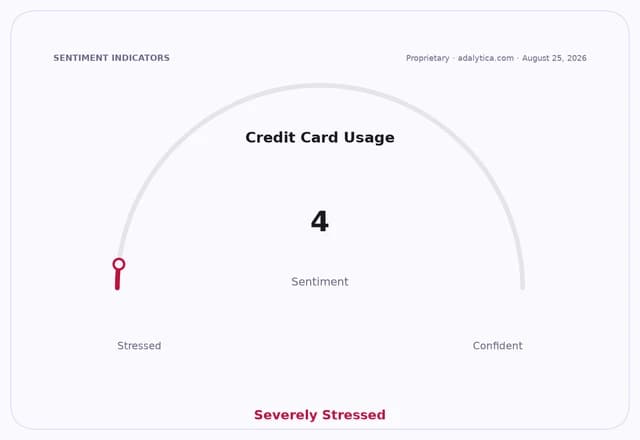
Adalytica’s Credit Card Usage Sentiment gauge shows “Extreme Fear” at 4, while Consumer Spending Sentiment is also at 7, underscoring how sharply the household backdrop has weakened even as awareness remains elevated. That combination points to a consumer under strain, not a healthy credit expansion.
The next focus will be whether the rate cap eases defaults without starving borrowers of access to credit. If repayment stress keeps worsening, authorities may face pressure to tighten more rules on consumer lending, while investors will be watching for signs of margin compression and deteriorating receivables across Argentina’s card and consumer finance market.
| Entity | Gains | Losses |
|---|---|---|
| Argentine households | ▲Lower card borrowing costs | ▼Less access to revolving credit |
| BCRA / regulators | ▲Slower credit stress buildup | ▼Pressure to police lenders further |
| Banks / card issuers | ▲Potential shift of borrowers to formal lenders | ▼Margin pressure on non-bank rivals |
| Non-bank lenders | ▲None | ▼Lower yields, higher delinquency risk |