Argentina household loan delinquency rises to 12.9%
Argentina’s household loan delinquency rose again in July to 12.9%, the highest level in more than two decades, underscoring how weak consumption and falling real credit balances are feeding stress across the banking system.
The new increase, after a pause in June, matters because it points to a fresh deterioration in borrowers’ ability to service debt at a time when banks are already facing slowing real lending growth and a still-fragile consumer backdrop. The Banco Central de la República Argentina said the ratio for family financing rose 0.1 percentage point from June, while the overall private-sector credit delinquency rate edged up to 7.7%.
The household figure is the key number for lenders and investors because consumer books tend to be among the first places where strain shows up when inflation, incomes and employment fail to keep pace with financing costs. The central bank said the rise in the irregularity ratio reflected both a decline in the real stock of total financing, which mechanically lifts delinquency ratios, and a continued increase in non-performing balances, even if that increase has slowed.
For banks, the reading is a warning that asset quality remains under pressure even as headline macro conditions stabilize. The probability of default estimated by the central bank for families eased to 3.9% from the previous month, but that still leaves household credit risk elevated. For companies, delinquency was lower at 3.6%, up 0.1 percentage point on the month, suggesting corporate stress is present but remains far less acute than in household lending.
The gap between household and corporate performance is important for investors because it implies the burden of Argentina’s adjustment is still being borne disproportionately by consumers. That can weigh on credit-card lenders and banks with heavier retail exposure, while institutions with more diversified books may be better insulated. It also suggests that any recovery in loan growth will likely depend on a sustained improvement in real wages, employment and broader domestic demand rather than just lower inflation.
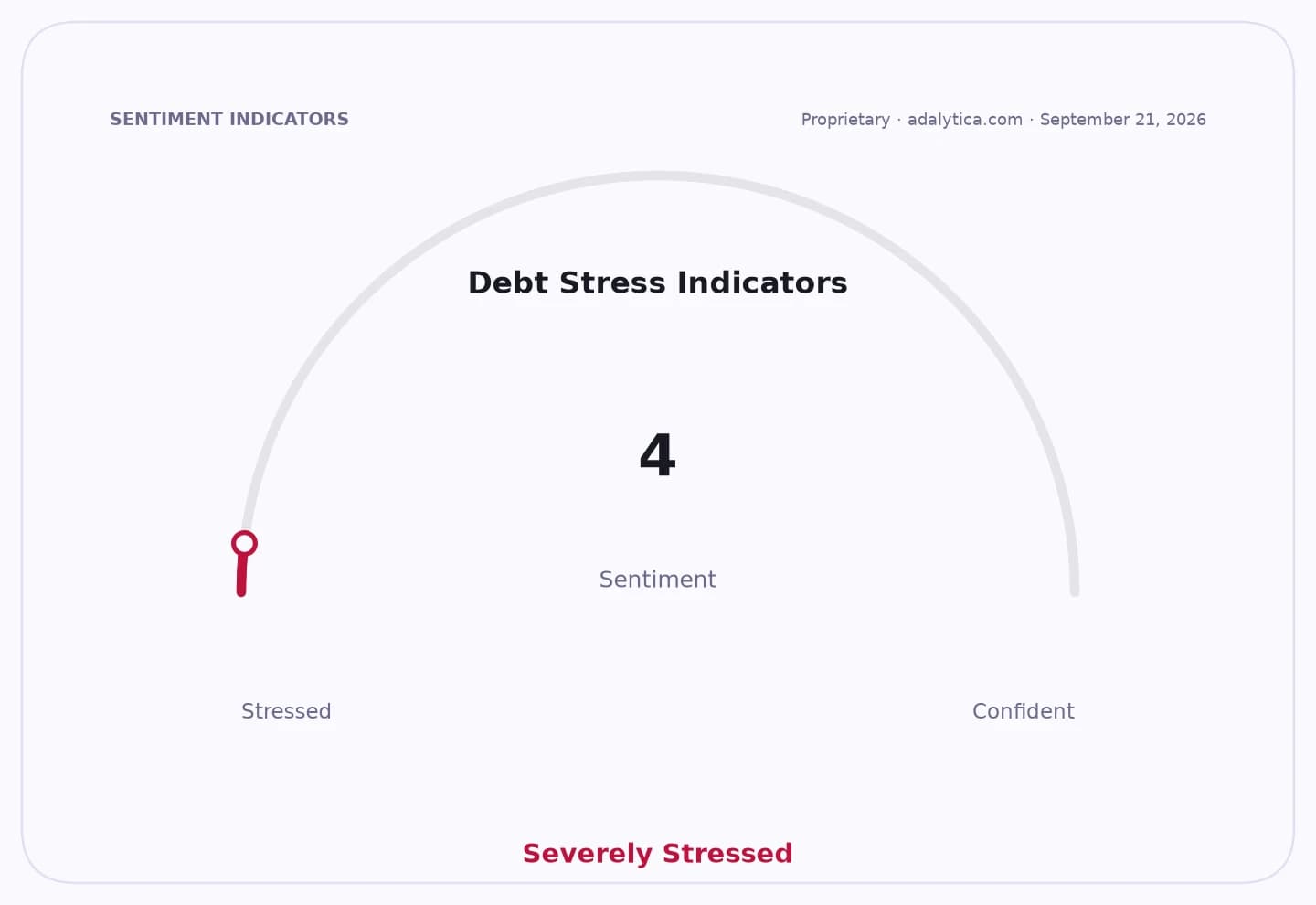
Market signals around consumer stress reinforce that view. Adalytica’s Household Debt Stress sentiment gauge remains in “Extreme Fear,” while the household savings-rate gauge also sits at “Extreme Fear,” pointing to persistent caution among borrowers and limited room for balance-sheet repair. In the U.S., investors often use delinquency trends as an early indicator of consumer resilience; in Argentina, where inflation and policy normalization remain in flux, the same logic is even more relevant.
For banks and credit investors, the immediate question is whether July marks a one-month wobble or the start of another leg higher. If real incomes continue to lag and the stock of credit keeps shrinking in real terms, delinquency could stay near record levels for longer, keeping pressure on underwriting standards, loan growth and earnings quality. If consumption stabilizes, the worst of the move may already be visible — but for now, the July data argue that Argentina’s household credit cycle is still under strain.
| Entity | Gains | Losses |
|---|---|---|
| Argentine banks | ▲slower corporate stress | ▼rising household losses |
| Retail lenders | ▲higher pricing power | ▼worse asset quality |
| Consumers | ▲debt relief if credit tightens | ▼higher delinquency burden |
| Corporate borrowers | ▲relatively contained default rates | ▼tighter lending conditions |