Argentina Milei seeks bloc discipline before budget
Javier Milei is trying to keep his bloc disciplined at a moment when Argentina’s policy path matters more to investors than the day-to-day noise of Congress.
The president has summoned lawmakers from La Libertad Avanza to Casa Rosada to align the messaging and legislative strategy just as his government sends its Law for the Defense of National Sovereignty to the lower house and prepares to present the 2027 budget. That combination matters because it puts fiscal policy, regulatory control and political coordination on the same timetable — exactly the kind of sequencing markets watch for when they are pricing sovereign risk, currency stability and the durability of an austerity program.
For investors, the signal is not just that Milei wants to talk economics. It is that he is trying to preserve legislative momentum around the core of his program: tighter spending, greater executive control over the reform agenda and a faster route through Congress for bills that can reinforce the state’s authority in strategic areas such as the Falklands/Malvinas. If the government can keep its coalition aligned, it improves the odds that the budget arrives as a credible anchor rather than a political hostage to internal fragmentation.
The timing also matters. A budget presentation in the middle of an active parliamentary push gives the administration a chance to frame the macro narrative before opponents define it. That is crucial in a country where fiscal credibility is the main transmission mechanism into the peso, local rates and equity valuations. Argentina’s U.S.-listed ETF, ARGT, has already pushed to 96.88, near the upper end of its recent range, while EEM has climbed to 67.0, reflecting a broader appetite for emerging-market exposure. Those moves can quickly reverse if Congress starts to look like a veto point for Milei’s agenda.
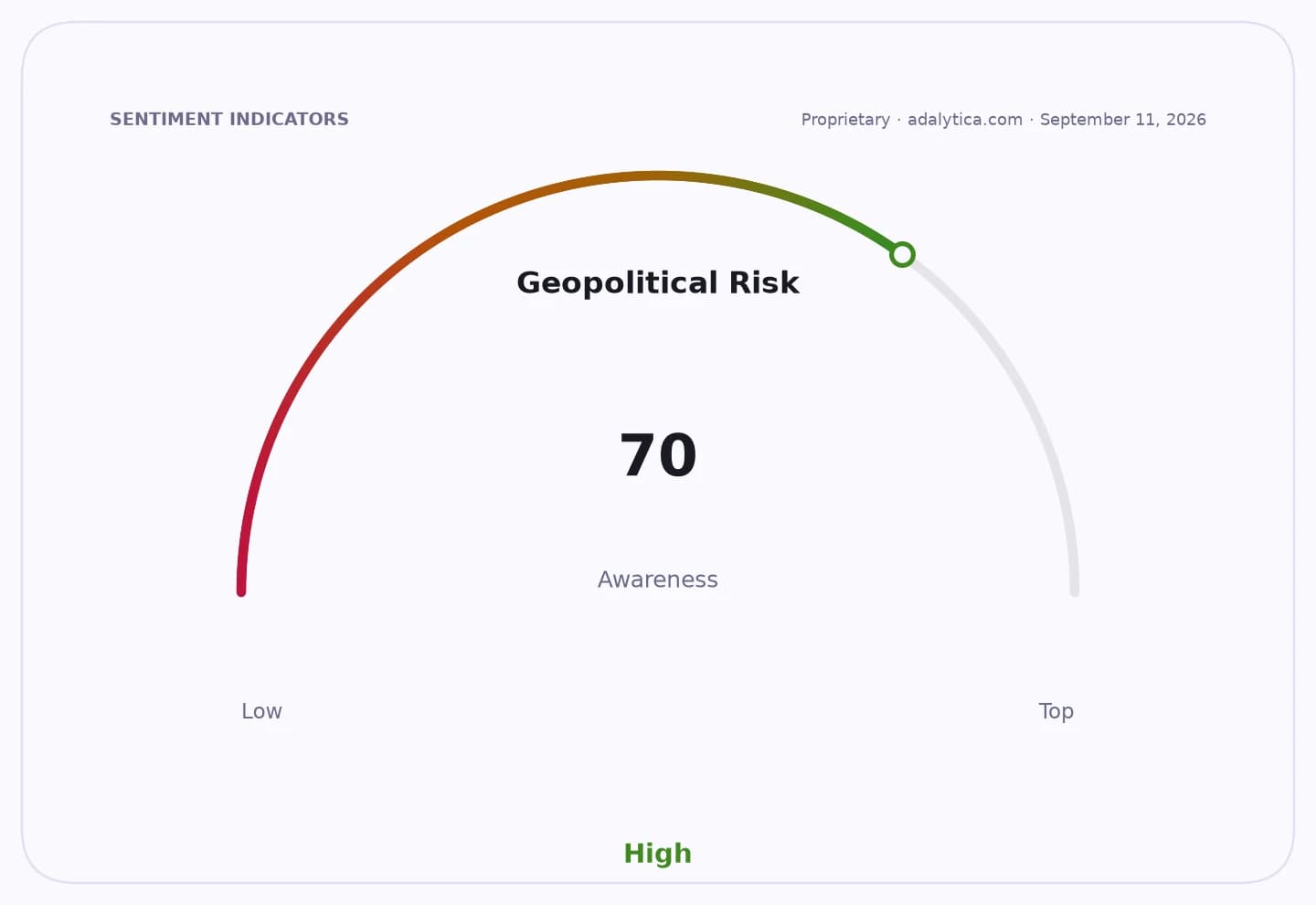
The market backdrop underscores why the meeting matters. Adalytica’s Global Stability Sentiment gauge has fallen to 30, in “Fear,” down 19 points on the day and 70 points over 30 days, a reminder that geopolitical and policy uncertainty remains elevated. By contrast, U.S. dollar trade signals remain neutral, suggesting investors are not yet in outright risk-off mode. That leaves room for a political surprise in Buenos Aires to influence flows, particularly if the budget is read as disciplined and reformist rather than accommodative.
The investable thesis is straightforward: the market still underprices the upside from sustained governance in Argentina. If Milei can convert legislative coordination into a workable budget and pass strategic bills without a showdown, the next leg of the trade is not just in Argentina equities but in the second-order beneficiaries — exporters, banks, infrastructure names and firms exposed to a steadier policy regime. That is the asymmetry investors should be watching now: a relatively small improvement in congressional execution can unlock a much larger rerating in Argentine risk assets.
The next catalyst is the 2027 budget presentation. If it reinforces fiscal orthodoxy and the government keeps its bloc together, Argentina can continue to attract capital as a turnaround story rather than a headline-driven trade. If Congress fractures the narrative, the premium built into local assets can evaporate quickly. For now, the better bet is to position early for policy continuity, not wait for consensus to arrive.
| Entity | Gains | Losses |
|---|---|---|
| Milei government | ▲Legislative discipline | ▼Political drift |
| Argentina equities/ARGT | ▲Reform rerating | ▼Policy uncertainty |
| Budget hawks | ▲Fiscal credibility | ▼Spending pressure |
| Opposition blocs | ▲— | ▼Agenda control |