Asia stocks rise on US-China trade hopes
Asian equities climbed on Monday, led by technology stocks, as investors bet that a thaw in US-China trade relations could extend the fragile truce between the world’s two biggest economies and ease pressure on the region’s export-heavy manufacturers.
The move matters because trade policy remains one of the biggest macro variables for Asia’s growth, corporate earnings and supply chains. A clearer path to a trade deal — or even a longer ceasefire — would support semiconductor exporters, consumer-tech names and broader regional risk assets that have been trading against a backdrop of tariff, export-control and rare-earth uncertainty.
South Korea’s Kospi rose 1.7%, with Samsung Electronics jumping 4% and SK Hynix edging up 0.1%. In China, the CSI 300 gained about 0.5% and the Shanghai Composite added 0.6%, while Hong Kong’s Hang Seng rose 0.6%. Singapore’s Straits Times Index added 0.3% and futures tied to India’s Nifty 50 were also higher. Japan was shut for a holiday, muting regional turnover.
The rally was anchored in expectations that US President Donald Trump and Chinese President Xi Jinping will use their planned meeting later this week to prolong the trade truce. Weekend talks in New York between US Treasury Secretary Scott Bessent and Chinese Vice Premier He Lifeng were described by both sides as positive, and the two countries agreed to open a dialogue on artificial intelligence ahead of the summit.
For investors, that matters most in semiconductors and large-cap technology, where earnings are highly sensitive to cross-border demand, chip controls and supply-chain stability. South Korean chipmakers, Taiwanese foundry names and US megacap tech all benefit when the market prices in fewer restrictions and a steadier demand outlook. Conventional technical indicators also showed the rally had room to run in some names: Apple and Nvidia were trading around their 50-day moving averages, while TSMC remained above both its 50-day and 200-day averages, a sign of constructive momentum rather than an outright panic bid.
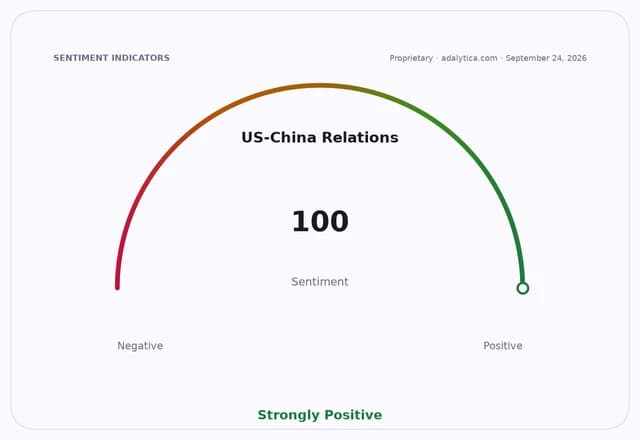
The latest price action also reflects a broader shift in market tone. Adalytica’s US-China Relations Sentiment gauge showed “Extreme Greed,” underscoring how quickly positioning has swung toward optimism after weeks of caution. That said, the same optimism leaves the market vulnerable if the summit delivers only symbolic progress. Investors still face unresolved issues around tariffs, rare-earth exports and technology restrictions — the very areas that have repeatedly upended sentiment in Asia and on Wall Street.
Oil prices eased for a fourth straight session, giving equities some relief by reducing immediate inflation pressure, though Brent remained near $103 a barrel amid Middle East supply concerns and the US-Iran conflict. At the same time, rising US Treasury yields remain a counterweight for global risk assets, as expectations the Federal Reserve may keep tightening have pushed borrowing costs higher and tightened financial conditions.
The near-term market test is whether the Trump-Xi meeting produces an extension of the trade truce with enough detail to support earnings estimates for chipmakers and exporters. If it does, Asia’s tech-led rally could broaden into industrials and consumer stocks. If it does not, the region’s gains may prove another short-lived relief rally in a market still dominated by policy risk.
| Entity | Gains | Losses |
|---|---|---|
| Asian tech exporters | ▲Better demand outlook | ▼Tariff and export-control risk |
| China and US negotiators | ▲Smoother summit backdrop | ▼Pressure if talks stall |
| Samsung, SK Hynix, TSMC | ▲Semiconductor sentiment rebound | ▼Trade-related supply-chain uncertainty |
| Risk assets in Asia | ▲Stronger appetite for equities | ▼Safe-haven bids and defensive positioning |