ASML Shares Rise as U.S. Presses Dutch Export Curbs

The U.S. is pressing the Netherlands to stop ASML from shipping more chipmaking tools to China, a move that would widen export controls on one of the world’s most important semiconductor suppliers and raise fresh risks for global AI and chip production.
The push matters because ASML’s lithography systems sit at the center of advanced semiconductor manufacturing, and any further restriction on China sales would hit a business line that remains politically sensitive even after years of tighter Western controls. For Washington, the goal is to slow Beijing’s access to technology that can be used to expand domestic chip capacity; for investors, the issue is whether the next round of curbs starts to bite into ASML’s order visibility, margins and long-term growth mix.
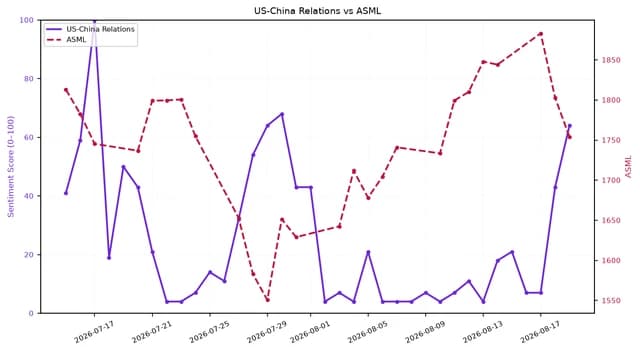
ASML shares have been volatile but still sit well above their 200-day moving average, closing at 1,753.99 on Aug. 19 after touching 1,883.12 two sessions earlier. The stock’s RSI reading of 60.3 suggests momentum has cooled from overbought levels, while the 50-day average at 1,780.0 shows the shares are still holding near a key trend line even as the China policy backdrop turns more hostile.
The timing is notable because ASML has just raised its 2026 outlook after reporting stronger-than-expected second-quarter sales of €9.3 billion and net income of €2.9 billion, with full-year revenue now seen at €43 billion to €45 billion and gross margin at 54% to 56%. That gives the company near-term operational strength, but it also means investors are now weighing robust AI-driven demand against the risk that geopolitics trims one of its most strategically important customer markets.
The broader semiconductor trade is also being pulled in opposite directions. Taiwan Semiconductor Manufacturing Co. remains near elevated levels at $413.46, and Nvidia closed at $219.02, showing that AI infrastructure demand is still supporting the sector even as policymakers tighten the screws on China-linked chip flows.
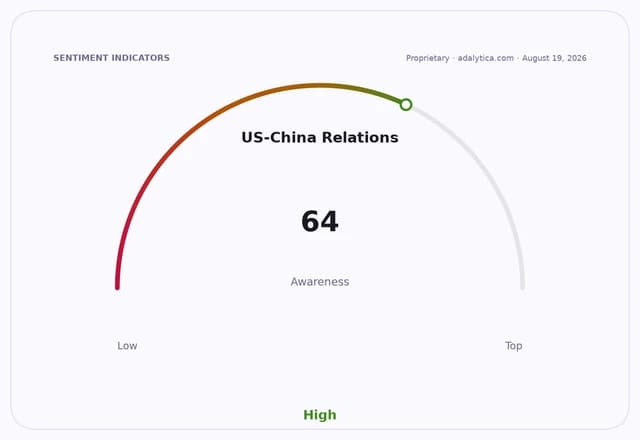
Adalytica’s U.S.–China relations sentiment snapshot turned more positive on the day, but the 21-point one-day jump still leaves the gauge at a neutral 64, underscoring how quickly market mood can shift around trade and technology controls. For ASML, the immediate catalyst is whether Washington can persuade The Hague to adopt a broader ban; for investors, the key risk is that a political decision, not demand, becomes the main limit on future China sales.
| Entity | Gains | Losses |
|---|---|---|
| U.S. policymakers | ▲Tighter China tech controls | ▼Near-term trade friction |
| Netherlands government | ▲U.S. security alignment | ▼ASML trade backlash |
| ASML | ▲Strong AI demand outside China | ▼China sales and visibility |
| China chipmakers | ▲Time to build domestic supply | ▼Access to top-tier lithography |