Auto Parts Stocks Hold Up as Inflation Stays Sticky
Motorcar Parts of America’s latest trading action and the broader aftermarket backdrop point to the same story: auto-parts costs are proving stubborn, and the companies best positioned to preserve pricing power are likely to be the winners.
That matters because the aftermarket is one of the few corners of consumer spending where inflation can still be passed through, at least for now. Carlos Rondón, president of Canidra, said the sector is focused on keeping prices stable and maintaining customer trust, a reminder that even in a weaker consumer environment, auto-parts suppliers and retailers are trying to defend margins rather than cut prices aggressively.
The message is showing up in the stocks. Motorcar Parts of America, which reports earnings tied to the cost of cores and finished goods, has been volatile but remains above its February low of $9.52, recently trading around $12.46. The stock’s 200-day moving average sits near $12.60, a sign the market is still testing whether the rebound in the aftermarket is durable. Advance Auto Parts is far more constructive: shares were last at $56.55, close to the 50-day moving average and above the 200-day average of $52.22, after recovering sharply from spring weakness. O’Reilly Automotive remains the cleanest signal of all, holding near $91.05 with its 50-day average above the 200-day, a classic marker of a business still commanding investor confidence.
The economics are straightforward. Older vehicles need more maintenance, and the aftermarket tends to benefit when consumers delay new-car purchases and keep cars on the road longer. O’Reilly’s latest filing underscores that point, saying out-of-warranty, older vehicles generate strong demand for maintenance products. Advance Auto has also noted it can pass along higher acquisition costs when input prices rise. That gives the group some insulation from inflation, but it also means shoppers are paying up for repairs and replacement parts rather than absorbing lower prices.
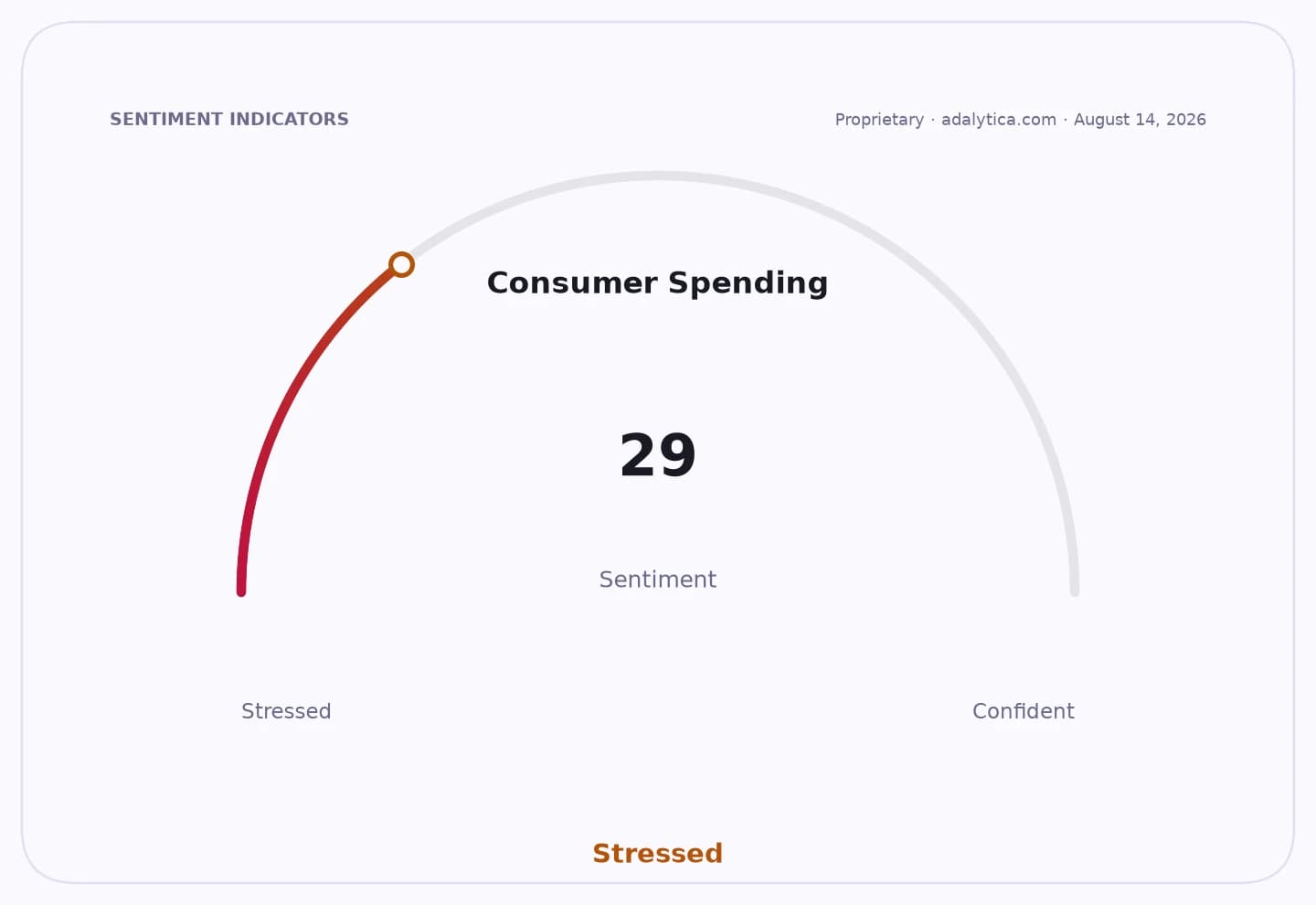
This is where the real investment opportunity lies. The market is underestimating the resilience of the aftermarket pricing cycle and over-focusing on near-term consumer caution. Adalytica’s Consumer Spending Sentiment gauge is at 29, in “Fear,” yet awareness remains elevated, suggesting buyers are still highly engaged even as sentiment deteriorates. In plain English: consumers may feel worse, but they still need to fix their cars. That is a powerful setup for the best-positioned chains, distributors and manufacturers with scale, pricing discipline and inventory control.
For investors, the winners are the companies that can hold gross margin while preserving traffic. O’Reilly looks like the highest-quality compounder in the group, Advance Auto offers turnaround leverage if pricing stabilizes, and Motorcar Parts remains a more speculative way to play parts inflation and replacement demand. The losers are the players stuck between rising costs and price-sensitive customers, where margin compression can quickly erase sales gains.
If the current pattern holds, this is not just a short-term trade in auto parts. It is a multi-year setup tied to an aging vehicle fleet, sticky repair inflation and the consumer’s continued dependence on essential maintenance. In that environment, investors should stay with the toll roads of the auto economy, not the vulnerable names that have to eat the cost.
| Entity | Gains | Losses |
|---|---|---|
| O’Reilly Automotive | ▲Pricing power and traffic | ▼Cost inflation |
| Advance Auto Parts | ▲Margin recovery potential | ▼Weak consumer sentiment |
| Motorcar Parts of America | ▲Replacement-demand tailwind | ▼Core and goods cost pressure |
| Consumers / DIY buyers | ▲Access to repair supply | ▼Higher parts bills |