Belgium lets Fluvius plan gas network phaseout by 2050
Belgium’s move to let Fluvius prepare for a full natural gas network phaseout by 2050 is a structural hit to one of Europe’s most entrenched energy businesses, accelerating a transition that will eventually reshape utility capex, fuel demand and the economics of heating.
The significance is bigger than a single network operator. Natural gas has long been treated as a bridge fuel in Europe, but a formal path to eliminate it from homes and businesses turns that bridge into a runway to obsolescence. That matters for investors because it changes the valuation logic across utilities, pipeline-linked assets and gas suppliers, while opening a multi-decade opportunity set in electrification, grid upgrades, heat pumps and energy-efficiency equipment.
For Belgium, the policy gives Fluvius room to plan an orderly wind-down instead of defending assets that may become stranded. For the broader market, it reinforces a message already being heard from regulators across the continent: the endgame for distributed gas is not expansion, but managed retreat. That is economically important because gas networks are capital-intensive and slow to depreciate. Once policymakers start signaling a 2050 phaseout, long-lived infrastructure no longer looks like a safe annuity, but a shrinking asset base that must be monetized before demand erodes.
The market implications are clearest in Europe’s utility complex. Gas distributors and incumbent energy companies face a longer period of uncertainty over tariff recovery, replacement investment and the pace at which customers abandon gas boilers. At the same time, electricity infrastructure should gain a durable tailwind as heating demand shifts to the grid. In practice, that means more spending on transmission, distribution automation, storage and flexible generation — the toll roads of the new energy system.
The pricing action in natural gas underscores how fragile the old model has become. UNG, the U.S. natural gas ETF, has been volatile and recently traded at $10.54, below its 200-day moving average of $11.61, even as shorter-term momentum improved. XLE, the energy equity ETF, has held up far better, with shares at $65.93, well above both its 50-day and 200-day moving averages. That divergence reflects the market’s preference for oil-linked cash flows over pure gas exposure, and it suggests investors are already discounting a less certain long-term role for gas in developed markets.
The bigger trade is not just what loses, but what replaces it. I believe investors should see the natural gas phaseout as a secular capital-allocation signal, not a niche utility headline. The winners are likely to be grid operators, electrification names, building retrofit plays and companies supplying the equipment that makes gas displacement possible. The losers are the owners of slow-moving pipes, legacy heating systems and gas-dependent demand chains that depend on a political consensus that is now breaking down.
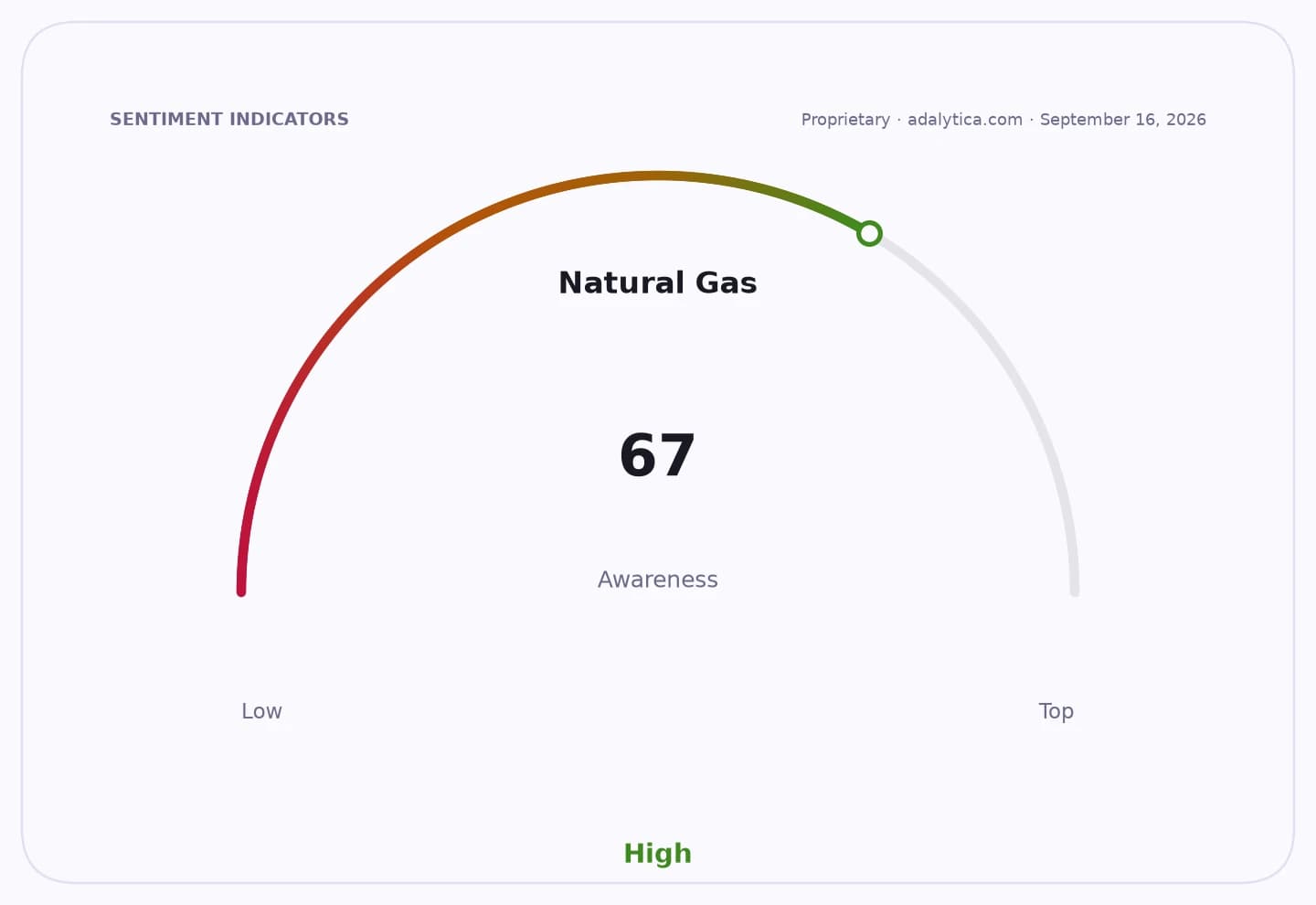
Adalytica’s natural gas trade signals show sentiment improving to 68, but that is still only neutral; by contrast, the structural policy backdrop is deteriorating for gas infrastructure even if short-term trading stabilizes. Geopolitical risk is also elevated, with Adalytica’s global stability gauge at an extreme-fear reading of 4, which only strengthens the case for energy systems that are more local, electrified and resilient.
The investable takeaway is straightforward: this is another reminder that the energy transition is not abstract policy rhetoric. It is a multi-decade capital reallocation story, and the market is still underestimating how much value can migrate from gas pipes to power grids, efficiency and clean-heating supply chains. The best positioning is to own the infrastructure of replacement, not the infrastructure being retired.
| Entity | Gains | Losses |
|---|---|---|
| Fluvius | ▲planning clarity | ▼legacy gas volumes |
| Grid and electrification firms | ▲multi-year capex tailwind | ▼none material |
| Gas distributors/pipeline owners | ▲limited transition revenue | ▼stranded-asset risk |
| UNG / gas bulls | ▲short-term volatility trading | ▼long-term demand outlook |