Big Tech earnings to test AI capex discipline
Meta, Microsoft, Amazon and Apple are about to test the market’s most important assumption: that the biggest platforms can keep funding an AI spending spree without breaking margins, free cash flow or investor patience.
That matters because the Magnificent Seven have become the market’s main capital engine. If the largest tech names can still translate AI capex into durable earnings growth, they can justify higher valuations and keep drawing passive and active money away from the rest of the market. If they cannot, this year’s leadership trade starts to look crowded, expensive and vulnerable.

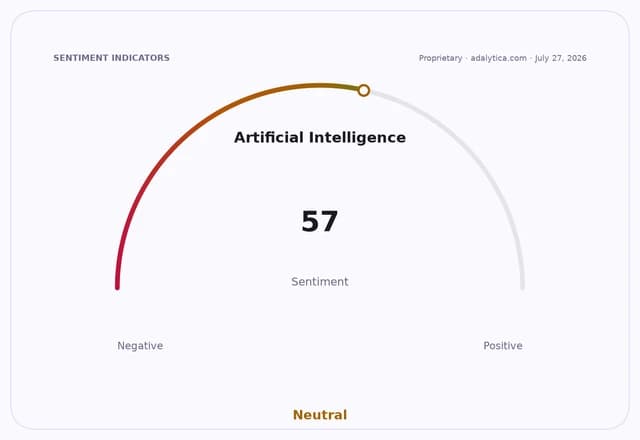
Microsoft is the clearest pressure point. Adalytica’s Microsoft earnings sentiment gauge sits at just 4, or extreme fear, even as awareness is at 96, showing investors are highly focused on the print but deeply uneasy about what it may say on AI spend, cloud growth and margin discipline. The stock has also been trapped below its 200-day moving average, which points to a market that still wants proof rather than promises. That is exactly where the thesis gets interesting: when expectations are this split, even a modestly better-than-feared result can reset sentiment fast.
Meta enters with a different setup. The stock has bounced hard from spring lows and is still trading above both its 50-day and 200-day moving averages, a sign that investors continue to reward its ability to turn advertising scale into cash while funding AI infrastructure. But the stock’s recent pullback from the upper end of its range shows the market is no longer willing to pay up blindly. Traders want evidence that Meta’s AI investments are improving engagement and ad pricing, not just swelling expense lines.
Amazon is the other key tell. The shares remain above the 200-day moving average but below the 50-day, a classic “show me” signal for a company whose cloud business and retail margin story are being judged against rising AI spend. Investors are watching whether AWS can accelerate enough to offset pressure elsewhere, especially after a year in which the market has rewarded pure AI infrastructure plays more than platform names that must also fund logistics, fulfillment and retail complexity.
Apple is the odd one out, and that may be the point. It is less about AI data-center capex and more about whether a slow-growth hardware giant can keep defending its ecosystem, services margin and installed base at a time when the whole sector is being priced around the next compute cycle. Apple earnings will matter because the company is still a major index weight and a cash-flow anchor; if it disappoints, the market loses one of its most reliable defensive supports.
The bigger economic story is that the AI race is no longer just a technology narrative. It is a balance-sheet story. Microsoft, Meta and Amazon are pouring money into compute, talent and infrastructure, and investors are now asking a tougher question: who earns the return on all that capital, and how quickly? The answer will ripple through semiconductors, data-center real estate, power utilities, networking and software vendors that have ridden the same wave. The winners are no longer just the companies selling AI dreams. They are the ones that can convert AI investment into operating leverage.
That is why this week can move more than individual stocks. A clean set of earnings from the biggest spenders would validate the entire AI capex cycle and keep the trade broad. A miss, especially from Microsoft or Amazon, would likely force a rotation toward cash-rich defensives and away from the most crowded growth names. With broad-market sentiment already fragile, the bar for disappointment is low and the payoff for upside surprise is high.
My view is simple: the market underestimates how quickly the earnings gap will widen between AI infrastructure winners and companies merely exposed to AI enthusiasm. If these giants prove that spend is turning into growth, the rally can extend. If not, the leadership trade narrows fast. For investors, this is the moment to favor the picks-and-shovels of AI infrastructure over the most expensive platform names — and to be ready for a sharp repricing if this week’s earnings show that the AI boom is outrunning its profits.
| Entity | Gains | Losses |
|---|---|---|
| Meta | ▲AI ad upside and cash flow leverage | ▼Margin skeptics if spend rises too fast |
| Microsoft | ▲Cloud and AI monetization credibility | ▼Bulls if capex disappoints |
| Amazon | ▲AWS acceleration and operating leverage | ▼Retail margin pressure and capex drag |
| Apple | ▲Ecosystem durability and cash flow support | ▼Investors seeking AI growth leadership |