Big Tech faces higher regulation, AI capex costs

Big Tech’s public image is turning into an investment problem, and the market is already pricing that shift into the biggest U.S. technology names.
ORF’s premiere of “The most dangerous companies in the world – Big Tech” arrives as investors confront a more concrete reality: the dominant platform companies are facing heavier regulation, rising compliance costs, and a fresh wave of capital intensity tied to AI, cybersecurity and infrastructure. That combination matters because it threatens the one thing the market has long paid up for in mega-cap technology — high margins, predictable growth and fortress-like returns on capital.

The warning signs are showing up in the tape. The Nasdaq 100 tracker QQQ has rebounded to $718.70, but it is still trading below its 50-day moving average near $713.66, with the 200-day average much lower at $647.84. That tells you the mega-cap complex is stabilizing, not resolving, after a violent reset. Microsoft, one of the sector’s bellwethers, has surged back to $501.45 after collapsing as low as $352.83 in late June, but its RSI reading of 86.0 points to an overheated bounce rather than a clean new uptrend. XLK, the tech sector ETF, has recovered to $186.13 from $166.57 in late July, yet the broader backdrop remains one of sharp swings and elevated valuation sensitivity.
The market underestimates how much the next phase of AI will be about spending, not just software leverage. Microsoft’s latest filing says governments are actively enforcing competition laws across the U.S., Europe, the U.K. and China, while Alphabet has flagged stronger regulatory scrutiny around AI and data use. Meta, Amazon and Apple are making similar disclosures about antitrust, platform rules and operating constraints. That matters because regulation does not just dent sentiment; it can slow product rollouts, raise legal costs and force business-model changes at the exact moment companies are pouring billions into AI data centers, chips and network buildouts.
This is where the investable story gets interesting. The market is still trying to value Big Tech as if it were a pure-margin software and advertising franchise, but the new regime looks more like a capital-intensive utility with political risk attached. That should compress multiples for the platforms over time, even as it creates an opening for the companies selling the picks and shovels — semiconductors, power systems, cooling, networking, cybersecurity and data-center infrastructure. Investors should be thinking less about owning the entire Big Tech stack and more about owning the bottlenecks that Big Tech cannot scale without.
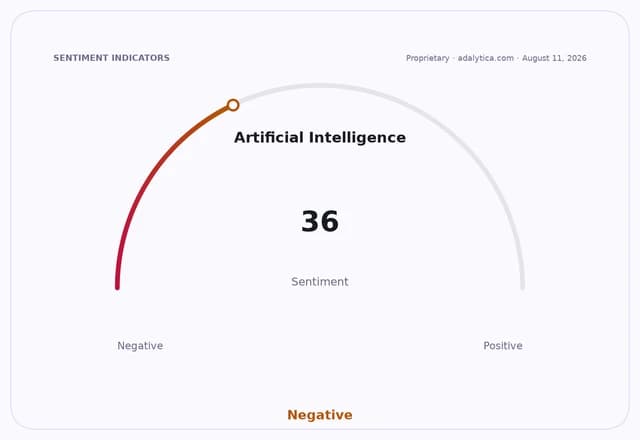
Adalytica’s AI sentiment snapshot also reinforces that tension. Awareness around AI remains at an extreme-greed level of 93, while sentiment itself is neutral at 36, suggesting the story is widely understood but not yet cleanly owned as a long-duration trade. In other words, the market knows AI is important; it has not fully adjusted for the regulatory and capital-cost burden that comes with it.
That leaves a clear setup into the next catalyst cycle. If Big Tech continues to be defined by antitrust scrutiny, geopolitical tension and escalating AI capex, the winners are likely to be the infrastructure and security layers underneath it — not the platforms themselves. For investors, that argues for selective exposure to AI enablers and away from the most crowded mega-cap names until the market proves that higher spending can still coexist with premium margins.
| Entity | Gains | Losses |
|---|---|---|
| AI infrastructure suppliers | ▲More capex demand | ▼N/A |
| Big Tech platforms | ▲Scale and data advantages | ▼Higher regulation burden |
| Cybersecurity firms | ▲Rising demand | ▼N/A |
| Mega-cap tech valuations | ▲N/A | ▼Margin compression risk |