Bitcoin ETFs Mirror Gold’s Adoption and Volatility Cycle
Bitcoin’s exchange-traded fund trade is looking increasingly like gold’s own long march from novelty to mainstream: powerful inflows can fuel a structural re-rating, but the same crowding that validates the product also leaves it vulnerable to sharp air pockets.
That is the core of the warning behind the “triumph and pain” comparison. Gold’s ETF era eventually helped turn bullion into a core portfolio asset, but the path was not linear — periods of surging adoption were repeatedly followed by violent drawdowns as positioning became stretched and macro support wobbled. Bitcoin is now showing the same duality. The token has rebounded to about $64,822 after falling as low as $62,702 earlier this year, yet it still trades well below its 50-day and 200-day moving averages, underscoring a market that has stabilized without fully repairing its longer-term trend damage.
For investors, that matters because the ETF wrapper changes who owns the asset, but not Bitcoin’s underlying volatility. The launch and rapid growth of products such as BlackRock’s IBIT made the market easier to access for institutions and advisers, and helped legitimize Bitcoin as a portfolio allocation rather than a speculative side bet. But the same ease of access can amplify selling when risk appetite reverses. IBIT has recovered from a slump to roughly $36.35, but remains far below its 50-day average of $38.66 and 200-day average of $46.47, a sign that the ETF complex is still working through earlier deleveraging.
The comparison with gold is especially relevant because gold itself has been through this cycle. GLD, the largest gold-backed ETF, has shown that ETF adoption can create a durable bid over time, while also exposing the asset to fast sentiment swings. Gold’s own price path in the context data was marked by a strong run into early 2026, followed by a sharp pullback and then stabilization around the high-$300s. That pattern mirrors the broader thesis: ETF access can deepen liquidity and widen ownership, but it also encourages momentum trading and makes flows more important in the short run.
Bitcoin’s current setup suggests the market is caught between those two forces. Standard technical indicators show the token’s relative strength index at 57.7, recovering from oversold territory in February, while its MACD has turned marginally positive. That implies the near-term momentum has improved. But the bigger picture is less forgiving: Bitcoin still sits roughly 30% below its 200-day average of $73,158, which means long-duration investors have not been rewarded for simply buying the dip. The market is no longer in panic, but it is not yet in a confirmed uptrend either.
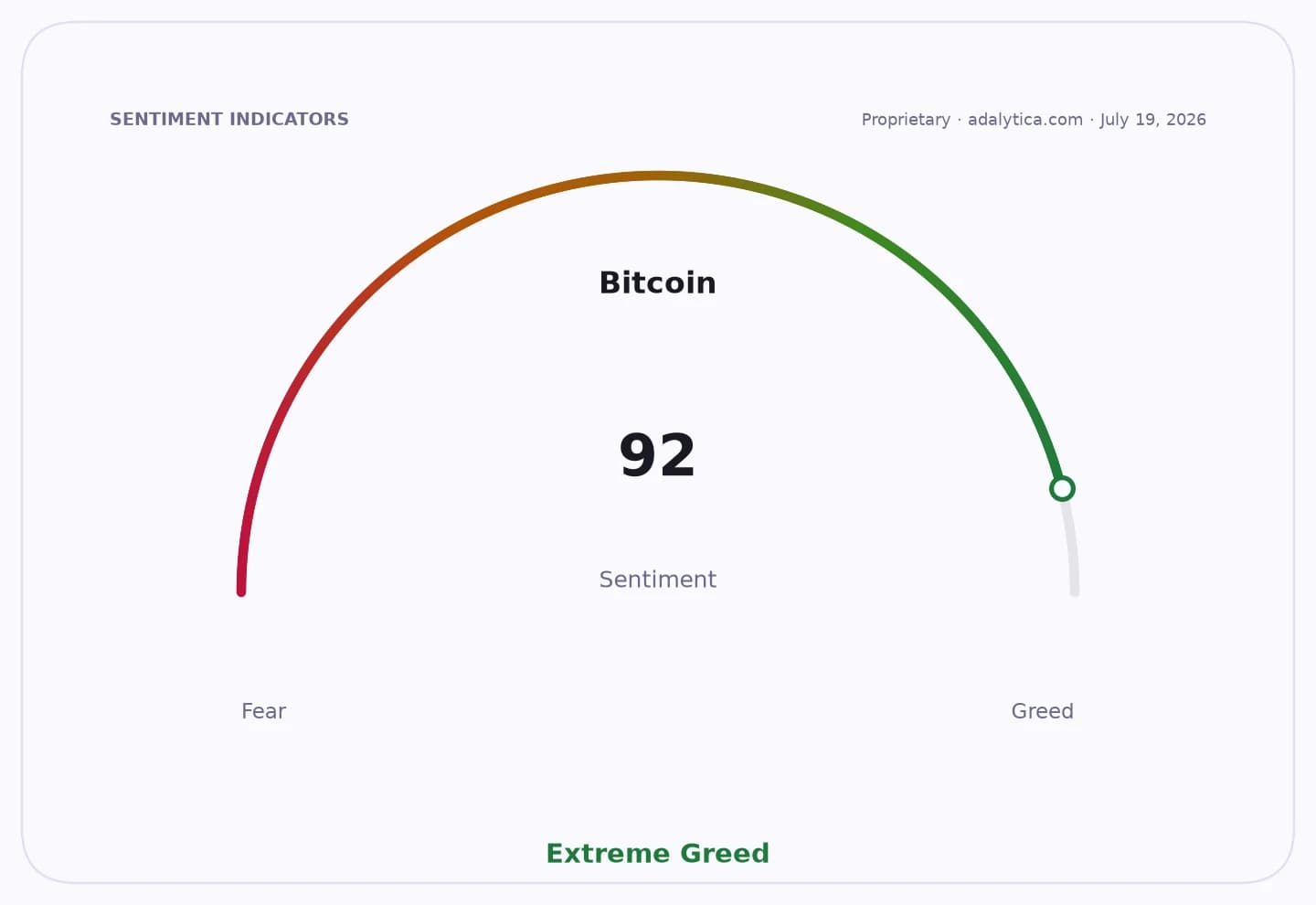
That tension also explains the mixed investor psychology captured by Adalytica’s Bitcoin Fear & Greed Index, which reads 92, or “Extreme Greed,” even as its awareness gauge remains in “Extreme Fear” territory at 10. In practice, that suggests a market with intense speculative interest but fragile conviction — a combination that often appears near inflection points, not durable equilibrium. In other words, Bitcoin may be benefiting from the same broad adoption dynamics that helped gold, while also inheriting the boom-bust reflexes that come with ETF-driven access.
The regulatory backdrop adds another reason for caution. Authorities are tightening rules on leveraged ETFs after losses and volatility in single-stock leveraged products, a reminder that policymakers are becoming more sensitive to retail risk-taking across exchange-traded structures. While those measures are not aimed directly at spot Bitcoin ETFs, they reinforce a broader theme investors cannot ignore: as products grow more popular, regulators tend to scrutinize them more closely, especially when flows and volatility spike together.
The bull case is straightforward. If Bitcoin continues to gain credibility as a reserve-like or alternative-asset allocation, ETF ownership could steadily compress the gap between crypto and mainstream portfolio construction, just as gold ETFs did for bullion. The bear case is equally familiar. If macro conditions tighten, speculative positioning unwinds, or risk assets stumble, ETF ownership could accelerate the downside as easily as it amplified the rally.
For now, the lesson from gold is not that Bitcoin ETF adoption is failing. It is that the path to permanence is rarely smooth. The market may eventually reward the product’s triumph; investors should be prepared for the pain that often comes with it.
| Entity | Gains | Losses |
|---|---|---|
| Bitcoin ETF issuers | ▲Higher assets under management | ▼Lower fee revenue if inflows slow |
| Long-term allocators | ▲Easier market access | ▼Short-term volatility risk |
| Momentum traders | ▲Upside from flow-driven rallies | ▼Sharp reversals on de-risking |
| Regulators | ▲More oversight leverage | ▼Less flexibility for product growth |