Bitcoin Rises as Inflation and Rates Stay Elevated
Bitcoin is back behaving less like a momentum trade and more like a macro asset, and that matters because rising inflation and higher-for-longer interest rates are making the case for holding scarce, non-sovereign stores of value more compelling.
The cryptocurrency closed at $85,790 on Sept. 22, up from $81,143 a day earlier and more than 25% above its Feb. 5 trough of $62,702, even as the U.S. 10-year Treasury yield hovered around 5% and the federal funds rate sat at 3.63%. That combination is the point: when nominal yields rise but inflation also stays sticky, investors start looking for assets that are not tied to central bank balance sheets or political promises. Bitcoin is increasingly being treated that way.
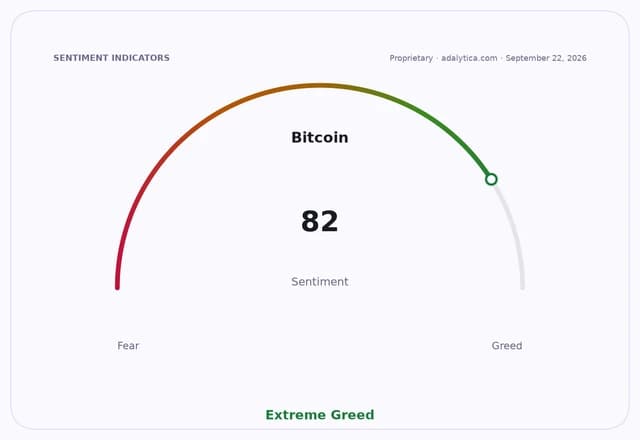
That shift is showing up in the tape. Bitcoin’s 50-day moving average has climbed to $74,117 and sits well above the 200-day average of $70,671, while the relative strength index has reached 69.5, close to overbought territory but still consistent with strong trend demand. On Adalytica’s Bitcoin Fear & Greed Index, sentiment stands at 82 and awareness at 80, both in “Greed,” suggesting the move is being chased rather than doubted. In other words, the market is not just recovering — it is repricing Bitcoin as a macro hedge again.
The macro backdrop explains why shorting Bitcoin is becoming a harder trade. The CPI series shows U.S. prices still elevated at 334.131 in August, while the policy rate remains restrictive but is no longer rising fast enough to crush every risk asset indiscriminately. In that environment, Bitcoin has an argument that many speculative names do not: it is finite, global, and outside the banking system. If inflation expectations firm while real yields fail to rise in tandem, the marginal buyer of Bitcoin is likely to see the asset less as a casino chip and more as monetary insurance.
The other crucial development is rotation. The seed idea that “speculative money left for AI” is not a throwaway line; it is the market’s hidden setup. Capital that once chased everything crypto is now splitting between AI infrastructure, data-center power, and hard assets that can survive a policy mistake. That helps explain why Bitcoin can strengthen even while some crypto-linked equities remain more volatile. MicroStrategy, the most levered proxy for Bitcoin, has jumped to $168.50 from $132.25 on Sept. 17, while Coinbase rose to $201.05 from $173.97 over the same stretch. Investors are not abandoning the space; they are concentrating around the highest-conviction balance-sheet and infrastructure winners.
The economic significance is bigger than crypto itself. If Bitcoin can hold above $80,000 while rates are still elevated and inflation remains uncomfortable, then the market is telling you that monetary debasement is becoming a live investing theme again. That matters for gold, for inflation-linked securities, for Bitcoin miners, for custodians, and for any institution still debating whether digital scarcity belongs in a reserve-style portfolio. It also matters for the U.S. dollar, which Adalytica’s trade signals show at “Extreme Greed” on sentiment but “Extreme Fear” on awareness — a warning that policy confidence can reverse faster than consensus expects.
For investors, the opportunity is not to chase every crypto bounce. It is to own the picks-and-shovels of the next monetary hedging cycle while it is still being discounted. Bitcoin itself remains the cleanest expression of the thesis, but the secondary winners are the platforms, custodians, and leveraged balance-sheet holders that benefit when institutional demand returns. The risk is obvious: if real yields spike hard or liquidity tightens further, Bitcoin can still unwind quickly. But the broader trend is becoming harder to ignore.
The market is moving toward a simple conclusion: in a world of sticky inflation, rising rates, and competing claims on capital from AI and hard assets, Bitcoin is no longer being priced purely as speculative beta. It is being tested as a reserve asset. If that re-rating holds, the next leg higher may come from investors who were too early on the short side and too late on the hedge.
| Entity | Gains | Losses |
|---|---|---|
| Bitcoin | ▲Reserve-asset demand | ▼Short sellers |
| BTC-Linked Equities | ▲Leverage to renewed inflows | ▼Passive holders |
| U.S. Dollar | ▲Safe-haven bids near term | ▼Credibility if inflation sticks |
| Inflation Hedges | ▲Higher allocation demand | ▼Cash and nominal bonds |