Bitcoin and other digital assets bounced on Wednesday after Democrats won control of both houses of Congress, but the real story is that Washington may now be a less friendly place for the next phase of crypto’s regulatory push.
Bitcoin Falls on Regulatory and Security Concerns

That matters because the industry has spent the last two election cycles trying to buy influence on both sides of the aisle, betting that lighter-touch rules would accelerate institutional adoption, stablecoin use and exchange-traded product growth. Instead, the market is confronting a tougher mix of political uncertainty, a record security scandal and weaker risk appetite, and that combination is still driving capital out of the asset class.
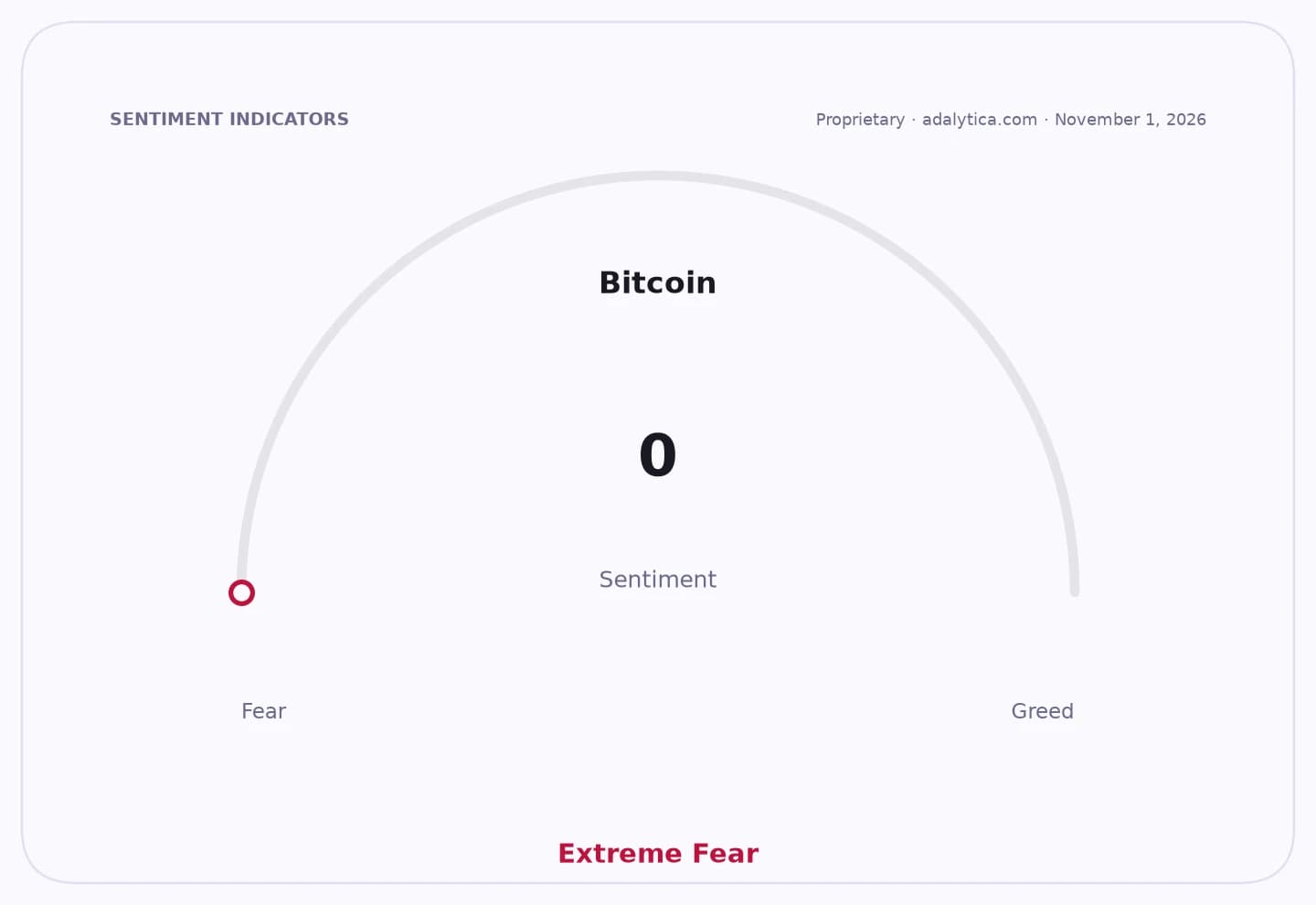
Sentiment Indicators
Bitcoin
Bitcoin rose 0.7% to $78,354 after briefly touching a six-week low, while ether gained 1.4% to $2,323. Smaller tokens including sol, dogecoin and ada also recovered, tracking a broader rebound in US stocks, where futures were up 0.3% after sliding as much as 2% overnight. The move suggests crypto remains tightly tethered to the same macro forces steering equities: falling risk appetite, higher borrowing costs and a rotation into safer assets.
Even so, the backdrop remains fragile. Bitcoin is down about 41% from its record above $122,000 in October 2025, and the broader crypto market has shed roughly $300 billion in value over the past month, according to the data cited. Bitcoin-backed exchange-traded funds saw $215 million in October outflows, taking year-to-date redemptions to $1.84 billion, while last week’s $6 billion Binance hack sparked the largest weekly ETF outflow since early July. Binance customers have also withdrawn a net $4.72 billion since the exchange reopened at the weekend, underscoring how fast trust can vanish in a market built on custody confidence.
For investors, that creates a sharper split than the headline bounce suggests. A friendlier Congress under Democrats does not automatically mean faster crypto legislation, and it may actually slow the push for the kind of market structure rules institutions have been waiting for. At the same time, the post-hack selloff is forcing the market to price in a more basic issue: whether centralized exchanges and related tokens deserve premium valuations at all when security risk is still existential.
The opportunity, in our view, is not in chasing the most battered speculative coins. It is in positioning for the beneficiaries of the next phase of crypto’s institutionalization — regulated exchange platforms, custody infrastructure, compliant stablecoin rails and firms that help large investors hold digital assets safely. If Washington eventually delivers clearer rules, the winners will be the businesses that can scale with oversight rather than fight it. If it does not, the market’s current rebound will prove just another bear-market squeeze.
| Entity | Gains | Losses |
|---|---|---|
| Bitcoin and ether | ▲Short-covering rebound | ▼Regulatory overhang persists |
| Crypto-friendly infrastructure firms | ▲Possible compliance-led inflows | ▼Slower legislative progress |
| Centralized exchanges like Binance | ▲Trading activity recovery | ▼Security scrutiny and withdrawals |
| Crypto ETF issuers | ▲Potential dip-buying demand | ▼Ongoing redemption pressure |