Bitcoin Rises to $86,909 Amid High Rates
Bitcoin’s rebound to about $86,909 shows why even a long-running inflation and rate-tightening cycle has not broken demand for the world’s largest cryptocurrency — but it also underlines why new investors need to treat it as a high-volatility position, not a shortcut to inflation protection.
Higher borrowing costs and tighter liquidity have historically been a headwind for speculative assets, yet Bitcoin is still trading with enough momentum to keep drawing retail and institutional attention. The token rose 1.05% in 24 hours in the Indonesian-language source cited, while in broader market data it climbed to $86,908.51 on Sept. 21, well above its 50-day moving average of $73,677 and 200-day moving average of $70,585. That technical positioning suggests the uptrend remains intact, even as the relative strength index reached 70.5, a level that often implies the asset is approaching overbought territory.
For investors, the key issue is not whether Bitcoin can keep rising in a high-rate environment, but whether they can survive the drawdowns that typically accompany it. The asset’s history of 70% or larger declines from peak levels is why financial planners continue to recommend dollar-cost averaging, small portfolio weights and the use of “cold” money rather than funds needed for living expenses or debt service. In practical terms, a 5% Bitcoin allocation that falls 70% would shave 3.5 percentage points off total portfolio value, assuming other holdings are unchanged — manageable for some, but still painful for households with weak cash flow or no emergency reserve.
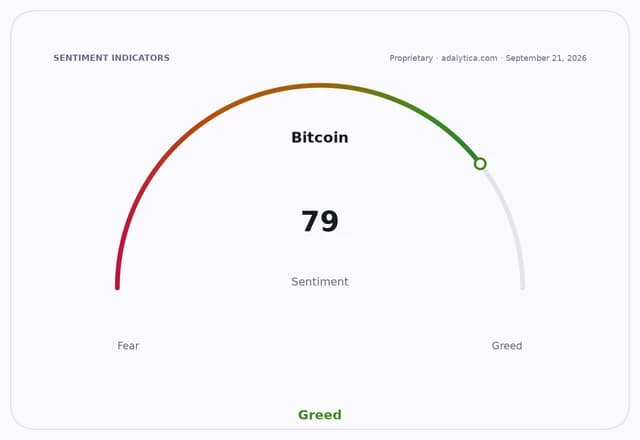
That matters economically because Bitcoin is now large enough to influence risk appetite across parts of the market. Its market capitalization was about $1.53 trillion in the Indonesian source, with daily turnover around $30.34 billion, making it a meaningful destination for capital when investors are hunting for upside in an environment where rates remain elevated and traditional assets face pressure from sticky inflation. Adalytica’s Bitcoin Fear & Greed reading at 79, firmly in “Greed,” points to improving risk sentiment, but also to the possibility of crowded positioning after a strong run.
The argument for buying now is that Bitcoin has become increasingly embedded in the broader liquidity trade. If inflation stays persistent and central banks slow or pause rather than reverse policy quickly, some investors will still view Bitcoin as a scarce asset with long-duration appeal. The bearish case is the opposite: a sustained high-rate regime can keep pressure on speculative capital, and Bitcoin’s own volatility can overwhelm thesis-driven buying, especially for newcomers tempted by recent gains.
That is why the most relevant lesson for investors is less about timing the next price move and more about portfolio construction. Bitcoin can fit in an aggressive allocation, but only after cash flow is stable, emergency savings are in place and higher-interest consumer debt is gone. In a market where sentiment can swing quickly and technicals can turn stretched, the better question is not whether to chase Bitcoin, but how much risk a portfolio can absorb if the next correction is violent.
| Entity | Gains | Losses |
|---|---|---|
| Bitcoin buyers using DCA | ▲Lower timing risk | ▼Missed upside if price runs |
| Existing Bitcoin holders | ▲Higher portfolio value | ▼Risk of sharp reversal |
| Conservative households | ▲Capital preserved | ▼Less exposure to upside |
| Central banks / rate hawks | ▲Inflation-fighting credibility | ▼Slower risk-asset demand |