Bank of America’s latest quarter is set to show whether the powerful rally in big US banks is being justified by fundamentals or has already outrun them.
BofA Earnings to Test Bank Rally
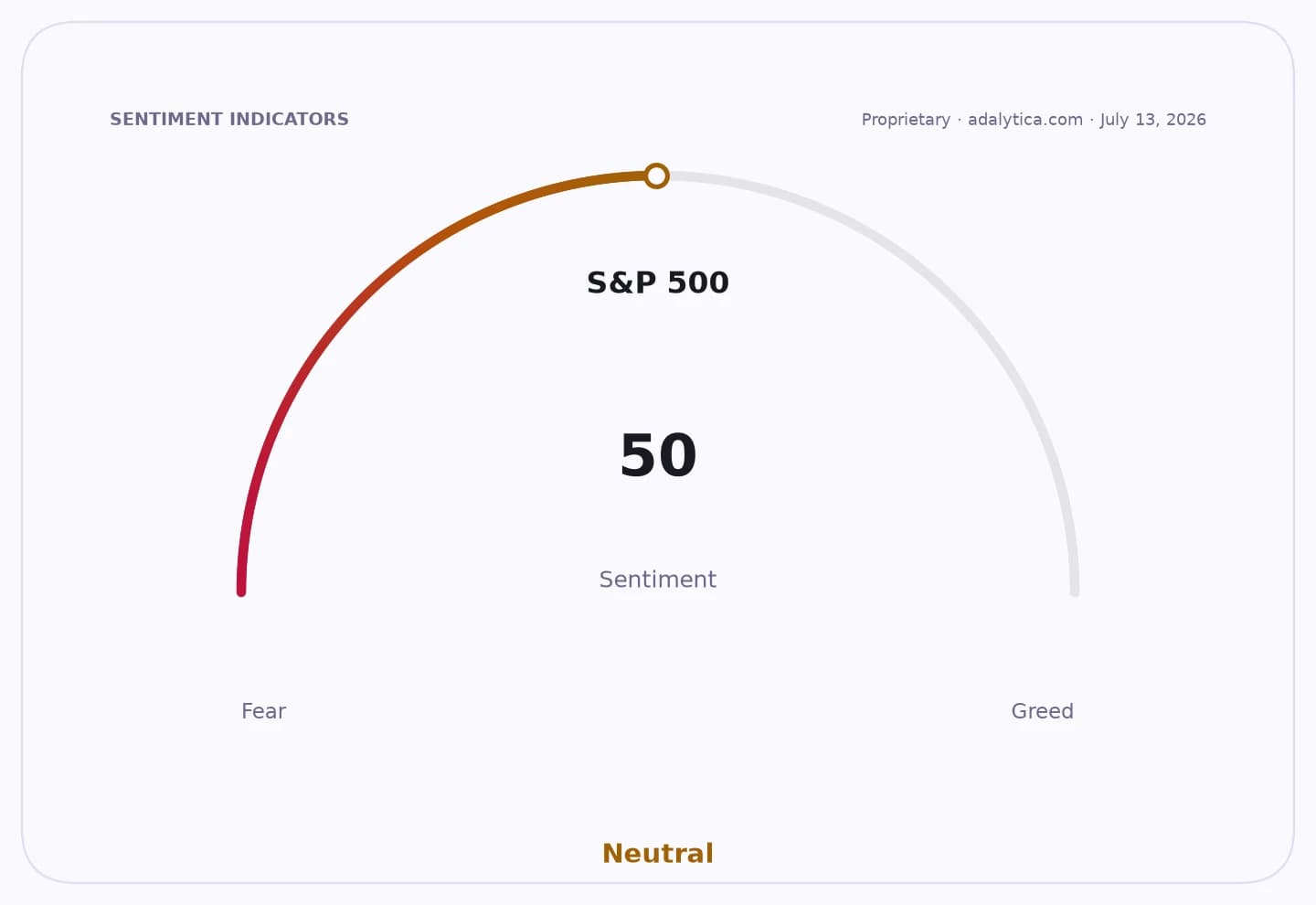
The stakes are high because Bank of America, alongside JPMorgan Chase and Wells Fargo, has been one of the key beneficiaries of a sharp rebound in financial stocks this year. BAC shares are trading near $60, up from about $46 in mid-August, and the move has been accompanied by improving momentum on conventional technical gauges such as the 50-day and 200-day moving averages. But the broader backdrop is less forgiving: US Treasury sentiment tracked by Adalytica has deteriorated sharply, suggesting bond-market nerves are rising as investors reassess the path for rates and growth.
Sentiment IndicatorsⓘProprietary · adalytica.com · July 13, 2026
This is a snapshot — live sentiment, awareness and momentum for 130+ markets update continuously in the dashboard.Open AlphaPulse
For Bank of America, that mix matters economically because the bank is especially sensitive to the spread between lending yields and deposit costs. A strong quarter would indicate that net interest income is still holding up even as the rate cycle matures and customers keep shopping for better deposit returns. A weaker report would raise questions about whether the industry’s earnings power has already peaked, particularly if loan demand softens or funding costs stay sticky.
The market is already telling a story of confidence. BAC has outperformed the wider market this year, while JPMorgan has climbed even faster and Wells Fargo has also gained steadily, underscoring how investors have gravitated toward the large US lenders with the scale to defend margins and return capital. JPMorgan’s shares are up to the mid-$330s from below $300 late last year, while Wells Fargo has recovered into the high-$80s after a steep spring selloff. That relative strength suggests the sector is being priced for durable profitability, not just a cyclical bounce.
Investors will be watching Bank of America’s consumer banking franchise, deposit trends and capital return plans especially closely. The bank’s first-quarter filing showed consumer banking income improving, and home-equity production rising, signs that the domestic lending engine still has life. The question now is whether that momentum has extended into the second quarter and whether the bank has been able to protect returns without leaning excessively on one-off trading or market gains.
There is also a broader macro message in the report. If Bank of America confirms healthy earnings and stable credit quality, it would support the view that US households and businesses remain resilient even as financial conditions tighten. If it disappoints, it could reinforce a more cautious narrative already visible in the Treasury market: growth is cooling, the easy part of the banking rebound is over and investors may need to pay more for earnings that are no longer accelerating.
For shareholders, the central issue is valuation. After the run-up, BAC no longer trades like a recovery story. It needs to show either stronger revenue growth, better expense discipline or a clearer path to capital returns to justify further upside. The bull case is that deposit franchises remain powerful and the bank keeps compounding book value. The bear case is that margins compress faster than expected and the stock has already discounted much of the good news.
What Bank of America says about this quarter will therefore matter well beyond one earnings print. It will help determine whether the latest rally in US banks is the start of a more durable re-rating or simply a late-cycle move vulnerable to any disappointment in lending, funding costs or the macro outlook.
| Entity | Gains | Losses |
|---|---|---|
| Bank of America shareholders | ▲Stronger earnings, capital returns | ▼Margin compression, softer guidance |
| JPMorgan Chase | ▲Relative strength if BAC underdelivers | ▼Sector-wide rerating if BAC impresses |
| Wells Fargo | ▲Validation of big-bank strength | ▼Stumbles if sector earnings weaken |
| Treasury bond bulls | ▲If banks signal slower growth | ▼If earnings confirm resilience |