Brazil Banks Cut Risky Lending as Debt Strains Grow

Brazil’s biggest lenders are pulling back from riskier credit just as household debt strains threaten to slow consumer spending and, by extension, the country’s broader growth engine.
That matters because Brazil’s banking system is one of the main transmission channels for economic momentum. When banks get cautious, loan growth cools, and when loan growth cools, households buy less, businesses hire less and earnings across the economy tend to lose steam. In a market that still leans heavily on domestic demand, this is more than a banking story — it is a read on the health of Brazil’s consumer economy.
The latest market action in Brazilian banks shows investors are already weighing that shift. Itau Unibanco, the country’s biggest private lender, has slipped to about 7.30 reais from 8.15 reais in late July, while Banco Bradesco has fallen to 3.10 reais from 3.73 reais. Santander Brasil, meanwhile, has held up far better, trading near 14.69 reais after a strong run earlier in the year, but even there the shares have cooled from recent highs. The message is familiar: investors are rewarding balance-sheet discipline, but they are not yet paying up for aggressive credit expansion.
The caution also fits the macro backdrop. U.S. rates remain elevated at roughly 4.7% on the 10-year Treasury and the Fed funds rate is still around 3.63%, a reminder that global financial conditions are not exactly loose. In Brazil, that kind of external backdrop adds pressure to funding costs and risk appetite, especially for lenders deciding whether to stretch further into unsecured consumer credit. Banks can trim rates at the margin, but they cannot force borrowers to take on debt they already fear may be too heavy.
What makes this especially important for investors is that the pullback in riskier lending may protect near-term asset quality, even as it caps upside in loan growth. That is a classic trade-off in banking. Cutting back on weaker credits can help preserve capital and reduce future losses, but it also leaves less room for revenue acceleration. For long-term shareholders, the key question is whether the banks are sacrificing a little growth now to avoid a much bigger credit cycle problem later.
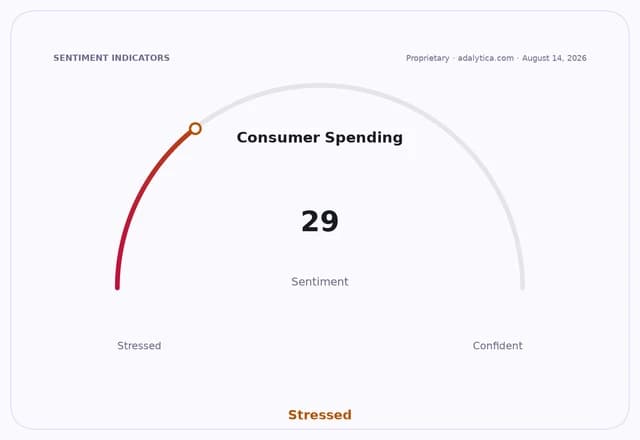
The consumer data argue that caution is warranted. Adalytica’s Credit Card Usage Sentiment sits at 64, neutral but still far below the kind of exuberance that usually supports a borrowing binge. More telling, Consumer Spending Sentiment is stuck in fear at 29, with awareness still elevated. In plain English, households may be spending, but they are doing so with a guarded hand. That is not the setup banks want if they are trying to expand riskier lending profitably.
The lenders themselves are telling a similar story in their filings. Bradesco has emphasized credit-risk mitigation and portfolio diversification, while Santander has highlighted the sensitivity of results to customer behavior and credit quality. Those are not throwaway disclosures; they are clues that management teams see a more fragile borrower than they did a year ago. When management starts talking more about underwriting discipline than growth, investors should listen.
For shareholders, the long-term takeaway is straightforward: this is a period to favor quality over volume. Brazil’s large banks still have powerful franchises, sticky deposit bases and the ability to compound over time, but the next leg of returns is more likely to come from careful risk selection than from a broad lending boom. If you own these names for the long run, the slowdown in risky credit is not necessarily a red flag — it may be the cost of keeping returns durable.
Worth watching, then, is not just whether loan growth reaccelerates, but whether household debt stops worsening first. Until that happens, Brazil’s big banks are likely to keep playing defense, and investors should probably prefer the lenders with the strongest underwriting and the most resilient capital.
| Entity | Gains | Losses |
|---|---|---|
| Big Brazilian banks | ▲Lower credit losses | ▼Slower loan growth |
| Households | ▲Less forced borrowing | ▼Tighter credit access |
| Investors in quality lenders | ▲Better asset quality | ▼Less near-term revenue upside |
| Riskier borrowers | ▲Fewer fresh loans | ▼Higher financing strain |