Bulgaria minimum wage talks face union resistance
Bulgaria’s push to set a minimum wage of 672 euros and above is running into early resistance, with a leading union chief warning that employers and labor are unlikely to reach agreement under the government’s new formula.
Dimitar Manolov, president of the KT Podkrepa trade union, said he was “not optimistic” that the social partners could strike a consensus on the new floor, underscoring the risk that Sofia will again be forced to arbitrate a politically sensitive wage decision. That matters because the minimum wage is not just a labor issue: it feeds directly into household purchasing power, wage inflation, payroll costs for employers and the government’s wider effort to contain living-cost pressures.
The dispute is centered on how Bulgaria will determine the minimum wage going forward. Under the new model, unions and employers are expected to try to agree first, with the cabinet stepping in if they fail. Manolov said the method proposed by the labor ministry is flawed, especially because it ties the wage to labor productivity. In his view, productivity should only be part of the calculation if workers also share in profits, arguing that employees should not bear the burden of broader production failures.
The comments highlight a familiar fault line in emerging European labor policy: governments want a rule-based formula that reduces political discretion, while unions fear productivity-linked mechanisms can cap pay increases even when inflation and living costs remain elevated. Employers, by contrast, typically favor formulas that restrain labor costs and protect margins, particularly in smaller firms with limited pricing power. The result is often a standoff that leaves the state as final arbiter anyway.
For investors, the stakes are most immediate in domestically exposed Bulgarian sectors — retail, food services, manufacturing and transport — where payroll costs can move quickly through operating margins. Higher minimum pay would support consumer spending at the lower end of the income scale, but it could also pressure small businesses already dealing with energy, financing and input-cost uncertainty. If the government has to impose the wage rather than secure a tripartite deal, that would signal a weaker social consensus and raise the chance of further labor disputes later in the year.
Manolov also questioned broader government measures aimed at easing fuel and price pressures, saying Bulgaria’s excise taxes are already relatively low and warning that intervention may not curb inflation. That skepticism fits a wider macro backdrop in which wage negotiations are increasingly being tied to the cost of living, even as policymakers try to avoid an inflationary wage-price loop.
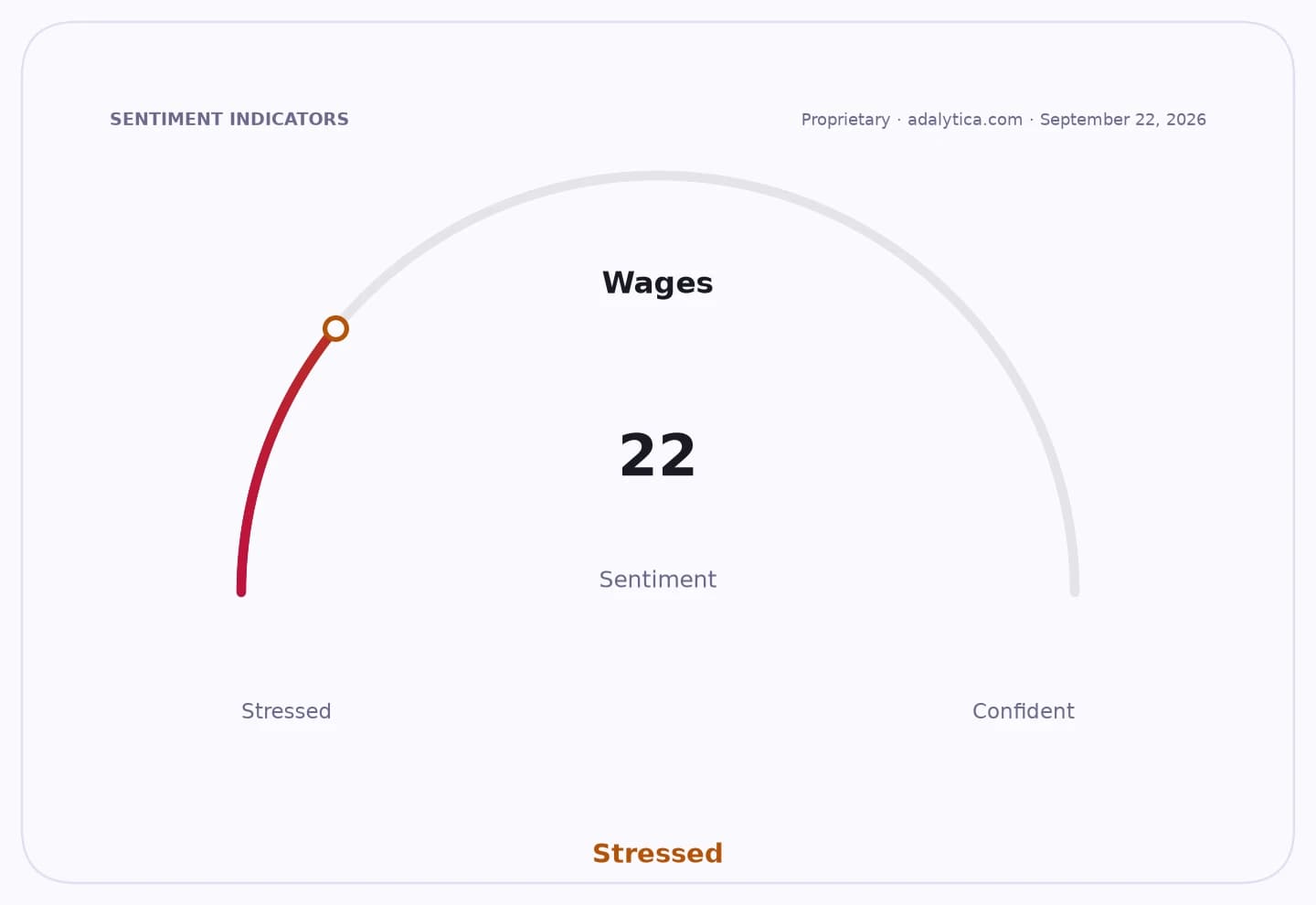
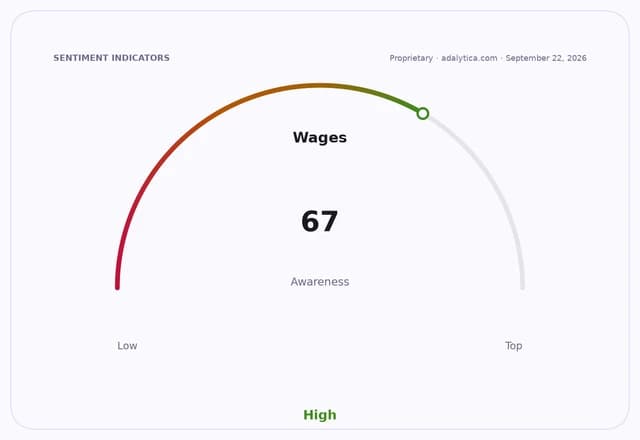
Adalytica’s Wage Inflation Sentiment gauge is in Fear territory, reflecting heightened tension around pay-setting, while its Nonfarm Payrolls Sentiment is in Extreme Fear, a sign that labor-market concerns remain elevated. Taken together, the signals suggest investors should watch not only whether Bulgaria lands above the 672-euro threshold, but whether the government can secure a durable formula that limits uncertainty for employers without provoking a broader wage push.
| Entity | Gains | Losses |
|---|---|---|
| Workers | ▲Higher pay floor | ▼Delayed wage settlement |
| Employers | ▲Wage restraint | ▼Higher payroll costs |
| Bulgarian government | ▲Policy control | ▼Political and social pressure |
| Retailers and small firms | ▲Predictable labor costs if talks fail | ▼Margin compression if wage rises |