Canada trade standoff tests Carney and Trump
Canada’s trade standoff with the Trump administration is becoming a test of how much pressure a far smaller economy can absorb before Washington feels the political cost.
The immediate issue is not whether Ottawa can match U.S. firepower — it cannot — but whether Mark Carney can keep Canada’s response selective enough to avoid a broader hit to growth while still showing voters and exporters that he is not folding. With the U.S. economy at about $31 trillion, roughly 13 times Canada’s size, the asymmetry in the fight is clear. But Canada sends about 75% of its exports to the U.S., which makes the dispute economically painful for both sides and politically useful for Carney as he tries to reduce dependence on a market that has become increasingly unreliable.
That dependence is exactly why the Canadian response has been calibrated rather than sweeping. Carney rejected Trump’s latest trade offer last month, prompting fresh tariffs from Washington, which Ottawa answered with retaliatory steps this week before Trump escalated again with new levies on Canadian alcohol and dairy products. Economists say a blanket response would be dangerous for Canada, but targeted measures can hit U.S. interests with limited damage at home. One example cited by economists is wine sales, where Ottawa can hurt American producers without a major backlash for Canadian consumers.
Investors are watching for two separate channels of risk. The first is growth: a prolonged tariff cycle would weigh on Canadian exports, investment and business confidence, while also feeding uncertainty into North American supply chains. The second is politics: Trump has repeatedly downplayed Canada’s importance, but the dispute is already spilling into U.S. domestic politics, with Republican senators in Maine and Kansas criticizing the pressure campaign as elections approach. That raises the odds Washington eventually moderates its stance if the trade fight starts to cost the GOP in battleground or vulnerable states.
The broader economic narrative is that Carney is using the confrontation to accelerate diversification. Ottawa is pushing a new pipeline to the Pacific to expand oil shipments to Asia, while Europe is emerging as the main external alternative. Carney is due in Strasbourg this month to become the first prime minister to address the European Union in that setting, underscoring how central Brussels has become to Canada’s effort to hedge against U.S. volatility. For markets, the key question is whether this turns into a contained tariff skirmish or a longer realignment of Canadian trade, energy and industrial flows.
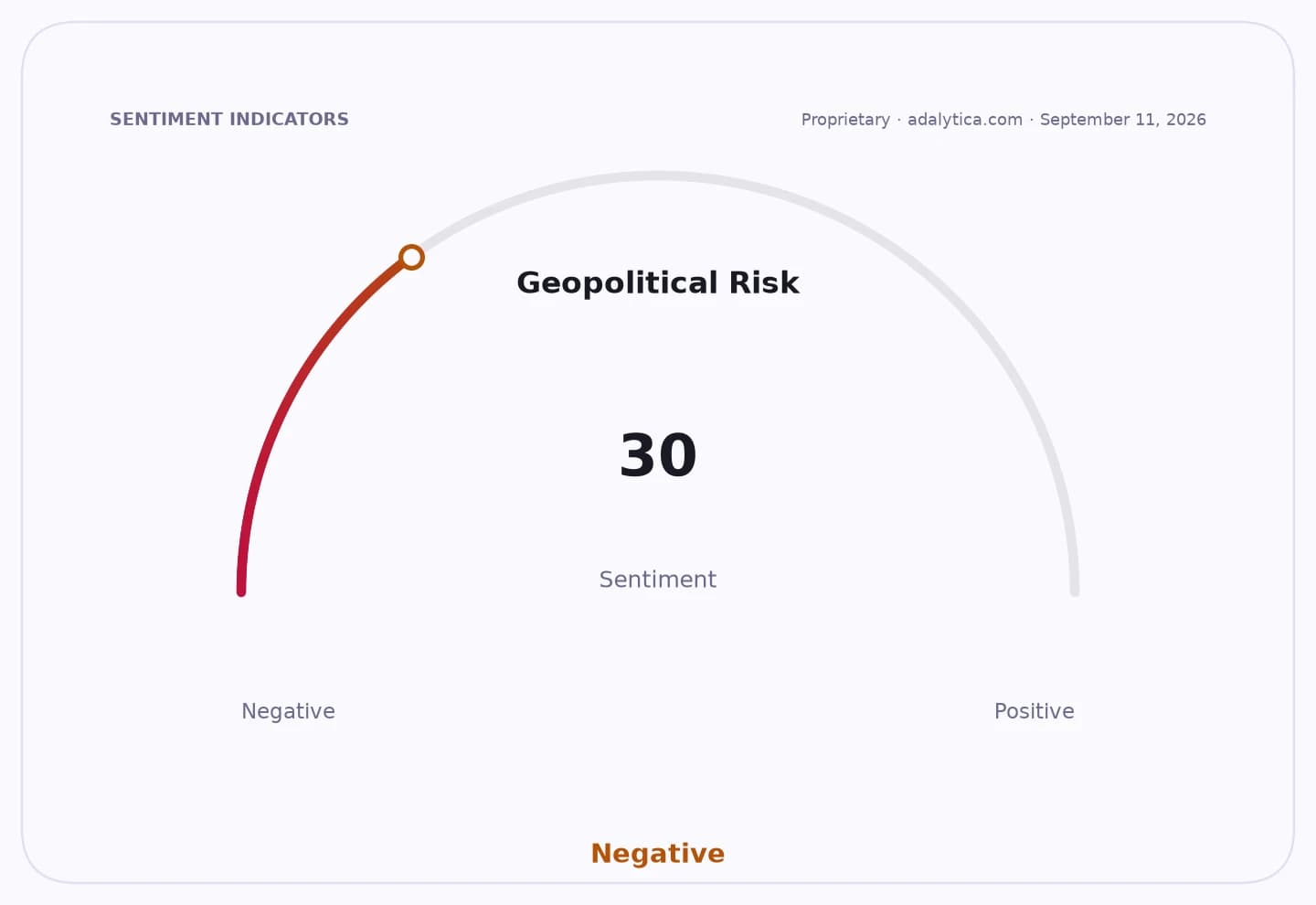
Bond and equity traders are also reading the dispute through a risk lens. U.S. Treasury yields remain elevated, with the 10-year around 4.83% and the 2-year near 4.43%, while the S&P 500 is still near record territory, suggesting markets have not priced a full-blown North American growth shock. The iShares 20+ Year Treasury Bond ETF was little changed around 80.86, with conventional technical indicators showing the fund still below its 200-day moving average and with RSI in the low 40s, a sign of cautious rather than panic positioning. Adalytica’s Global Stability Sentiment gauge remains in “fear,” reflecting how geopolitical stress is filtering through risk appetite even as U.S. equities hold up.
In the near term, the winner is less likely to be the side that inflicts the most pain than the one that can endure it longest without political damage. That gives Carney limited room to maneuver, but it also leaves Trump exposed if the dispute begins to cost Republican votes in states where Canadian trade and Canadian firms matter.
| Entity | Gains | Losses |
|---|---|---|
| Canada | ▲Diversification push | ▼Export dependence on U.S. |
| Trump administration | ▲Leverage in talks | ▼GOP political blowback |
| U.S. exporters | ▲None from escalation | ▼Tariffs on Canadian retaliation |
| Canadian consumers | ▲Targeted countermeasures | ▼Higher trade uncertainty |