Canadian Dollar Rises on Oil and Weak U.S. Dollar

The Canadian dollar is getting a lift from a two-sided macro tailwind: crude oil is pushing higher while the U.S. dollar is under heavy pressure, giving the loonie room to outperform even as longer-dated U.S. yields remain elevated.
That combination matters because Canada’s currency is among the most oil-sensitive major FX pairs, and the latest move in energy prices directly improves the country’s terms of trade, commodity export receipts and corporate cash flow across the resource sector. At the same time, a weaker dollar backdrop reduces the hurdle for CAD gains against the greenback, especially when market positioning turns away from U.S. assets.
West Texas Intermediate was last at $86.07 a barrel on Aug. 20, up from $84.94 two days earlier and forecast at $86.737 for Aug. 19 in the data set, a level that remains far above the spring lows and keeps Canadian energy producers firmly in a favorable pricing environment. Imperial Oil’s latest filing underscored the operating leverage: in the second quarter, WTI averaged US$92.69, up from US$63.69 a year earlier, while the company said higher commodity prices were the main driver of higher royalties.
For Canada, that kind of oil-price support tends to ripple beyond the producers themselves. Stronger crude prices feed through to export revenues, government royalties and the broader balance of payments, which in turn can support the currency even if domestic growth is uneven. The move also helps explain why FXC, the Canadian dollar ETF, has clawed higher to 70.71 from 68.76 in early July, while its 50-day moving average has turned up and the relative strength index is above 74, a sign of short-term momentum in the loonie.
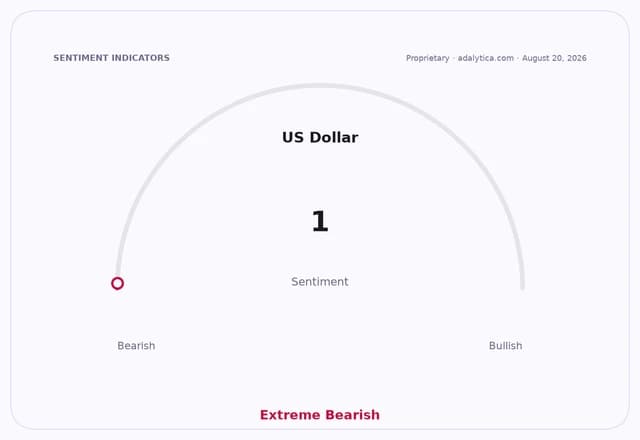
The U.S. side of the equation is equally important. The 10-year Treasury yield was forecast at 4.729% for Aug. 19, but the more immediate driver for FX is the sharp deterioration in dollar sentiment. Adalytica’s U.S. Dollar Trade Signals show sentiment at 1, labeled “Extreme Fear,” with awareness still elevated at 82, suggesting investors are alert to the dollar’s move even as conviction has flipped bearish. That dynamic lowers the chance of a sustained USD rebound and leaves commodity-linked currencies, including CAD, relatively better bid.
Still, the rally is not one-way. Canada’s currency remains vulnerable if oil retraces or if the Federal Reserve keeps U.S. yields elevated long enough to reassert dollar support. The 10-year Treasury yield near 4.7% is not a benign backdrop for risk-sensitive FX, and the loonie’s recent gain has pushed FXC close to its upper Bollinger Band, implying the move may be stretched in the near term.
For investors, the immediate question is whether the current setup marks the start of a broader CAD re-rating or just a tactical trade. Bullish cases depend on sustained oil strength and continued USD weakness; bearish cases rest on energy volatility, a tighter U.S. rates story and the possibility that CAD’s gains are already pricing in much of the near-term good news. The next catalysts will be crude’s ability to hold above the mid-$80s and whether U.S. dollar sentiment can recover from its extreme bearish reading.
| Entity | Gains | Losses |
|---|---|---|
| Canadian dollar | ▲Stronger terms of trade | ▼Importers paying USD |
| Oil producers in Canada | ▲Higher realized prices | ▼Consumers of fuel |
| U.S. dollar bears | ▲Momentum in FX markets | ▼Long-dollar positions |
| Canadian exporters | ▲Better commodity revenue | ▼Hedged revenue books |