Chaco SME Retail Sales Index July Forecast 674,837.9
Retail sales at Chaco’s small and medium-sized businesses are proving more durable than the broader consumer mood, giving Argentina’s local merchants a rare pocket of stability even as household spending remains under pressure.
The key significance is not that SME sales are surging, but that they are still expanding in an economy where consumers remain cautious and where retail demand has been one of the weakest transmission channels from any macro improvement. That matters because SMEs are the backbone of provincial employment, tax collection and supplier networks, especially in northern Argentina, where softer purchasing power tends to hit smaller stores first.
The latest reading in the SME Retail Sales Index points to continued growth, with the July forecast at 674,837.9, up 1.32% from June’s 666,056. The index has climbed steadily from 621,713 in December 2024 and 616,540 in May 2025 to 657,830 in April 2026, suggesting gradual rather than explosive recovery. In annual terms, the index remains above prior levels, but the recent pace has clearly moderated, underscoring that the sector is stabilizing more than accelerating.
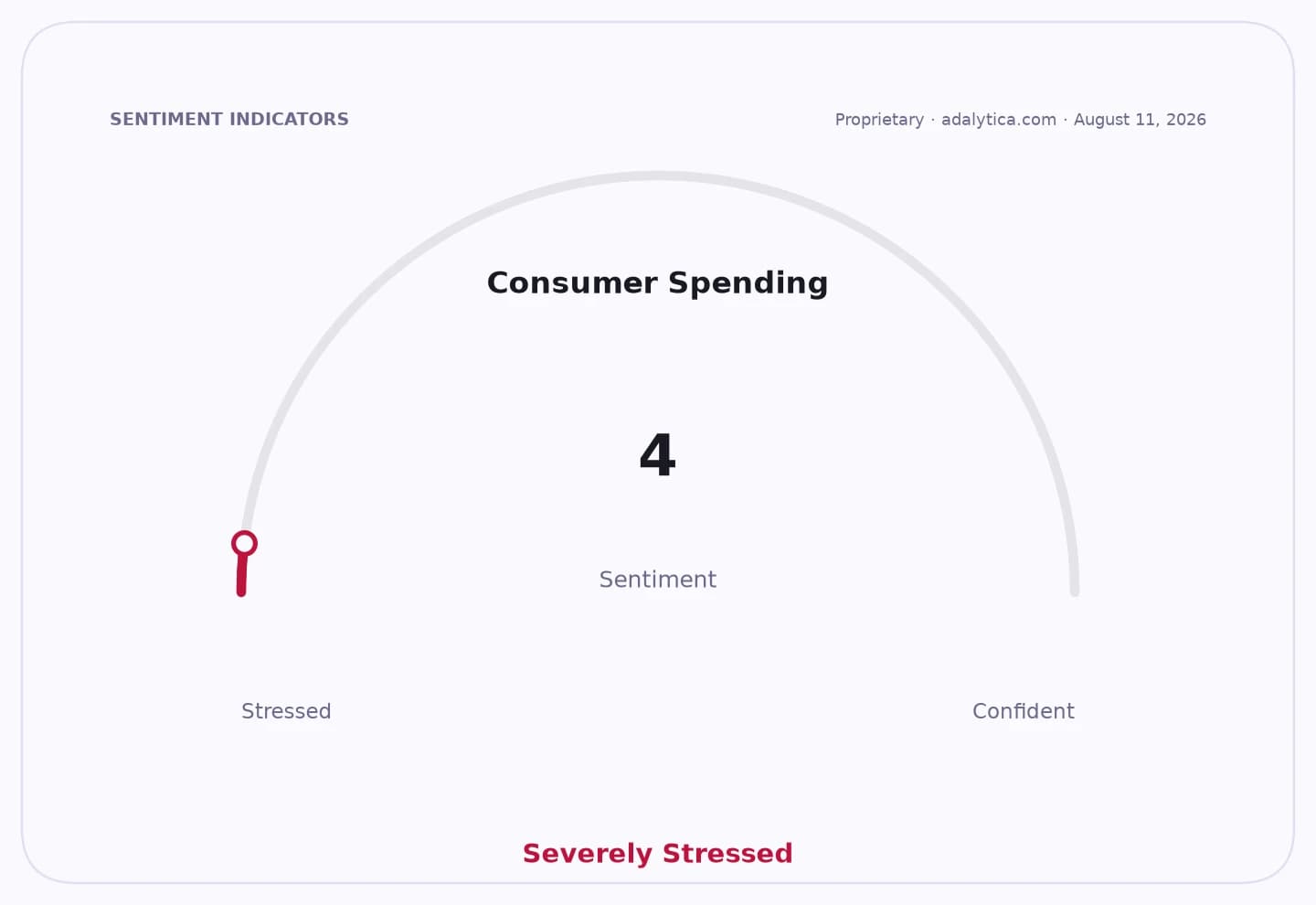
That resilience is important because it appears to be holding up even as consumer-spending sentiment has deteriorated sharply in Adalytica’s proprietary gauge, which shows “Extreme Fear” at 4.0 in the latest snapshot. By contrast, broader confidence readings have been volatile, and the gap between sentiment and actual retail activity suggests that forced spending needs, price normalization or selective household prioritization may be supporting sales in essential and lower-ticket categories.
For investors, the story matters less as a direct market catalyst than as a read-through on domestic demand, credit quality and the durability of Argentina’s small-business recovery. Banks and lenders exposed to SME clients, as well as listed retailers and consumer-facing firms, will want to see whether modest sales gains translate into better cash flow and lower delinquency risk. A sustained uptrend would support working-capital demand and inventory replenishment; a stall would reinforce the view that the recovery remains fragile and uneven.
The backdrop remains mixed. Equity markets have recently been stronger, with the S&P 500 trading near highs and showing conventional technical momentum on the 50-day and 200-day moving averages, but that global risk appetite is not the main driver of Chaco’s small-business economy. Local conditions — wages, inflation, financing costs and household purchasing power — are still the decisive variables.
FECHACO and CAME’s ratification of the index’s solidity therefore matters because it frames SME retail not as a one-off improvement, but as a sector that is holding together despite a weak consumer environment. The next test is whether August numbers confirm that the gain is broadening beyond a few categories or whether the index is merely grinding higher on a narrow base.
| Entity | Gains | Losses |
|---|---|---|
| Chaco SMEs | ▲steadier sales | ▼weak purchasing power |
| FECHACO/CAME | ▲evidence of resilience | ▼pressure to prove recovery |
| Consumers | ▲selective price stability | ▼constrained real spending |
| Banks/lenders | ▲better SME cash flow | ▼slower credit expansion |