China AI Firms Focus on Deployment and Monetization
China’s top artificial-intelligence companies are brushing off loud warnings from U.S. tech leaders and doubling down on a strategy the market may be underestimating: ship faster, control the risk, and make money from real-world deployment.
That divergence matters because it is no longer just a debate over safety rhetoric. It is becoming a geopolitical and commercial split in how the world’s two AI superpowers plan to win. In the U.S., executives such as Sam Altman, Elon Musk and Dario Amodei are calling for a slower pace of development. In China, companies from Alibaba and Tencent to start-up founders are largely staying quiet, while Beijing keeps tightening governance rules without slowing the race for applications.

The economic implication is straightforward. China is trying to turn AI into a productivity engine for industry rather than a prestige contest over the most advanced model. That is a different investment playbook. It favors infrastructure, cloud, power, chips, software integration and enterprise rollouts over headline-grabbing model launches. If Chinese AI firms can monetize faster, the payoff may come in enterprise efficiency and lower costs long before Western rivals can fully translate model quality into profits.
That is exactly why the silence from Chinese AI executives is so telling. Ray Von, founder of Tencent-backed OpenPie, dismissed the U.S. warnings as overblown and said Chinese firms are focused on deployment, not public hand-wringing. Another consultant, Alex Lu, said the real challenge is not building the “most impressive” model, but extracting value from AI in business workflows, where hallucinations and weak returns still limit adoption. In other words, China is treating AI less like a philosophical debate and more like an industrial rollout.
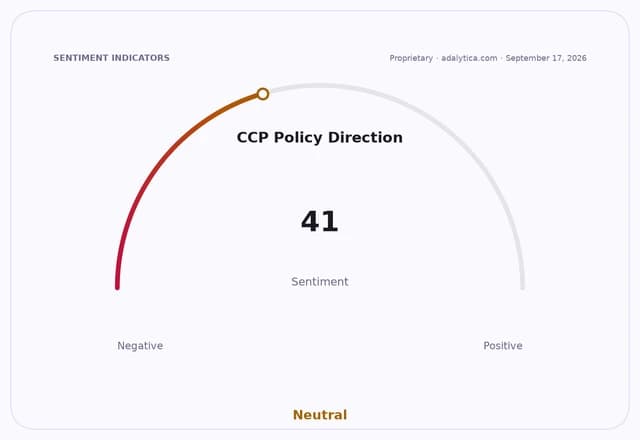
Beijing is backing that approach with regulation, not retreat. During Cybersecurity Week, authorities released a third version of their AI Safety Governance Framework, covering issues such as content labeling and rapid risk detection. The message is not that China wants unfettered AI; it wants AI under state control and aimed at economic output. That gives domestic champions a clearer operating lane than many investors assume, even as export controls and geopolitics complicate access to advanced U.S. hardware.
For investors, the key takeaway is that the market may still be pricing China AI too much like a policy risk and too little like an industrialization theme. The winners are likely to be the toll collectors in the stack: Alibaba, Tencent, Baidu and the surrounding ecosystem of cloud, data-center, power and semiconductor suppliers that enable inference and enterprise deployment. The losers are the companies and countries stuck in a slower monetization cycle, where safety debates delay usage while capex keeps climbing.
The stock tape already shows how much skepticism remains. Alibaba’s U.S.-listed shares have fallen sharply from recent highs, while Baidu and Tencent have also retreated from earlier strength, leaving valuation room if China’s AI spending cycle turns into actual enterprise adoption. Technicals look washed out in places, with Alibaba and Baidu both trading below their 50-day and 200-day moving averages and momentum readings weak, which often matters when a narrative is this depressed.
Our thesis is that the market underestimates the second-order effect of China’s AI stance: not a slower race, but a different winner’s circle. The U.S. may dominate the rhetoric on AI safety, but China is positioning to dominate the commercialization of AI inside a tightly managed economy. If that model works, the next leg of returns will come from the picks-and-shovels of AI infrastructure and the platforms that can turn models into revenue.
For investors looking for asymmetric exposure, the opportunity is to lean into the Chinese AI stack selectively, especially names tied to cloud, enterprise software and compute demand, while recognizing that the real catalyst will be proof of monetization rather than another round of model hype. The AI race is widening, and the biggest mistake would be assuming that the loudest warnings will determine who wins.
| Entity | Gains | Losses |
|---|---|---|
| Alibaba, Tencent, Baidu | ▲Enterprise AI uptake | ▼Safety-debate premium |
| AI infrastructure suppliers | ▲Higher capex demand | ▼Margin pressure from controls |
| U.S. AI safety hawks | ▲Public debate influence | ▼Pace advantage |
| Late adopters | ▲More time to react | ▼First-mover monetization |