China Tightens AI Specialist Travel Controls

China is tightening control over the movement of its artificial intelligence specialists, adding another layer to its technology confrontation with the West and raising the stakes for investors exposed to Chinese internet, AI and semiconductor names.
The new rules, announced by the State Council, give immigration and customs authorities broad discretion to question travelers, inspect mobile phones and deny exits if officials find “opaque or false” information. Foreigners who lie on visa documents can be barred from entry for one to five years, while Chinese citizens who left illegally or used fraudulent documents can be blocked from travel for six months to three years.
The move matters economically because Beijing is treating human capital as a strategic asset, not just an input. For AI companies, chipmakers and robotics firms, the ability to move engineers, founders and technical staff across borders has long been part of how knowledge, talent and deal flow circulate. By tying travel permission to national-security concerns, China is making that exchange more conditional and less predictable.
That has direct implications for the country’s technology sector. In June, some private-sector AI specialists were already told to clear overseas travel with authorities, a sign that the restrictions are extending beyond state workers and into the private companies driving China’s push in frontier models. The new framework appears to formalize that tighter grip, especially after Anthropic accused Chinese teams including Moonshot AI and DeepSeek of routing users to Claude and passing the answers off as their own. Beijing rejected the allegation as politically motivated, but the episode reinforced how sensitive access to advanced models has become.
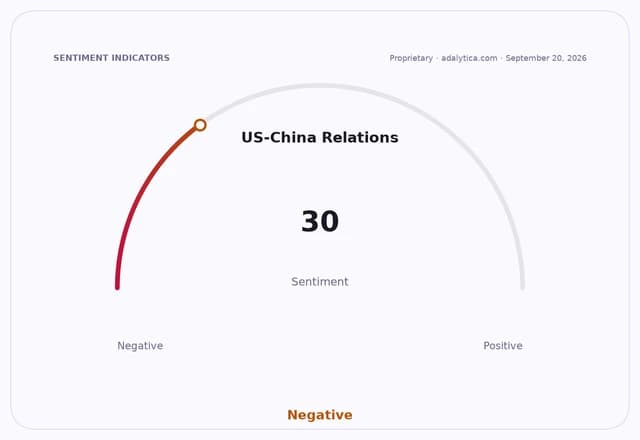
For investors, the story is less about a blanket shutdown than about selective friction. China is not closing its borders to business or tourism, but it is narrowing the path for people seen as critical nodes in AI, semiconductors and other strategic technologies. That raises execution risk for Chinese firms trying to recruit, collaborate and compete globally, while also complicating the outlook for Western companies dependent on Chinese demand or cross-border technical exchange.
The market backdrop reflects that unease. FXI, the iShares China Large-Cap ETF, was trading at $34.32 on Sept. 18, below its 200-day moving average of $36.28, with an RSI reading of 36.6 and a negative MACD signal — technicals that point to weak momentum. KWEB, the KraneShares CSI China Internet ETF, closed at $24.83, also below its 200-day average of $29.64, with an RSI of 32.6. Alibaba shares, meanwhile, finished at $113.24 after a sharp slide from earlier levels, underscoring how quickly sentiment can turn when policy risk intensifies.
The broader narrative is that China is moving from guarding technology with export controls to guarding it with people controls. That may help Beijing limit leakage in the short term, but it also risks making China’s innovation ecosystem more insular at a time when its companies need global access most. Investors will be watching for further guidance on enforcement, any expansion of travel limits to more sectors, and whether the new rules spill into trade, research partnerships or cross-border dealmaking.
| Entity | Gains | Losses |
|---|---|---|
| Beijing | ▲Tighter control over strategic know-how | ▼Openness and talent mobility |
| Chinese AI firms | ▲Better protection of proprietary work | ▼Easier global collaboration |
| U.S. tech rivals | ▲Fewer chances of tech leakage | ▼Access to Chinese engineers and market links |
| FXI / KWEB investors | ▲Possible policy clarity later | ▼Near-term China risk premium |