China Anti-Corruption Drive Shifts Policy Focus

The Communist Party of China has sharpened its disciplinary priorities for the second half of the year, reinforcing an anti-corruption drive that remains one of Beijing’s most important tools for controlling policy execution, public trust and financial risk.
That matters because a tighter enforcement push can change how money moves through the economy: it can curb graft and waste in state-linked sectors, but it can also make officials more cautious about approving spending, lending and investment. For investors, the message is that China’s policy backdrop is likely to stay more disciplined and less tolerant of excess, even as authorities try to stabilize growth.

The party meeting reviewed disciplinary work and set a roadmap for the months ahead, underscoring that the anti-corruption campaign is not being treated as a one-off political slogan but as a continuing governance priority. In practical terms, that keeps pressure on local governments, state enterprises and regulated industries to show cleaner procurement, tighter compliance and more transparent use of funds.
Markets have already been sensitive to that balance. China-focused exchange-traded funds have moved in uneven fashion, with FXI, which tracks large Chinese stocks, ending at 35.86 on Aug. 21 after trading as high as 40.34 earlier in the year, while MCHI closed at 55.66. BABA, one of the biggest private-sector bellwethers, fell to 119.34 from 130.53 the prior session, showing how quickly sentiment can swing when China policy headlines hit at the same time as investors are already parsing growth and regulatory risk.
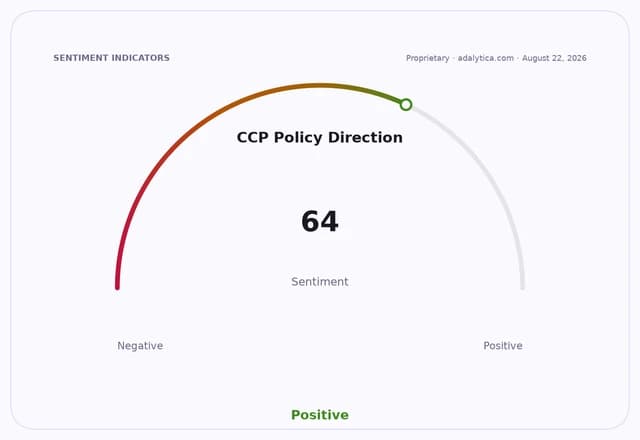
The broader backdrop suggests the crackdown is being used to project control at a time when Beijing wants to keep economic targets credible without unleashing a large, disorderly stimulus cycle. Adalytica’s China Economic Growth Target Sentiment gauge stands at 86, labeled “Extreme Greed,” while its China CCP Policy Direction Sentiment is 64, “Neutral,” after a sharp one-day decline. That combination points to a market still hoping for supportive policy, but less certain that officials will deliver broad-based easing if it conflicts with discipline.
For investors, the bull case is that cleaner governance can improve capital efficiency over time, reduce leakages in state spending and eventually support higher-quality growth. The bear case is that a more aggressive disciplinary environment can freeze decision-making, slow project approvals and keep risk premiums elevated for Chinese equities, especially in sectors with heavy government involvement or opaque financial flows.
What to watch next is whether the anti-corruption drive stays targeted at obvious abuses or broadens into a deeper reordering of incentives across local government and corporate China. If it remains narrowly focused, markets may treat it as background noise. If it starts to reshape spending, credit and regulatory behavior more materially, it will become a central variable for China assets into year-end.
| Entity | Gains | Losses |
|---|---|---|
| Central leadership | ▲stronger control | ▼policy slippage |
| Reform-minded investors | ▲cleaner governance | ▼slower approvals |
| State-linked sectors | ▲compliance credibility | ▼higher scrutiny |
| Chinese equities | ▲lower corruption risk | ▼higher execution uncertainty |