China Backs Argentina on Malvinas Sovereignty Claim

China’s endorsement of Argentina’s sovereignty claim over the Malvinas Islands adds another layer to a long-running territorial dispute, but the bigger economic significance lies in how Buenos Aires is using major-power alignment to reinforce its diplomatic position without jeopardizing trade ties with Beijing.
The statement from China’s ambassador in Argentina, Wang Wei, tied support for the Malvinas claim to Beijing’s own “one China” doctrine on Taiwan, a reminder that territorial issues are increasingly being used as reciprocal diplomatic currency. For Argentina, that linkage is useful: it broadens international backing for its position in multilateral forums while preserving access to one of its most important commercial partners.

China remains Argentina’s second-largest trading partner, its biggest buyer of agro-industrial exports and a meaningful source of investment, giving Beijing real leverage in the relationship. That makes China’s public support more than symbolic. It strengthens Argentina’s hand in the diplomatic campaign over the islands and signals that the issue still has resonance in the G77, the wider Global South and other regional blocs that have repeatedly called for talks between Buenos Aires and London.
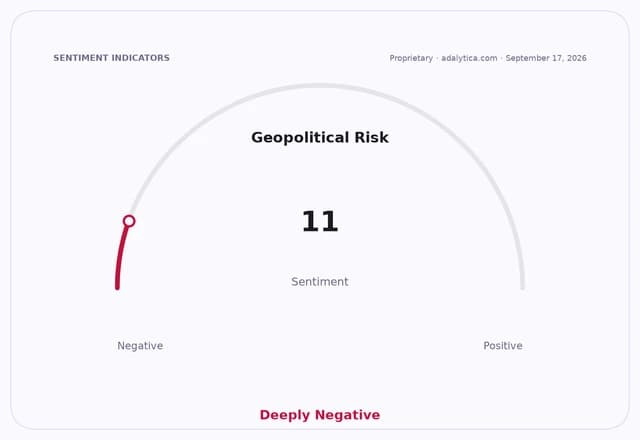
For investors, the message is less about a near-term market catalyst than about geopolitical risk management. Argentina’s economic strategy depends heavily on external financing, commodity demand and foreign capital, and its relationship with China is central to all three. A public Chinese show of support for Malvinas may help Argentina’s government domestically and diplomatically, but it also underscores the country’s dependence on balancing competing powers, especially as relations with the United States and the United Kingdom remain sensitive.
The history of the dispute matters here. The Malvinas issue has long drawn support from Latin America, parts of Asia and Africa, but most countries stop short of explicitly recognizing Argentine sovereignty, preferring language that acknowledges a dispute and urges negotiations. China’s backing therefore adds weight, but not a decisive shift in legal reality. The UK still controls the islands, and Washington has historically avoided formally siding on sovereignty.
The investor angle is clearest in sectors exposed to China-Argentina trade, especially agriculture, mining and infrastructure. Any stronger political alignment with Beijing could be positive for exporters and firms seeking Chinese capital, while adding friction for policy makers trying to diversify financing sources. The broader risk is that sovereignty disputes become more entangled with commercial relationships, raising the cost of diplomatic missteps.
For now, the main takeaway is that China is signaling support where it can do so cheaply and strategically, while Argentina gains another voice in a dispute where symbolism often matters as much as law. The durability of that support, and its impact on trade and investment, will depend on how far Buenos Aires is willing to lean into a foreign policy that increasingly reflects the rivalry between Washington and Beijing.
| Entity | Gains | Losses |
|---|---|---|
| Argentina | ▲Diplomatic backing | ▼Limited legal change |
| China | ▲Influence in Latin America | ▼Added geopolitical exposure |
| UK | ▲— | ▼More multilateral pressure |
| Argentine exporters | ▲Stronger China ties | ▼Higher policy dependence |