China ETFs Fall Below 200-Day Averages
Zhu Rongji, the former Chinese premier who helped turn the country into a global trading powerhouse, has died at 97, and his legacy still matters for investors because the export-driven model he championed remains central to China’s economy and to the balance of power in world trade.
For long-term investors, Zhu’s importance was never just political. He helped push through the reforms that made China a manufacturing engine, deepened its integration with global supply chains and laid the groundwork for the export boom that reshaped everything from consumer electronics to industrial metals. That model lifted growth, built corporate scale and helped create the China exposure that still sits inside emerging-market portfolios, index funds and multinational earnings today.
The market today is showing that China exposure remains a live question, not a historical footnote. The iShares China Large-Cap ETF, FXI, has slipped to 35.66, below its 200-day moving average of 36.87, while the broader China ETF, MCHI, closed at 55.62, also under its 200-day average of 58.15. Even the leveraged YINN, often a proxy for traders betting on a sharp China rebound, fell to 30.07 from 32.3 a day earlier. Those moves do not tell the whole story, but they do reflect how investors continue to wrestle with China’s growth path, policy mix and geopolitical risk.
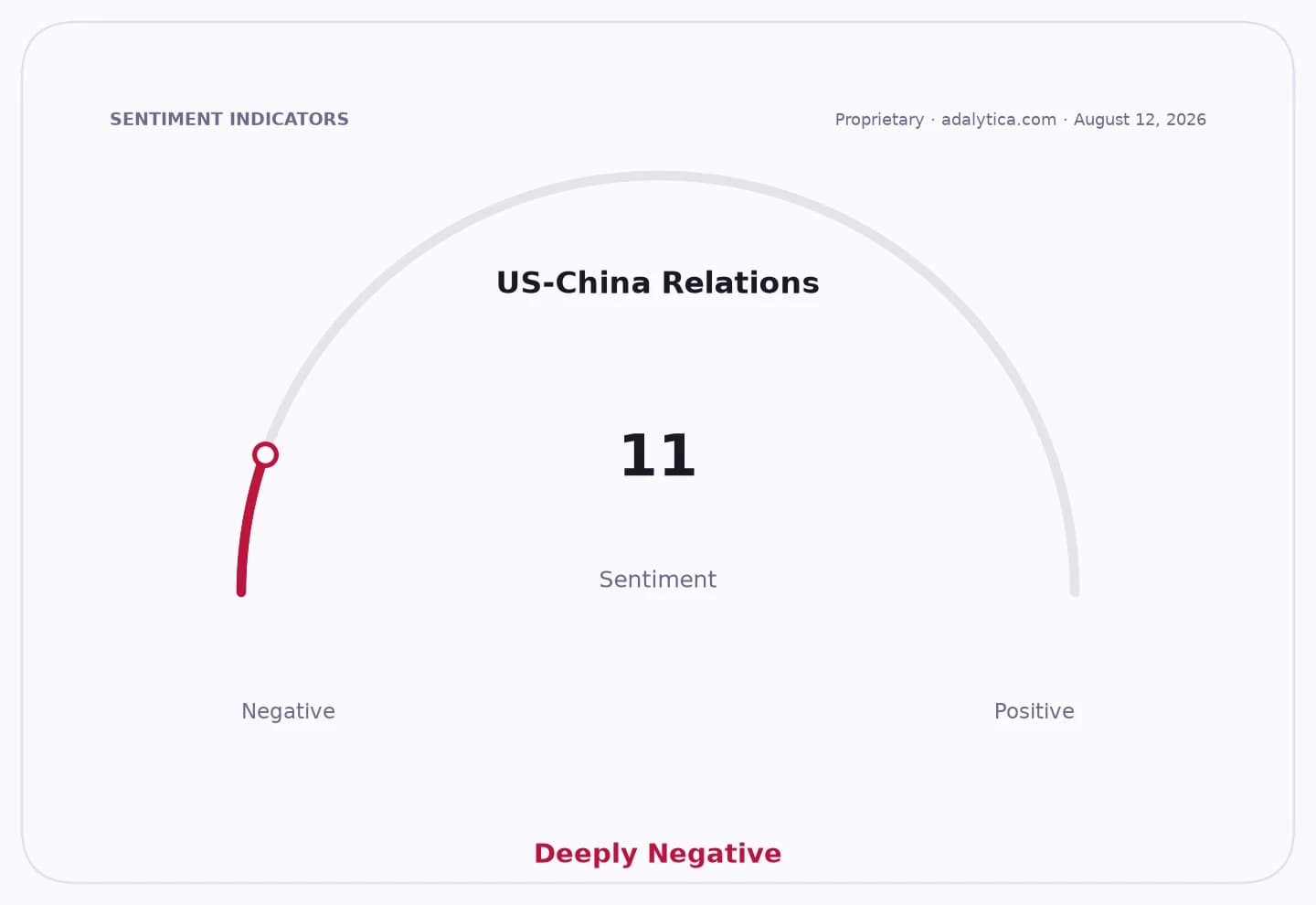
That tension is exactly why Zhu’s legacy remains economically relevant. China’s trade model built extraordinary scale, but it also left the country exposed to tariff fights, sanctions and demand swings abroad. Adalytica’s US–China Relations Sentiment gauge shows “Extreme Fear,” underscoring how quickly politics can affect capital flows, supply chains and valuations. When US-China relations sour, exporters, importers and multinational manufacturers all have to rethink their assumptions, and that can hit earnings far beyond China itself.
There is also a bigger macro lesson here. China’s rise as a trading giant helped hold down global goods prices for years, supported corporate margins and gave investors access to a vast new growth market. At the same time, it intensified competition, widened trade frictions and increased the importance of policy decisions in Beijing. That is why Zhu’s death is not just an obituary story; it is a reminder that one of the most consequential economic transformations of the past half-century still shapes portfolios, commodity demand and industrial strategy.
For investors, the takeaway is straightforward: China remains too big to ignore, but it is no longer a simple growth story. The best approach is patience, diversification and a clear-eyed view of risk. If you own China exposure, keep it as part of a broader portfolio rather than a single big bet, and think in years, not weeks. Zhu Rongji helped create the system that powered China’s ascent. The question for investors now is how much of that old export machine can still compound in a more contested world.
| Entity | Gains | Losses |
|---|---|---|
| China exporters | ▲Trade scale and market access | ▼Tariff and sanction risk |
| Global consumers | ▲Cheaper manufactured goods | ▼Less stable supply chains |
| China ETFs | ▲Rebound potential on policy support | ▼Geopolitical and growth uncertainty |
| US-China rivals | ▲Strategic leverage | ▼Business confidence and margins |