China court rejects gold-based loan revaluation

A Chinese court has rejected a man’s bid to recast a 140,000 yuan loan into a claim on 400 grams of gold, underscoring a basic legal distinction that matters for lenders, borrowers and anyone using bullion as a value benchmark: if cash changed hands, the debt is cash, even when it was raised by selling gold.
The ruling from a court in Liaoning province closed the door on an argument that a rising gold price should let the lender demand repayment at today’s bullion value, which he said had climbed to about 300,000 yuan from the 140,000 yuan he actually transferred to a friend in 2022. The case matters because it draws a bright line in civil law between a loan of money and a loan of metal, a distinction with direct consequences for contract enforcement, collateral structures and disputes in volatile commodity markets.

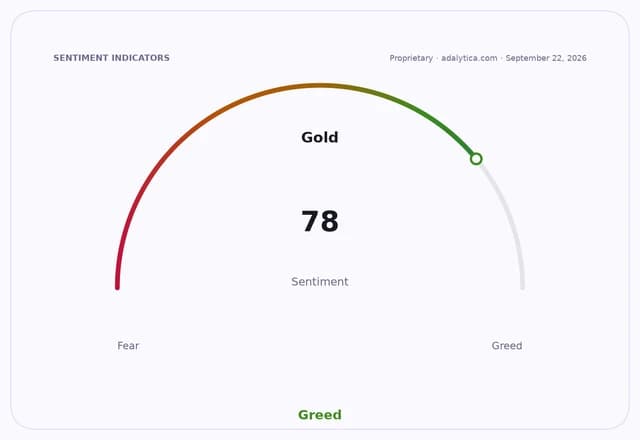
Gold’s surge has made that distinction more valuable. Front-month U.S. gold futures are trading around $4,384.8 an ounce, with the 50-day average near $4,330.7 and the 200-day average around $4,554.2, while Adalytica’s Gold Fear & Greed Index shows sentiment at 78, or “Greed,” even as awareness remains low. The move has also lifted bullion-backed products such as SPDR Gold Shares and iShares Gold Trust, which traded around $398.38 and $81.67 respectively on Sept. 21. That price backdrop helps explain why the lender tried to reframe his loss in metal terms after gold appreciated sharply.
But the legal logic cuts the other way. The court said the object of the loan must be judged by what was actually delivered between the parties, and in this case the lender sold his bars first and then wired yuan to the borrower. Gold was the funding source, not the thing lent. A later handwritten note referring to a 400-gram gold debt was not enough to override the original cash transaction, the court found.
That distinction matters well beyond one friendship gone bad. In China, where gold is both an investment asset and a store of value for households, people often reference bullion prices when settling private debts or informal financing arrangements. If courts were willing to let lenders reprice past cash loans to current bullion values, it would create a moving target for repayment and add legal uncertainty to private credit. By refusing that approach, the court effectively preserved nominal repayment terms and reduced the scope for windfall claims tied to commodity inflation.
For investors, the case is a reminder that gold’s price may be soaring, but legal claims tied to it are only as strong as the contract behind them. The bullish case for bullion remains intact as a hedge against inflation, policy uncertainty and currency stress; the bearish case is that much of the easy repricing has already occurred, with futures momentum now stretched by conventional technical measures such as RSI readings and moving averages. Either way, the court ruling suggests that in disputes over private lending, the paper trail will matter more than the metal’s rally.
The broader takeaway is simple: in China’s civil courts, a cash loan documented as cash will be enforced as cash, even if it was funded by liquidating gold. For lenders seeking protection against bullion volatility, that means clearer documentation and explicit metal-denominated contracts will be essential. Without them, rising gold prices may boost portfolio returns, but they will not rewrite old debts.
| Entity | Gains | Losses |
|---|---|---|
| Borrowers | ▲Repay at original cash value | ▼Face fewer retroactive claims |
| Lenders | ▲Clearer contract standards | ▼Cannot reprice cash loans to gold |
| Chinese courts | ▲Legal clarity | ▼More disputes over informal lending avoided |
| Gold bulls | ▲Higher bullion prices | ▼Less scope to use price gains in debt claims |