China, Indonesia deny US transshipment allegations
China’s forceful rejection of US allegations that it is routing goods through third countries to dodge tariffs underscores how trade enforcement is becoming a wider economic and geopolitical risk for global supply chains.
Beijing said it opposes the accusations of massive trade fraud, while Indonesia also denied it was being used as a transshipment hub for Chinese goods. The pushback matters because the dispute is no longer just about bilateral tariffs on finished goods; it is now moving into the harder-to-police world of rerouted exports, customs classifications and third-country manufacturing, where enforcement can alter shipping patterns, raise compliance costs and delay trade flows across Asia and the Americas.
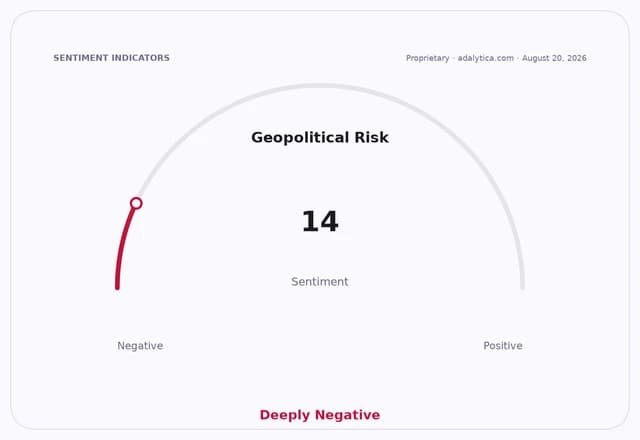
For investors, the issue cuts beyond politics. If Washington intensifies scrutiny on more than 40 countries, companies that depend on China-linked sourcing could face higher logistics costs, more paperwork and a greater risk of margin pressure if supply chains have to be reworked. Exporters in China and intermediaries in countries such as Mexico and Indonesia may see volume uncertainty, while importers and retailers in the US could confront slower replenishment and less pricing visibility.
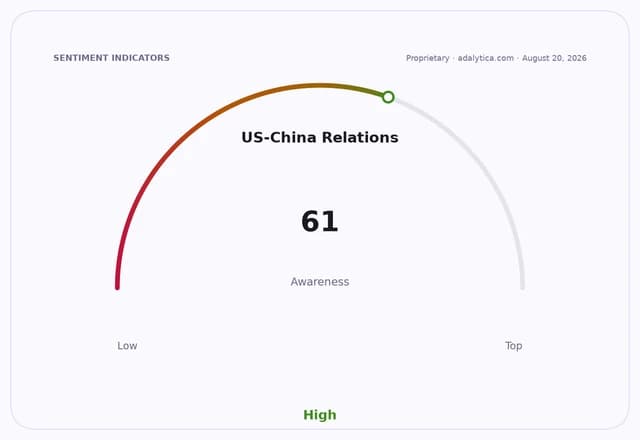
Markets have already been sensitive to any sign that trade tensions are broadening. FXI, the iShares China Large-Cap ETF, closed at $35.63 on Aug. 20, below its 200-day moving average of $36.71, suggesting investors remain cautious on Chinese equities even after a recent bounce. MCHI, the iShares MSCI China ETF, finished at $55.43, also under its 200-day average of $57.87. The broader backdrop has improved in risk assets tied to China-US relations, with Adalytica’s CN-USRX sentiment gauge at 75, but global stability sentiment remains deep in “Extreme Fear,” showing how quickly trade headlines can still unsettle positioning.
The economic narrative is straightforward: tariff policy is shifting from headline rates to enforcement and circumvention. That tends to be more disruptive for trade than tariff announcements alone, because it forces companies to map supply chains in real time and leaves little room for complacency. The US dollar trade signal from Adalytica has fallen into “Extreme Fear,” reflecting the market’s sensitivity to policy-driven shifts in global commerce.
Oil also sits in the background as a secondary market channel. USO, the US Oil Fund, rose to $134.70, but the bigger message for investors is that trade disputes can spill into freight demand, industrial activity and cross-border manufacturing plans, making commodity and currency markets more vulnerable to abrupt swings if enforcement escalates.
The next catalyst is whether the US turns the allegations into formal probes, penalties or new customs restrictions. If it does, the winners are likely to be domestic suppliers and firms with cleaner, non-China supply chains; the losers would be exporters, transshipment economies and US buyers that rely on low-friction imports.
| Entity | Gains | Losses |
|---|---|---|
| US customs enforcers | ▲tighter control | ▼higher trade frictions |
| Non-China suppliers | ▲share gains | ▼less competitive pressure |
| China exporters | ▲supply access if claims fade | ▼tariff exposure |
| Mexico/Indonesia transshipment hubs | ▲trade activity if cleared | ▼scrutiny and delays |