China Kyrgyzstan treaty deepens Belt and Road ties

China’s latest push into Kyrgyzstan is less about ceremony than control: a new permanent good-neighbor treaty, a joint declaration and 20 agreements deepen Beijing’s hold over a transit state that sits on one of Central Asia’s most important overland routes.
That matters because logistics is power. For China, Kyrgyzstan offers a land bridge into Central Asia and beyond, helping diversify trade routes, reduce reliance on sea lanes and lock in influence along the Belt and Road. For Kyrgyzstan, the deal promises more infrastructure, more trade and a stronger tie to its largest neighboring economic force — but also a deeper dependence on Chinese capital, Chinese demand and Chinese political goodwill.
Xi Jinping said China is ready to align more closely with Kyrgyzstan’s development strategy, a formulation that usually means financing, roads, rail links and customs coordination. In practical terms, that can lower transport frictions, speed cross-border commerce and make Chinese firms more central to the movement of goods through the region. Over time, those gains can reinforce themselves: once a corridor is built, freight, investment and influence tend to follow the rails and highways.
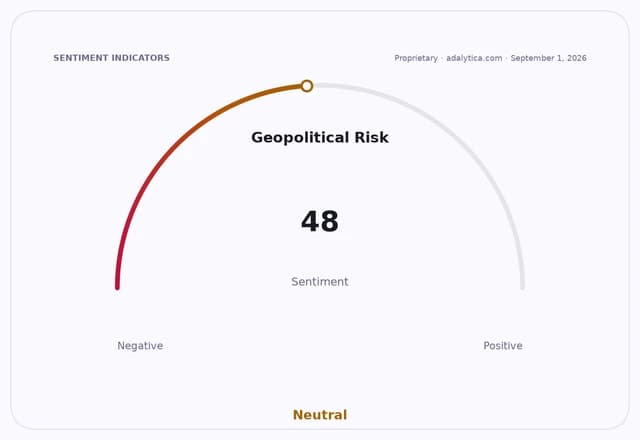
The investor angle is broader than Central Asia. Beijing is showing it still wants to use infrastructure diplomacy even as global stability looks fragile. Adalytica’s Global Stability Sentiment is at neutral, while its China CCP Policy Direction Sentiment remains in extreme fear territory, underscoring how sensitive markets remain to China’s next policy moves and overseas priorities. A more assertive logistical footprint abroad can support trade-facing sectors and state-backed construction themes, but it can also raise geopolitical risk if rivals read the move as strategic encirclement.
For long-term investors, the bigger lesson is that China’s overseas influence is increasingly being built corridor by corridor, not just deal by deal. Kyrgyzstan is not a market-moving headline on its own, but it fits a durable pattern: Beijing is trying to secure routes, shape commerce and embed itself in the plumbing of regional growth. That kind of strategy can outlast headlines, which is why it deserves a place on the watchlist for anyone following infrastructure, commodities, Asian trade and geopolitical risk.
| Entity | Gains | Losses |
|---|---|---|
| China | ▲Trade route control | ▼Less strategic uncertainty |
| Kyrgyzstan | ▲Infrastructure investment | ▼Policy independence |
| Local logistics firms | ▲More transit volume | ▼Greater Chinese competition |
| Rivals to Beijing | ▲— | ▼Influence in Central Asia |