China builds mothership for giant underwater drones
China is building what satellite imagery suggests is a 205-meter mothership for extra-large unmanned submarines, a move that could extend Beijing’s undersea reach deep into the Pacific while sharpening the maritime challenge for the U.S. and its allies.
The vessel under construction at Shanghai’s Hudong-Zhonghua shipyard appears designed to carry, launch and recover up to four XXLUUVs, or extra-extra-large unmanned underwater vehicles, turning China’s growing fleet of giant subsea drones from test assets into an operational system. That matters because it gives the People’s Liberation Army Navy a mobile base for long-duration surveillance, sensor deployment and potentially strike missions without risking a crewed submarine.
Naval News, citing satellite images, said the ship may be the first of its kind in the world built specifically for drones of that scale. The XXLUUVs spotted in tests near Hainan are reported to be about 35 meters and 45 meters long, roughly six to eight times the size of the U.S. Navy’s Orca XLUUV, underscoring how aggressively China is pushing unmanned undersea warfare.
The mothership fits into what analysts have called China’s “Great Undersea Wall,” a layered network of satellites, smart buoys, surface drones, seabed sensors and processing systems meant to monitor waters far from the mainland. For Beijing, that architecture strengthens intelligence gathering and area denial around the Ryukyu chain and the western Pacific, while also supporting gray-zone pressure below the threshold of open conflict.
For investors, the development reinforces a multi-year defense theme: higher spending on autonomous systems, undersea sensors and counter-drone defenses, especially among U.S. and allied militaries. That is supportive for primes such as Lockheed Martin, Northrop Grumman and RTX, while also pointing to more demand for shipbuilding, sonar, anti-submarine warfare and maritime surveillance capabilities.
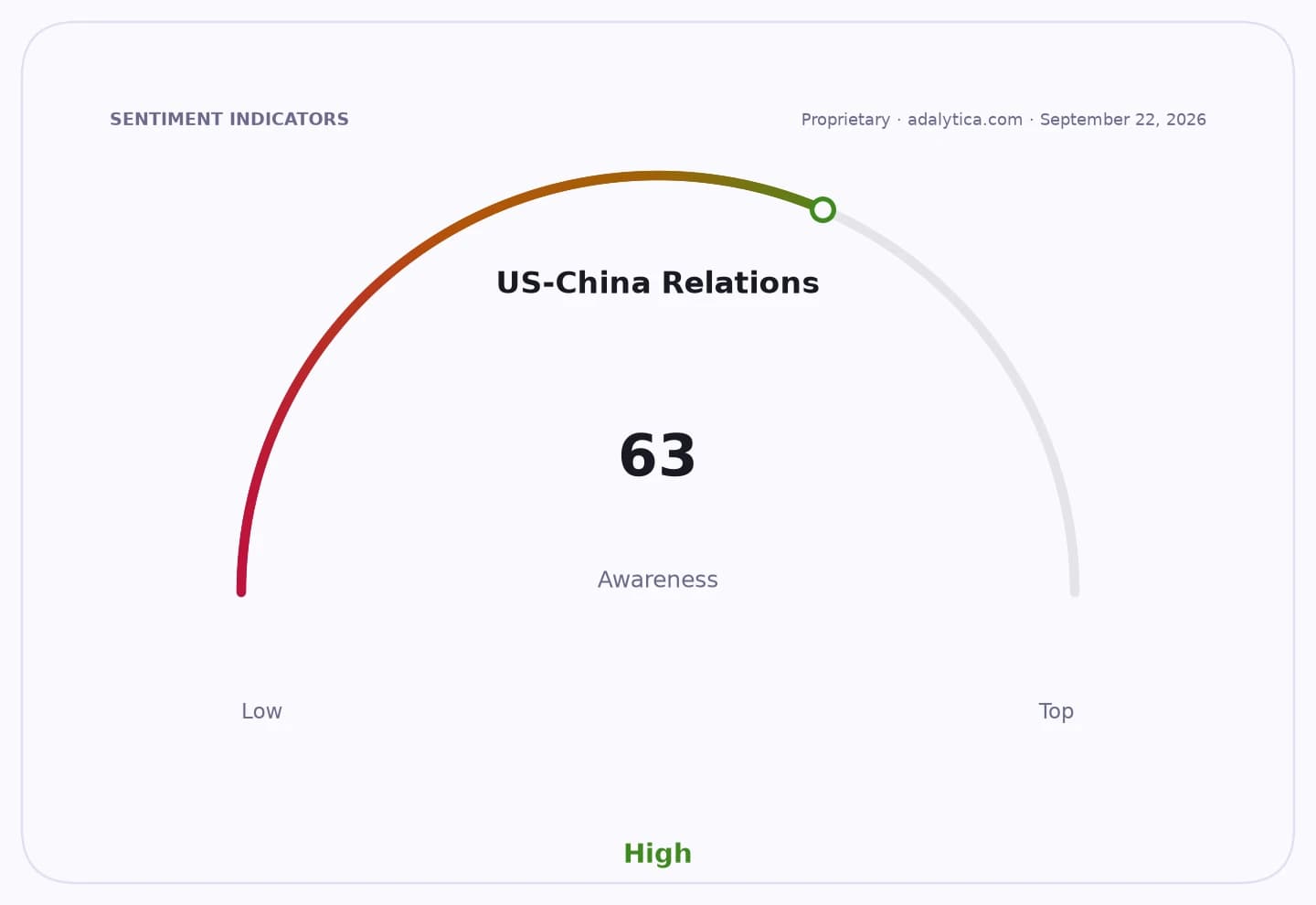
The news lands against a more cautious geopolitical backdrop, with Adalytica’s U.S.–China relations sentiment still neutral and global-stability awareness in fear territory, reflecting how quickly maritime and technology tensions can escalate. Beijing’s own tightening of drone rules in the capital also shows how sensitive unmanned systems have become at home and abroad.
The next catalyst is whether China moves from satellite-observed construction to a formal unveiling, and whether the U.S. and its allies respond with faster investment in seabed detection, anti-submarine warfare and unmanned maritime fleets.
| Entity | Gains | Losses |
|---|---|---|
| China / PLA Navy | ▲Undersea reach and persistence | ▼Strategic ambiguity if exposed |
| U.S. and allies | ▲Faster defense procurement cycle | ▼Maritime security headwinds |
| Lockheed Martin, Northrop Grumman, RTX | ▲Demand for drones, sensors, ASW | ▼Budget pressure if spending stalls |
| Crewed submarines and surface fleets | ▲— | ▼Greater detection and competition |