China Reduces Holdings of US Treasuries
China is still shrinking its stake in US government debt, and that matters because it points to a deeper shift in the world’s financial plumbing: Beijing is trying to rely less on the dollar just as Washington needs more buyers for a swelling pile of borrowing.
China’s holdings of US Treasuries fell to $633.4 billion in June from $659.3 billion in May, the lowest level since September 2008. That is down roughly 52% from the $1.3167 trillion peak reached in 2013. For investors, the big takeaway is not a single month’s drop. It is that a long-running buyer of US debt is gradually stepping back at the same time the Treasury market is already being asked to absorb heavier issuance, higher interest costs and more geopolitical risk.
Why does that matter? Because the Treasury market is the benchmark for global finance. If one of the largest official foreign holders keeps trimming exposure, the US has to lean more on domestic buyers and private global investors, who tend to be more sensitive to price and yield. That can push borrowing costs higher over time, even if the market never suffers a sudden shock.
China’s motives are increasingly clear. Officials and scholars cited in the source material point to three main reasons: concern that dollar assets could be frozen or sanctioned, especially after Russia’s reserves were immobilized; the risk of capital losses when long-term yields rise and bond prices fall; and a broader effort to diversify reserves into gold, other currencies and strategic assets. In other words, this is less about making a dramatic political statement and more about reducing dependence on a financial system Beijing sees as vulnerable.
That does not mean Treasuries have lost their value as leverage entirely. China could still sell in size if tensions with Washington escalate, especially if trade friction spills into sanctions. But that weapon is costly to use. A large sale would likely hurt the market value of the remaining portfolio, lift US yields and also put pressure on China’s own reserves and currency. The more likely path is steady, incremental selling and lower reinvestment at maturity.
The timing is sensitive. Washington is pressing Beijing on trade, with Treasury Secretary Scott Bessent arguing the world cannot live with a Chinese trade surplus of $1.2 trillion a year. President Xi is expected to visit the US later this month, while the two countries are also moving toward another tariff and sanctions-heavy phase if their trade truce is not extended in November. That makes every shift in reserve management more than just a portfolio decision; it becomes part of the broader bargaining environment.
For US investors, the implication is straightforward. China is not dumping Treasuries in a way that threatens immediate market dysfunction. But its retreat removes a large, price-insensitive buyer from the market over time. That leaves the US more exposed to the whims of private capital, which usually wants a higher yield to compensate for inflation, deficits and policy uncertainty. With US debt above $40 trillion and annual interest costs already approaching $1 trillion, even modest upward pressure on yields matters.
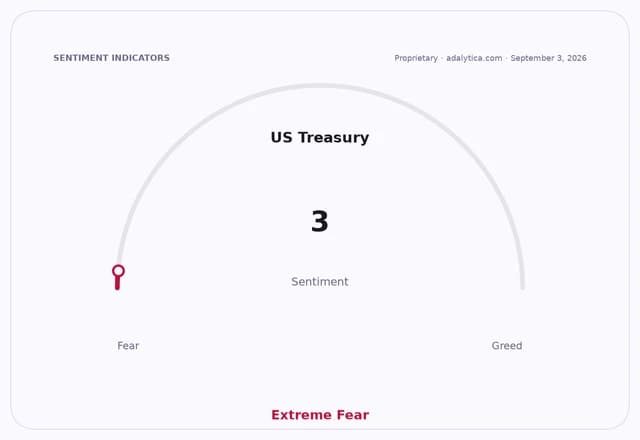
The market is already telling part of that story. The 10-year Treasury yield has been hovering near 4.8%, while Treasury-bond fund TLT has been trading below both its 50-day and 200-day moving averages, a sign of persistent pressure in the bond market rather than a clean rebound. Adalytica’s US Treasury bonds trade signal also shows extreme fear, underscoring how fragile sentiment remains around long-duration bonds.
For long-term investors, the lesson is not to chase headlines about China “selling America’s debt.” It is to recognize that reserve diversification is one more reason the cost of capital in the US may stay structurally higher than it was in the era of abundant foreign buying. That is a headwind for bond prices, but it also reinforces why diversified equity investors should focus on businesses with strong cash flow, pricing power and balance-sheet strength. This is worth watching, and for bondholders, it is a reminder to be patient and selective.
| Entity | Gains | Losses |
|---|---|---|
| China | ▲Lower dollar exposure | ▼Less Treasury leverage |
| US Treasury market | ▲More domestic/private demand | ▼Higher funding costs |
| US borrowers | ▲Short-term market resilience | ▼Higher long-term rates |
| Bond investors | ▲Yield opportunities | ▼Price pressure on long bonds |