China Russia India Iran Ties Lift Fragmentation Trades
China’s push to showcase tighter ties with Russia, India and Iran is less about ceremony than leverage, and that matters because Beijing is trying to harden a geopolitical shield around trade, energy and supply chains just as U.S. pressure and global fragmentation intensify. For investors, the message is that China’s policy response is no longer only domestic stimulus and market support — it is also a bid to reshape the external environment in which Chinese assets trade.
The narrative is straightforward: leverage wars are becoming the defining feature of the new global order, and Xi Jinping is using summit diplomacy to widen China’s room to maneuver. A deeper alignment with Russia and Iran can help secure discounted energy and alternative payment channels, while engagement with India keeps Beijing from facing a fully united Eurasian front. That combination matters economically because it supports China’s resilience on imports, routes and pricing power at a moment when geopolitics is increasingly feeding into inflation, shipping, sanctions risk and capex allocation.
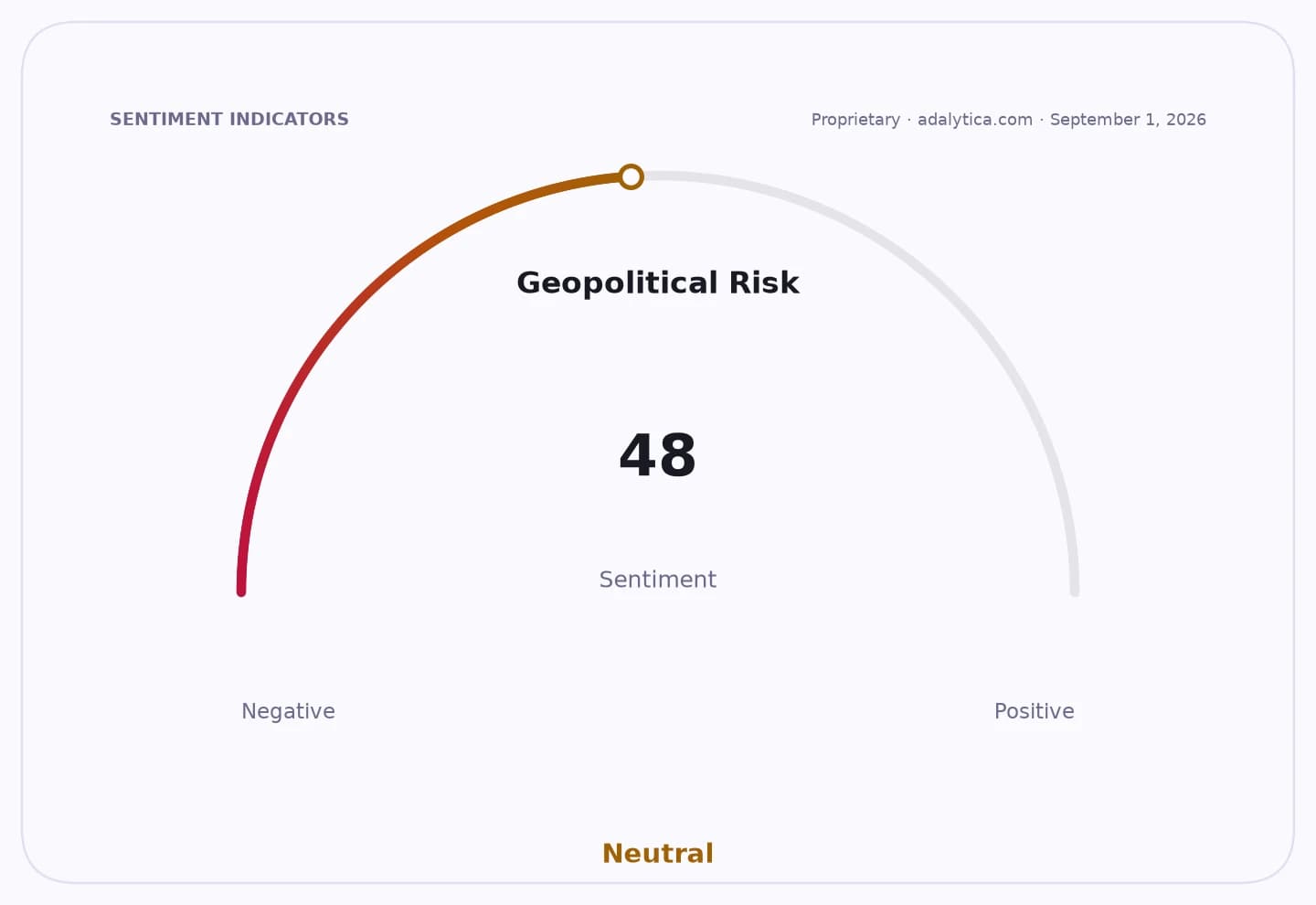
That is why the market cannot treat this as symbolic theater. The U.S.-China relationship remains the key macro variable, and Adalytica’s US–China Relations Sentiment gauge sits at 67, neutral, after whipsawing sharply over the past few days. Meanwhile, Adalytica’s Global Stability Sentiment gauge has fallen to 48 with awareness at 4, a sign that investors are still underpricing how quickly geopolitics can move from background noise to portfolio driver. When that happens, capital tends to rotate toward assets that benefit from fragmentation — defense, energy security, logistics, rare earths and domestic industrial policy — and away from the parts of the market most exposed to cross-border friction.
China equities are already telling a cautious story. FXI, the large-cap China ETF, closed at 35.34, below its 200-day moving average of 36.55, even after stabilizing above its 50-day moving average near 34.52. MCHI, a broader China benchmark, finished at 54.41, also under its 200-day average of 57.47. Those levels suggest investors are not yet paying up for a sustained re-rating of Chinese assets, even though the geopolitical backdrop is becoming more central to earnings, policy and capital flows. YINN, the leveraged bull fund, remains highly volatile and still well below its 200-day average, underscoring that traders continue to doubt a clean China breakout.
The investment implication is that the biggest opportunity may not be a broad, indiscriminate China bet. It is the second-order beneficiaries of China’s push for strategic autonomy and external leverage. If Beijing succeeds in securing more durable ties across Eurasia and the Middle East, the winners are likely to be companies tied to shipping, commodities, industrial inputs, infrastructure and selective China exporters that can benefit from policy support and supply-chain rerouting. The losers are firms and funds most exposed to sanctions escalation, tariff risk and a further deterioration in U.S.-China bargaining power.
Our thesis is that the market is still treating this as diplomacy, when it is really about pricing power and resilience. Xi is trying to buy China more optionality in a world where sanctions, energy chokepoints and alliance politics are becoming market variables. For investors, that means staying selective: own the toll roads of fragmentation, not the most crowded China beta trade.
| Entity | Gains | Losses |
|---|---|---|
| China’s strategic bloc-building | ▲More leverage, energy security | ▼Less diplomatic isolation |
| FXI and MCHI bulls | ▲A geopolitics-driven rerating | ▼Little yet; still below 200-day averages |
| Defense, shipping, energy-security stocks | ▲Higher demand from fragmentation | ▼— |
| Sanctions-sensitive global multinationals | ▲— | ▼More supply-chain and policy risk |