China Russia War Goal Stability Trade Routes
China’s real goal in the Russia-Ukraine war is not a Russian defeat or collapse, but a contained, stable Russia that keeps trade routes open and the geopolitical balance from tipping too far toward the West. That matters because Beijing is thinking in years, not headlines: it wants leverage over Moscow, access to an Arctic corridor to Europe, and a way to preserve its own economic and strategic options if the conflict eventually ends.
The key point for investors is that prolonged war is still not Beijing’s preferred outcome. A drawn-out conflict keeps instability elevated, complicates supply chains and raises the risk of fresh sanctions or trade restrictions that can ripple through global markets. China is trying to project neutrality, but its behavior suggests a more practical posture — support where useful, restraint where necessary, and no interest in letting Russia unravel.
That helps explain why China continues to keep ties with Moscow intact while avoiding a full-throated embrace. The expert cited in the original report said Beijing wants Russia to remain a country and values the logistical corridor through the Arctic that runs along Russia’s border. In other words, China sees Russia less as an ideological ally than as a strategic asset — one that can help diversify trade routes and preserve influence in a more fragmented world.
For investors, the market implication is not a single trade, but a broad risk assessment. A stable China-Russia alignment can support energy flows, shipping routes and defense spending, while worsening friction between China and the West could keep risk premiums elevated across emerging markets. The FXI China ETF was recently trading around $35.54, below its 200-day moving average near $36.51, while EEM, the broader emerging-markets fund, sat around $67.15, still above its 200-day average. That split reflects a market that is not fully pricing in a clean geopolitical resolution — or a decisive improvement in China’s external environment.
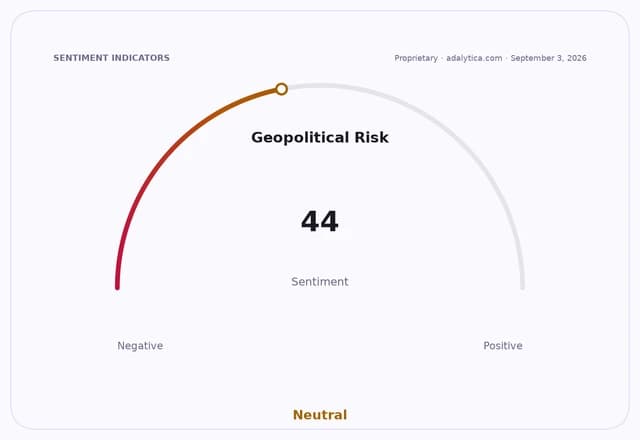
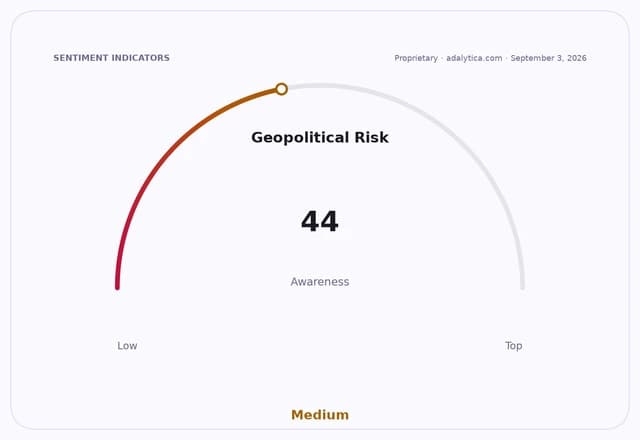
Conventional technical indicators also suggest investors are waiting rather than rushing. FXI’s RSI was around 64, showing improving momentum but not euphoria, while EEM’s RSI was near 54, a sign of a steadier but still cautious tone. In Adalytica’s US-China Relations sentiment gauge, the reading was neutral at 70, underscoring how quickly headlines can shift expectations even when the strategic picture changes slowly. Global stability sentiment was also neutral at 44, a reminder that geopolitical risk remains a background variable for portfolio construction.
The broader lesson is that China’s approach to Russia is guided by self-interest, not loyalty. It wants stability, bargaining power and room to maneuver if the war ends, but it does not want Russia to become so weak that the regional order becomes harder to manage. For long-term investors, that means keeping an eye on China-linked assets, defense exposure and commodities — but not chasing every headline. The war’s economic aftershocks are likely to persist, and the safest approach is patience, diversification and a willingness to hold through volatility.
| Entity | Gains | Losses |
|---|---|---|
| China | ▲Strategic leverage | ▼None if war drags on |
| Russia | ▲Regime and state stability | ▼Strategic autonomy |
| Ukraine/West | ▲Limited diplomatic pressure | ▼Faster conflict resolution |
| FXI/EEM investors | ▲Long-term policy clarity | ▼Near-term volatility |