China Stocks Still Lag Despite Multipolar Push

China’s bid to define a multipolar world is colliding with a harder economic reality: investors still see the country as a strategic counterweight to the US, but not yet as a full substitute for American power, capital markets depth or policy predictability.
That gap matters because Beijing’s influence overseas increasingly depends on whether it can convert diplomacy, trade and infrastructure links into durable economic leverage at home and abroad. The latest market moves suggest global investors remain interested in China exposure, but they are far from convinced that the country can turn regional outreach into a broad re-rating of Chinese assets.
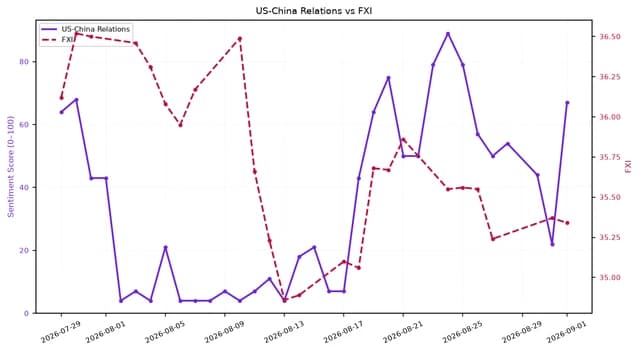
The clearest read-through is in the China-related equity proxies. The iShares China Large-Cap ETF, FXI, has recovered to 35.34 after sliding as low as 34.13 in July, but it still trades below its 200-day moving average of 36.55. That is a sign of tentative repair rather than a confirmed trend reversal. The relative strength index has moved back to 44.1 from oversold territory earlier in the year, while the 50-day average at 34.52 sits just above the latest close, suggesting momentum is stabilizing but not decisively strong.
Hong Kong equities show a similar pattern. The iShares MSCI Hong Kong ETF, EWH, closed at 22.55, only modestly above its 200-day average of 22.36 and barely above its 50-day average of 22.20. In other words, investors have not yet built a strong conviction that China’s regional and geopolitical messaging will translate into faster growth or better corporate earnings across the Chinese and Hong Kong complex.
That caution is understandable. The narrative coming out of Beijing — closer ties with Central Asian partners, expanded trade routes with Europe and a more assertive regional role — is consistent with a world in which US primacy is diluted. But the economic burden of proving that thesis is on China itself. Multipolarity only matters to markets if it supports trade flows, lowers financing frictions, protects supply chains and keeps domestic growth from slowing too much.
The oil market underscores how fragile the broader backdrop remains. USO, the oil ETF, surged to 141.00 and is well above both its 50-day and 200-day moving averages, a reminder that geopolitics is still being priced through higher energy risk and a more uncertain global trade environment. That can help producers and energy assets, but it complicates the outlook for China, which remains a major energy importer and is more exposed than the US to external price shocks.
Adalytica’s US–China Relations Sentiment gauge is neutral at 67, but awareness has risen, indicating that investors are paying closer attention even if conviction is limited. The broader Global Stability Sentiment reading is also neutral, yet the sharp fall in awareness to 4 points reflects how quickly market focus can swing when geopolitical risk rises. For investors, that means China is not being priced as a simple growth trade or a clean geopolitical hedge; it remains a policy and headlines-driven market.
The bull case is that Beijing can use a more multipolar environment to broaden partnerships, redirect trade and reduce dependence on Western demand. The bear case is that strategic ambition outpaces domestic fundamentals, leaving China with more geopolitical reach but only modest market upside. For now, the market is leaning toward the second view.
The next catalyst is whether China can show that its external strategy improves hard economic outcomes — export resilience, capital inflows, corporate earnings and a more durable lift in domestic confidence. Until then, investors are likely to treat the multipolar story as strategically important but only partially investable.
| Entity | Gains | Losses |
|---|---|---|
| China | ▲Regional influence | ▼Investor conviction |
| US | ▲Alliance leverage | ▼Monopoly on global leadership |
| FXI / Chinese equities | ▲Stabilization hope | ▼Re-rating momentum |
| Oil / energy assets | ▲Geopolitical premium | ▼Demand certainty |