China Criticizes US AI Supply-Chain Plan in Latin America
China said exclusive blocs and geopolitical calculations are undermining the technological development of Latin America and the Caribbean, escalating a broader fight over who sets the rules for artificial intelligence, semiconductors and critical minerals in the region.
The remarks from foreign ministry spokesman Guo Jiakun came after reports that the US embassy in Panama had presented a pilot AI supply-chain accreditation and traceability platform, billed as the first of its kind. Beijing framed the initiative as another attempt by Washington to control technology and industrial flows and to block China’s access to strategic inputs.
The economic stakes go well beyond diplomatic rhetoric. Latin America is central to the next phase of the global technology cycle because it holds critical minerals, logistics chokepoints and increasingly important data and infrastructure markets. Whoever shapes standards for AI hardware, chip inputs and supply-chain verification can influence trade flows, investment decisions and financing conditions across the region. For local governments, the choice is not simply between the US and China, but between competing ecosystems that can determine access to capital, equipment and market opportunities.
For investors, the message is that technology decoupling is moving from rhetoric into procurement, certification and customs systems. That raises the risk of fragmented supply chains, duplicated compliance costs and slower project timelines for companies exposed to Latin American infrastructure, mining, telecoms and digital services. It also means firms with US-linked supply chains may gain from regulatory alignment, while those reliant on Chinese equipment or end markets could face greater scrutiny.
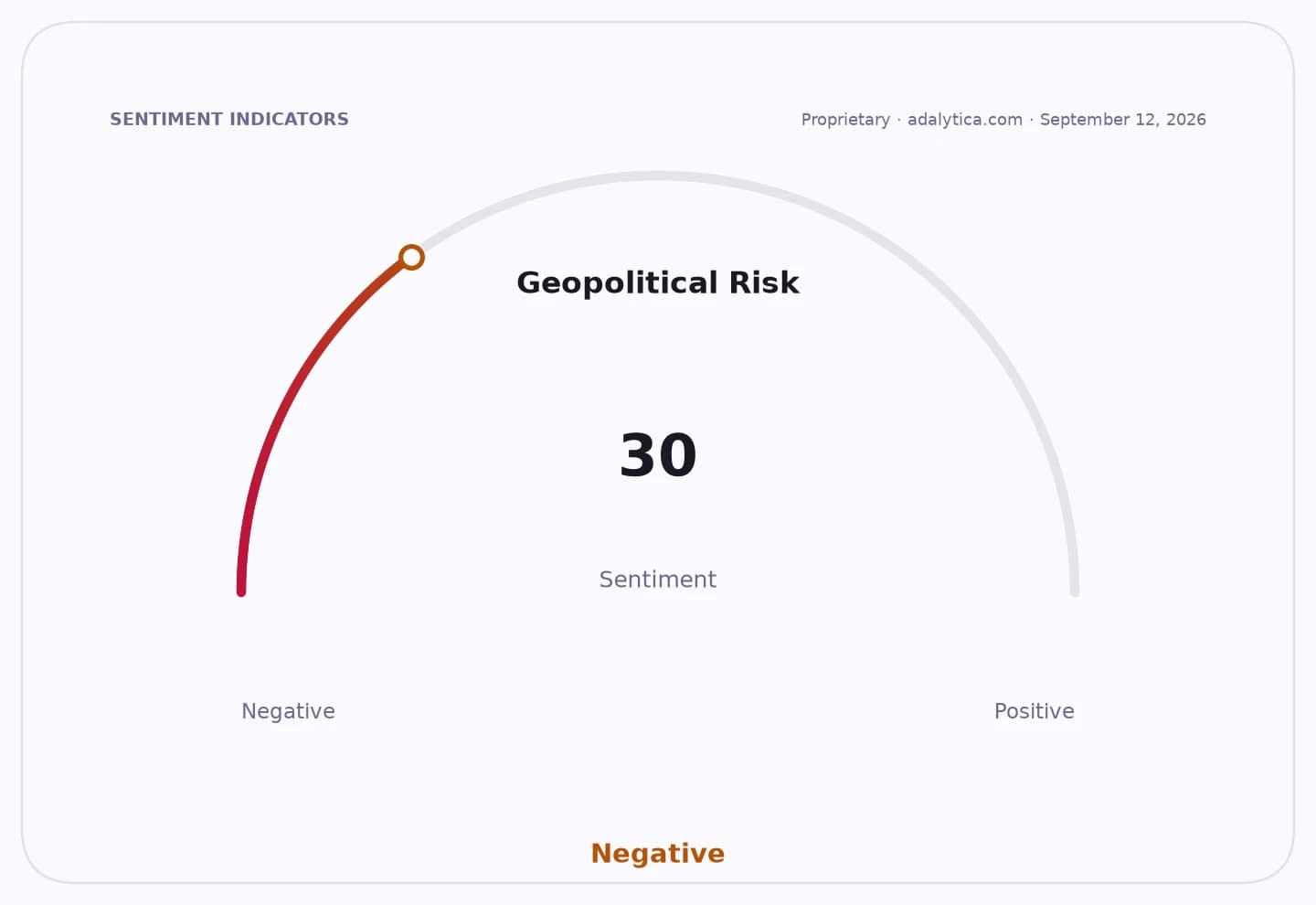
The market backdrop points to a risk-off tilt rather than a decisive repricing. Adalytica’s Global Stability Sentiment gauge is in “Fear” at 30, down 42 points over 30 days, while its S&P 500 Trade Signals show “Extreme Fear.” That does not by itself identify a Latin America-specific shock, but it does underline how geopolitical friction is being treated as a broader market risk, especially when it intersects with supply chains and strategic commodities.
Latin American equity funds have held up better than the wider risk complex, but not without volatility. The iShares Latin America 40 ETF, ILF, was recently around $35.97, above both its 50-day and 200-day moving averages, while the Brazil ETF EWZ traded at $38.19, also above its 50-day and 200-day averages. That suggests investors are not pricing in a full regional deterioration. Still, both funds are showing elevated relative strength readings, which can leave them vulnerable if trade and technology tensions worsen or if the dollar strengthens further.
China’s comment also fits a familiar pattern: framing technology access as a development issue while countering Washington’s effort to build standards-based coalitions around trusted suppliers. Beijing signaled it will continue working with Latin America and the Caribbean on what it calls a fair and equitable global AI governance system, an attempt to win political support by tying technology access to sovereignty and development.
For now, the immediate catalyst is political rather than financial, but the investment implications are real. If US-backed supply-chain verification gains traction, it could benefit compliant suppliers and regional partners integrated into Western industrial policy. If the contest hardens into a bloc system, Latin American countries may be forced to navigate higher costs, slower technology adoption and more complicated capital allocation decisions.
| Entity | Gains | Losses |
|---|---|---|
| US-backed suppliers | ▲Compliance advantage | ▼China-linked vendors |
| Latin American governments | ▲More leverage in negotiations | ▼Higher procurement complexity |
| China | ▲Diplomatic opening with region | ▼Influence in US-led standards |
| Investors in compliant tech supply chains | ▲Policy support | ▼Firms exposed to fragmentation |