Americans are growing more pessimistic about the economy, and the shift is now being tied directly to President Donald Trump’s stewardship rather than to a broad abstract unease. That matters because consumer sentiment is one of the earliest signals of whether households will keep spending, and spending remains the main engine of U.S. growth.
Consumer sentiment weakens as Trump blame builds
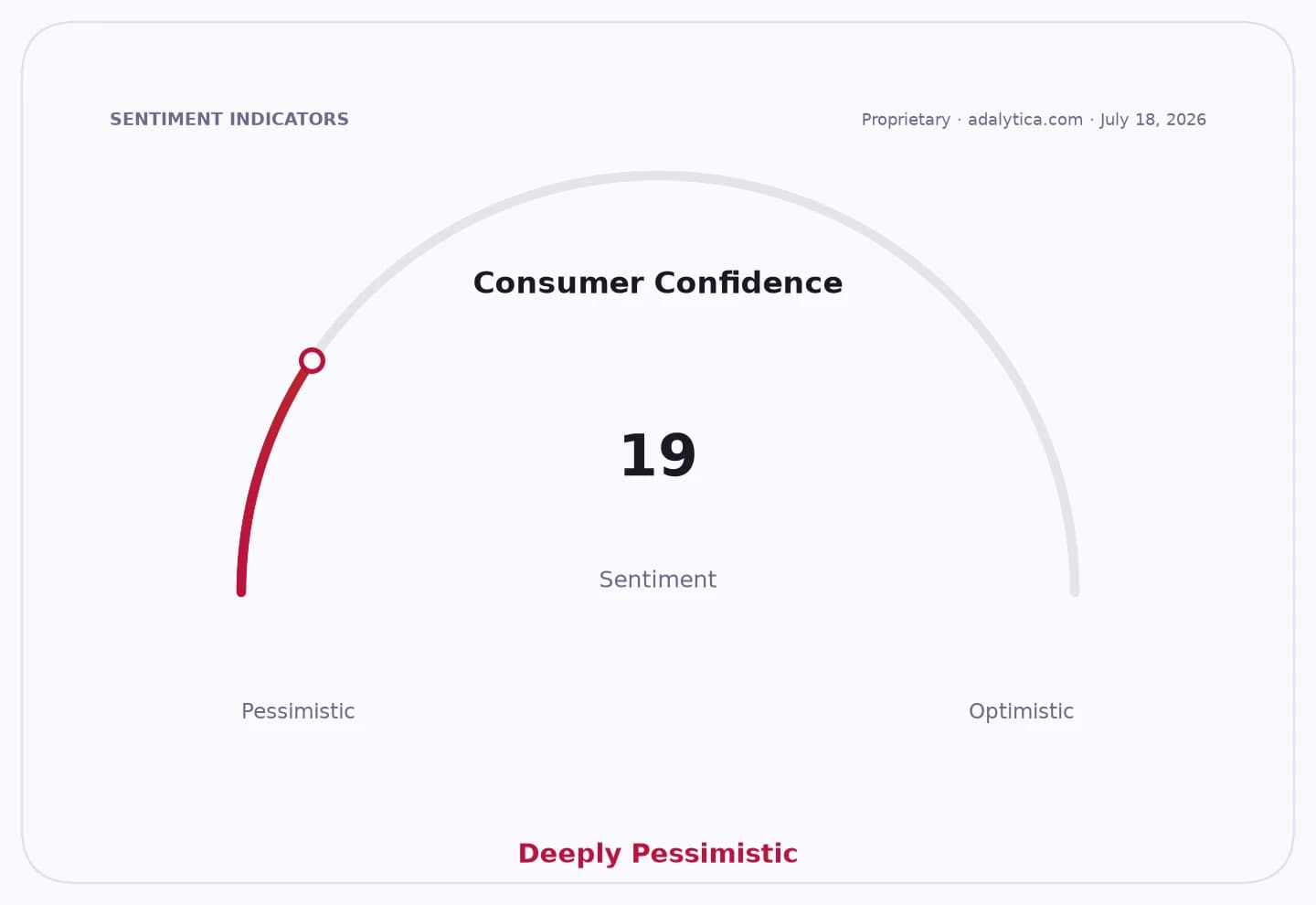
The latest readings point to a deterioration in public confidence even as the hard-data backdrop remains mixed. University of Michigan sentiment fell to 44.8 in May from 49.8 in April and 53.3 in March, extending a downtrend from the mid-60s earlier in the spring. Adalytica’s Consumer Confidence Recession Sentiment gauge is even weaker, at 19 and firmly in “Fear,” with awareness also in “Fear” at 26. The deterioration has been abrupt: the measure fell 28% over 30 days and 52% over seven days, suggesting sentiment is not merely drifting lower but breaking sharply.
Sentiment IndicatorsⓘProprietary · adalytica.com · July 18, 2026
This is a snapshot — live sentiment, awareness and momentum for 130+ markets update continuously in the dashboard.Open AlphaPulse
That disconnect between mood and macro fundamentals is the key economic story. The U.S. economy is not in recession by the traditional hard indicators in the context provided: GDP is still forecast to expand 1.54% in the April quarter to 32,358.0, while the unemployment rate is expected to ease to 4.18% in July from 4.2% in June. But consumers do not spend based on GDP forecasts; they spend based on how secure they feel about jobs, prices and policy. When confidence falls this quickly, it can feed directly into weaker retail sales, softer discretionary demand and more cautious hiring plans by businesses.
Politically, the blame being laid at Trump’s feet raises the stakes for the White House because it turns economic dissatisfaction into a referendum on policy. Voters often tolerate bad macro data if they believe the cause is temporary or external. A perception that the president is responsible for the pain is more dangerous: it can harden into a durable narrative that outlasts any single inflation print or jobs report. That is particularly important for Republicans in Congress and for industries that depend on consumer-facing demand, because a confidence shock can hit before official recession data arrive.
For investors, the immediate implication is that sentiment-sensitive parts of the market deserve closer scrutiny. Consumer discretionary stocks, small caps and cyclical sectors tend to react first when households get cautious, even if earnings estimates have not yet been cut. The S&P 500 remains in broadly neutral territory on Adalytica’s trade signals, but the 30-day slide in SPY sentiment to 56 from 77 at the start of July suggests equity optimism has also cooled. If the pessimism spreads into actual spending, corporate margins could come under pressure just as investors are trying to judge whether growth can hold up into the second half of the year.
The bullish case is that sentiment may be overreacting to politics and tariffs rather than to a true recessionary break. Hard data still show an economy expanding, unemployment remains low by historical standards, and household balance sheets are not flashing a crisis signal in the information provided. The bear case is that confidence is the first step in a broader slowdown: if consumers pull back, businesses will see it in revenue, then in hiring, and then in earnings revisions.
What to watch next is whether the deterioration in confidence starts to appear in spending and labor data. If it does, the political blame game will become economically material, not just a polling story. If it does not, the current pessimism may prove to be another warning shot that never fully turns into a downturn.
| Entity | Gains | Losses |
|---|---|---|
| Trump critics | ▲Blame narrative strengthens | ▼Need to answer for economy |
| Trump administration | ▲Can argue hard data still hold | ▼Faces confidence backlash |
| Consumers | ▲May delay spending | ▼Feel worse about future |
| Cyclical stocks | ▲Less immediate panic if data hold | ▼Vulnerable if spending slips |